
For more than a month, the world seemed to move to the rhythm of a soccer ball.
From packed stadiums in Mexico to multicultural celebrations in Canada and enormous fan gatherings across the United States, World Cup 2026 became more than an international sporting competition. It was a festival of cultures, national pride, family traditions and unforgettable human emotions.
This was the largest FIFA World Cup ever organized. For the first time, 48 national teams competed in 104 matches across three host countries: the United States, Canada and Mexico. By the final whistle, the tournament had produced a record 308 goals and countless moments that will live in soccer history.
But when the celebration finally reached its grand conclusion, one nation stood above all others: Spain.
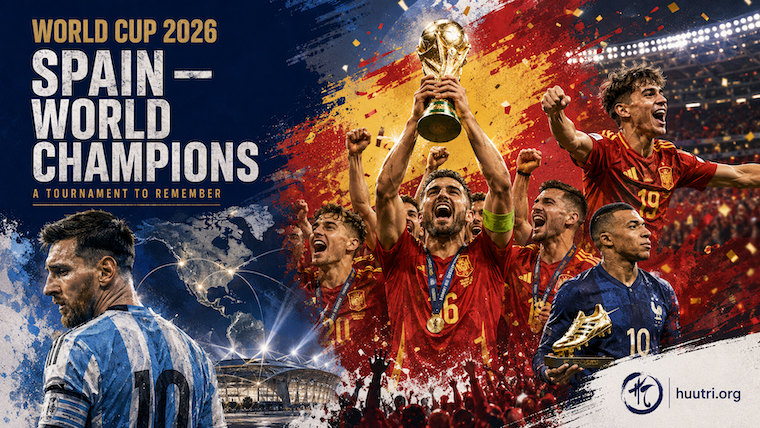 Spain Returns to the Summit
In the highly anticipated final at New York New Jersey Stadium, Spain faced defending champion Argentina in a dramatic contest between two very different soccer philosophies.
Argentina arrived with the experience, fighting spirit and individual brilliance of Lionel Messi. Spain relied on possession, discipline, intelligent movement and the confidence of a gifted new generation.
The match remained scoreless through 90 minutes. Argentina was forced to play extra time with 10 men after Enzo Fernández received a second yellow card late in regulation. Spain continued to apply pressure, patiently searching for an opening.
The decisive moment arrived in the 106th minute.
Substitute Ferran Torres found the net and gave Spain a 1–0 lead. Argentina tried to respond, but Spain’s defense held firm until the final whistle. The victory delivered Spain its second World Cup championship and its first since 2010. Reuters
Spain’s triumph was not built around a single superstar. It was the result of a complete system—a team comfortable with the ball, organized without it and remarkably calm under pressure.
At the center of that system was Rodri.
The Spanish midfielder controlled the tournament with precise passing, intelligent positioning and tireless defensive work. Although he did not score or record an assist, his influence was felt in nearly every phase of Spain’s play. His performance earned him the Golden Ball as the best player of World Cup 2026.
A Heartbreaking Ending for Messi and Argentina
For Argentina, the final brought profound disappointment.
The defending champions had hoped to become the first nation since Brazil in 1962 to win consecutive World Cups. Instead, their remarkable journey ended just one victory short of another historic achievement.
The most emotional image of the evening was Lionel Messi standing quietly after the final whistle.
At age 39, Messi had participated in his sixth World Cup and appeared in his third final, joining Brazil’s Cafu as one of only two male players to accomplish that feat. He scored eight goals during the tournament and once again carried the hopes of millions of Argentine supporters.
Whether this was Messi’s final World Cup appearance remains uncertain. But the evening felt like the closing of an extraordinary chapter.
Messi later described the defeat as a source of “immense pain,” while also expressing pride in his teammates and gratitude to Argentina’s supporters. He congratulated Spain and reminded fans that reaching consecutive World Cup finals was itself a remarkable achievement. Reuters
Even in defeat, Messi’s legacy remained untouched. His career has shown that greatness is not measured only by trophies, but also by the memories, emotions and inspiration an athlete leaves behind.
Mbappé Wins the Golden Boot
Although France did not reach the final, Kylian Mbappé delivered another spectacular individual tournament.
The French captain finished with 10 goals and won the Golden Boot as World Cup 2026’s leading scorer. It was the highest scoring total at a single World Cup since 1970.
Mbappé also became the first player to win the Golden Boot at two different World Cups, confirming his place among the greatest tournament performers in soccer history.
For many fans, Mbappé represents the bridge between generations. Messi and Cristiano Ronaldo defined the previous era. Mbappé, along with several emerging young players, now appears ready to carry the game into its next chapter.
Lamine Yamal and the Rise of a New Generation
One of the most exciting stories of World Cup 2026 was the emergence of Spain’s Lamine Yamal.
Only 19 years old, Yamal played with the confidence, imagination and composure of a much more experienced athlete. His quick movement, creativity and fearlessness gave Spain another attacking dimension and made him one of the tournament’s most captivating young stars.
The sight of a teenage Yamal celebrating a world championship while a 39-year-old Messi contemplated a painful defeat created a powerful image: one generation passing the spotlight to another.
It did not diminish Messi’s greatness. Instead, it demonstrated how soccer history continues to renew itself. Every legendary farewell creates space for another young player to dream.
The Biggest World Cup in History
World Cup 2026 was also remarkable for its unprecedented scale.
Millions of supporters attended matches and FIFA Fan Festivals throughout the three host countries. Mexico City welcomed some of the tournament’s largest crowds, while cities across the United States and Canada became international gathering places filled with jerseys, flags, music and food from around the world.
For immigrant families, the tournament carried special meaning.
A person could be an American citizen while cheering passionately for Mexico, Argentina, Vietnam’s regional neighbors or the homeland of their parents and grandparents. Children born in the United States discovered family traditions through soccer. Older fans remembered legendary matches they had watched decades earlier.
In those moments, identity was not limited to one flag. Soccer allowed people to celebrate the many cultures and histories that make up who they are.
The tournament’s extraordinary attendance and digital reach reflected the growing power of soccer in North America and around the world. FIFA
More Than a Game
World Cup 2026 will be remembered for Spain’s return to glory, Argentina’s courageous title defense, Messi’s emotional journey, Mbappé’s goals and the arrival of Lamine Yamal.
But statistics alone cannot explain why the tournament mattered.
Soccer gives people permission to hope together. It allows strangers to celebrate, families to reconnect and immigrant communities to express both pride in their adopted country and affection for their ancestral homeland.
For 104 matches, the world argued, cheered, cried and dreamed together.
Spain lifted the trophy, but the greatest victory belonged to the game itself—a universal language that continues to connect generations, cultures and nations.
-Lê Nguyên Vũ-