
Imagine sitting in a café in Paris, checking into a hotel in Tokyo, shopping at a market in Mexico City or sending a message to a relative in Việt Nam. You may not speak the local language, but say “OK,” and there is a good chance the other person will understand.
Young or old, male or female, Asian, European, African or American—we all use the same tiny expression. It appears in conversations, text messages, business meetings, medical offices, airport announcements and even on the buttons we click every day.
But where did “OK” come from? The answer is surprisingly funny.
 It began as a newspaper joke
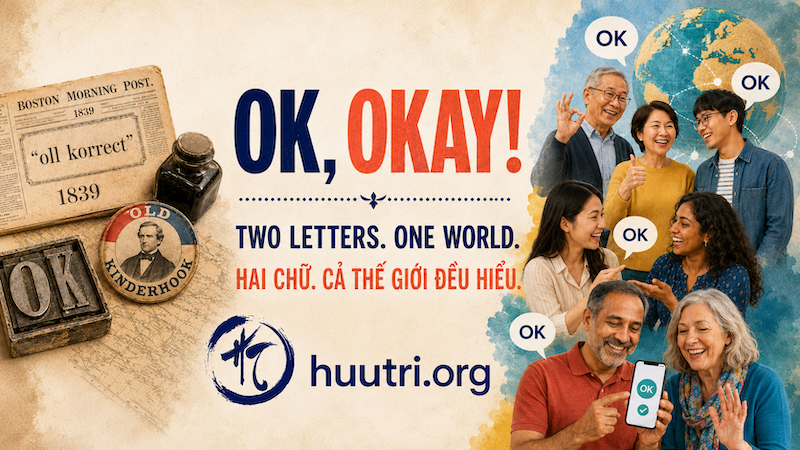
The earliest known printed appearance of “O.K.” occurred on March 23, 1839, in the Boston Morning Post. At the time, American newspaper writers enjoyed inventing abbreviations based on deliberately misspelled phrases—rather like today’s internet slang and playful texting.
“All correct” was jokingly misspelled as “oll korrect” and shortened to “O.K.”
In other words, one of the world’s most famous expressions began with two words that were both spelled incorrectly!
Other joke abbreviations circulated during the same period. “All right,” for example, became “oll wright,” or “O.W.” Most of those expressions quickly disappeared. Somehow, “O.K.” survived. Linguist Allen Walker Read later established this newspaper origin after studying historical records, and it is now the explanation accepted by major dictionaries and language scholars.
A presidential campaign made it famous
Just one year later, “OK” received an enormous publicity boost from American politics.
President Martin Van Buren was born in Kinderhook, New York, and was nicknamed “Old Kinderhook.” During his 1840 reelection campaign, supporters formed “O.K. Clubs” and displayed slogans encouraging people to vote for “OK.”
It was a perfect coincidence: the letters already meant “oll korrect,” but they could also stand for “Old Kinderhook.”
Van Buren lost the election, but “OK” won a permanent place in the English language. As Oxford’s account notes, the campaign helped popularize the expression throughout the United States.
How did “OK” conquer the world?
“OK” possesses several qualities that make a word easy to export:
- It is short—only two letters and two simple sounds.
- It is easy to pronounce, type, print and remember.
- It does not belong to a particular social class or generation.
- It expresses agreement without sounding overly enthusiastic.
- It can be inserted into almost any language without requiring translation.
The telegraph helped spread it during the 19th century because operators needed brief, unmistakable signals. Later, international commerce, American movies, radio, television, air travel, military communication and popular music carried it far beyond the United States.
In the digital age, “OK” became even more powerful. Computer programs placed it on dialogue boxes and confirmation screens. Mobile phones carried it across borders instantly. Today, people who cannot hold a conversation in English may still recognize “OK” without hesitation.
Some languages have even adapted the expression to fit their own spelling or grammar. French speakers may write oké; Vietnamese speakers comfortably say “OK rồi,” “OK nhé” or “Có OK không?” The word remains recognizably the same while taking on a little local personality.
One word, many jobs
Part of the genius of “OK” is its flexibility. It can perform almost any linguistic job we give it.
Approval:
“The plan is OK.”
Permission:
“The doctor gave me the OK to travel.”
Agreement:
“Let’s meet at 10.”
“OK.”
Acknowledgment:
“Your appointment is tomorrow.”
“OK, I understand.”
Reassurance:
“Don’t worry. Everything will be OK.”
A description of something average:
“How was the restaurant?”
“It was OK.”
A signal that we are ready to begin:
“OK, everyone—let’s get started.”
It can even become a verb: “The manager OK’d the request.”
Few expressions can work as an adjective, noun, verb, interjection and complete sentence while requiring only two letters. Merriam-Webster fittingly describes it as perhaps the most recognizable word in the world.
Are “OK” and “okay” different?
Not really. OK, O.K. and okay are all accepted spellings.
“OK” is the original form and remains common in signs, messages, headlines and computer commands. “Okay” developed later as the expression came to be treated as an ordinary spoken word rather than merely an abbreviation.
In most everyday writing, either OK or okay is perfectly…well, okay.
Does “OK” always mean exactly the same thing?
Its basic meaning travels easily, but its emotional tone can change.
A cheerful “OK!” may communicate enthusiasm. A quiet “Okay…” can suggest doubt. A short “OK.” in a text message may appear cold or annoyed—even if the sender intended only to confirm receipt.
Consider the difference:
- “OK!” — Absolutely!
- “Okay.” — I understand.
- “Okaaay…” — I am not convinced.
- “It was OK.” — It was acceptable, but not wonderful.
- “Are you OK?” — Is something wrong?
- “We’re OK.” — Our relationship or situation is fine.
So, people worldwide may recognize the word, but facial expressions, punctuation and tone of voice still help us understand what the speaker truly means.
A small word that connects generations
A grandparent may say “OK” while answering the telephone. A teenager may type “ok,” “k” or “okk” in a message. A doctor may ask, “Are you feeling OK?” A pilot, engineer or business executive may use it to confirm that something is ready.
The speakers may differ in race, gender, nationality, education and age, yet those two letters allow them to meet on common linguistic ground.
That may be the most beautiful part of the story. “OK” does not demand perfect grammar, a large vocabulary or a particular accent. It simply creates a small moment of understanding between people.
Born as a misspelled newspaper joke, promoted by a losing presidential candidate and carried around the world by technology and human contact, “OK” has become much more than an American expression. It is a practical little bridge across languages, cultures and generations.
And that is a remarkable achievement for a word that was never spelled “correctly” in the first place.
Is that an interesting story?
OK, we think so.
-Lê Nguyễn Thanh Phương-
Sources for Further Reading
- Smithsonian Magazine – How One Man Discovered the Obscure Origins of the Word “OK”
Explains Allen Walker Read’s research and the first known appearance of “O.K.” in the Boston Morning Post on March 23, 1839. - Merriam-Webster – The Hilarious History of “OK”
Describes the 1830s abbreviation craze and how “oll korrect” became “O.K.” - Oxford Advanced Learner’s Dictionary – OK
Provides the word’s definition, pronunciation and connection to Martin Van Buren’s “Old Kinderhook” campaign. - Oxford University Press – Happy Birthday, OK
Explores how a newspaper joke survived, spread through politics and telegraph communication, and eventually became an international expression. - TIME – The Word “O.K.” and Its First Known Appearance
Offers a concise history of the word’s 1839 newspaper debut and its journey into everyday global communication. - Google Books – OK: The Improbable Story of America’s Greatest Word by Allan Metcalf
A book-length account of the origin, evolution and worldwide influence of “OK.”