
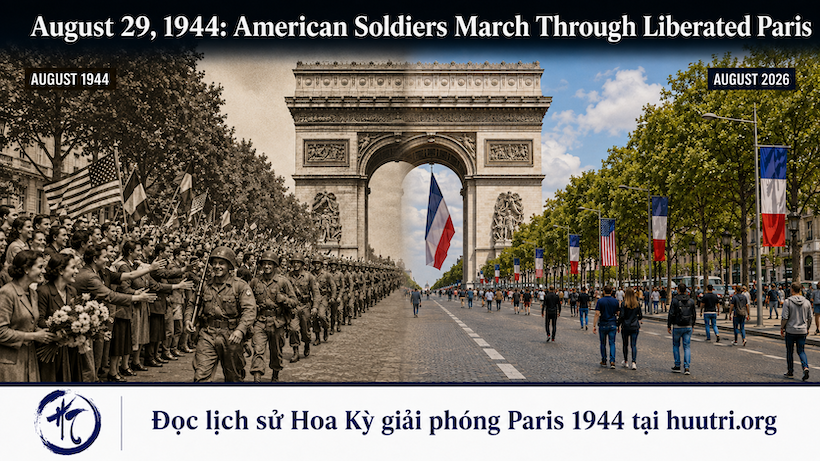
Eighty-two years later, the sight of American troops beneath the Arc de Triomphe remains one of the most powerful images of freedom in modern history.
 A historical clarification
Paris was officially liberated on August 25, 1944, when German forces surrendered after an uprising by the French Resistance and the arrival of General Philippe Leclerc’s French 2nd Armored Division and the U.S. 4th Infantry Division.
August 29, 1944, however, was the day thousands of soldiers from the U.S. Army’s 28th Infantry Division marched down the Champs-Élysées in a spectacular American victory parade. For the people of Paris, it confirmed that four years of Nazi occupation were truly over. For the American soldiers, it was a brief and glorious moment before they continued toward more battles—and greater sacrifices.
Paris under occupation
German forces entered Paris on June 14, 1940. For more than four years, the City of Light lived under Nazi control.
The occupation transformed everyday life. Food and fuel were rationed. Newspapers and radio broadcasts were censored. Curfews restricted movement. Jewish residents were arrested and deported, often with the cooperation of French authorities under the Vichy government. German flags hung from public buildings, and German troops marched along streets once associated with French national pride.
But resistance never disappeared. Underground networks gathered intelligence, sabotaged German operations, hid Allied airmen and Jewish families, distributed clandestine newspapers, and prepared for the day when France could rise again.
That hope became real after the Allied landings in Normandy on June 6, 1944. American, British, Canadian, Free French and other Allied forces fought their way through the hedgerows of Normandy. After the breakthrough from Saint-Lô, American armored columns began racing eastward.
Paris was finally within reach.
The battle for the capital
The Allied high command initially considered bypassing Paris. General Dwight D. Eisenhower understood the city’s political and emotional importance, but liberating and supplying a metropolis of several million people could divert troops, fuel and food from the pursuit of the retreating German army.
Events inside Paris made delay increasingly difficult.
On August 19, French police officers, Resistance fighters and ordinary citizens began an uprising. Barricades appeared in the streets. Gun battles erupted around police stations, government buildings and major intersections. The poorly armed Resistance faced a German garrison equipped with tanks, artillery and machine guns.
General Charles de Gaulle insisted that French troops be allowed to enter their capital. Eisenhower ultimately authorized the advance.
Late on August 24, an advance company from General Leclerc’s French 2nd Armored Division reached the Hôtel de Ville. The following morning, the remainder of the division and elements of the U.S. 4th Infantry Division entered Paris.
On August 25, German military governor General Dietrich von Choltitz surrendered. Hitler had demanded that Paris not be allowed to fall intact, but its bridges, monuments and historic neighborhoods survived. De Gaulle arrived that afternoon and proclaimed the restoration of French authority. The liberation had been achieved through the combined courage of the French Resistance, Free French forces and the Allied armies. The National WWII Museum
August 29: America marches through Paris
On August 26, de Gaulle and the French forces led a massive procession down the Champs-Élysées. Three days later, it was the Americans’ turn.
On August 29, approximately 15,000 soldiers of the U.S. 28th Infantry Division marched beneath the Arc de Triomphe and down one of the world’s most famous avenues. With their distinctive red keystone shoulder patches, the Pennsylvania National Guard soldiers advanced in long, disciplined columns while tanks and military vehicles followed behind.
The march was partly a celebration and partly a demonstration of Allied strength. De Gaulle had requested American troops to help secure the capital, but Eisenhower could not remove two divisions from the continuing campaign. His compromise was to route the 28th Infantry Division through Paris on its way to the front.
Thus, the men were not dressed for a ceremonial holiday. They carried rifles, packs and combat equipment. The war was still waiting for them beyond the city.
Parisians crowded sidewalks, windows, balconies and rooftops. French and American flags fluttered together. Flowers were tossed into the soldiers’ path. Men cheered, women embraced the passing troops, and children reached toward soldiers who represented something many had almost stopped believing they would see again: freedom.
The 28th became the first complete American division to enter Paris after its liberation. The U.S. Army describes the August 29 march as one of the defining moments in the division’s long history. U.S. Army
A beautiful but fleeting triumph
For the Americans, Paris offered only a brief pause.
Many of the soldiers marching through the cheering crowds had already endured brutal fighting in Normandy. After leaving Paris, they continued through Belgium and Luxembourg. In November, the 28th Division would suffer devastating losses during the Battle of Hürtgen Forest. Other members would later fight during the Battle of the Bulge.
That knowledge gives the famous photographs of August 29 a deeper meaning. The young men marching beneath the Arc de Triomphe did not know which of them would return home. They were celebrating a great victory while walking toward an uncertain future.
For Paris, the march represented deliverance. For the soldiers, it was recognition of what they had already sacrificed—and a reminder of the difficult mission still ahead.
Have French feelings toward Americans changed?
Yes—but the answer is more complicated than saying that the French have simply become “anti-American.”
In August 1944, gratitude was immediate, emotional and personal. American soldiers had crossed the Atlantic, landed under fire, fought through Normandy and helped drive the German occupation forces from France. For people who had lived through hunger, fear, arrests and repression, the Americans were visible symbols of rescue and hope.
Over the following decades, that gratitude became mixed with France’s strong desire to preserve its independence.
France welcomed American assistance through the Marshall Plan and became a founding member of NATO. At the same time, French leaders—particularly Charles de Gaulle—resisted excessive reliance on Washington. France withdrew from NATO’s integrated military command in 1966, although it remained a member of the alliance, and returned to the command structure in 2009.
Disagreements over Vietnam, nuclear policy, globalization, American cultural influence and the 2003 invasion of Iraq periodically strained the relationship. More recently, differences concerning trade, tariffs, Ukraine, European security and the reliability of American commitments have weakened political trust.
The shift has become particularly pronounced. Pew Research Center’s 2026 survey found American favorability in France at or near its lowest level in more than two decades of polling. Only 10% of French respondents believed that the United States considered France’s interests when making foreign-policy decisions. Pew Research Center
Yet criticism of an American president or government policy should not automatically be confused with hostility toward the American people—or rejection of the soldiers who fought in 1944.
French communities continue to care for monuments and graves honoring Allied servicemen. Normandy still welcomes veterans, descendants and American visitors with extraordinary warmth. Liberation anniversaries remain solemn national occasions. Military, cultural, educational and family connections continue despite political disagreements.
An alliance older than either modern republic
The friendship between France and the United States has never been one-sided. France provided indispensable soldiers, ships, weapons and financing during the American Revolution. The Franco-American alliance formally began in 1778, making France America’s oldest ally. U.S. Department of State
In 1781, French assistance helped Americans win their independence at Yorktown. In 1944, Americans returned across the Atlantic to help liberate France. That shared history explains why the relationship can survive even serious political arguments.
The sentiment has changed from the overwhelming gratitude of 1944 to something more cautious, critical and conditional. But beneath today’s disagreements lies a bond written into the histories of both nations.
On August 29, 1944, American soldiers marched through Paris while church bells rang and a liberated people cheered. Eighty-two years later, that moment reminds us that governments may disagree and public opinion may rise or fall—but courage, sacrifice and the restoration of freedom deserve to be remembered across generations.
-Nguyễn Bách Khoa-
Sources and Further Reading
- The Liberation of Paris — National WWII Museum
Historical background on the Resistance uprising, the French 2nd Armored Division, the U.S. 4th Infantry Division, the German surrender and the August 29 American parade. - The Liberation of Paris — Musée de la Libération de Paris
Official Paris museum account of the August 1944 uprising, approximately 600 barricades and the participation of ordinary Parisians. - Five Things to Know About the Liberation of Paris — Paris Musées
An accessible overview of General Leclerc, the French Resistance and the liberation of Paris. - World War II Photographs — U.S. National Archives
Includes the official photograph of the U.S. 28th Infantry Division marching down the Champs-Élysées on August 29, 1944. - 250 Years of Army History: Art and Photography — U.S. Army Center of Military History
Confirms that the August 29 victory parade occurred four days after the official liberation of Paris. - History of the 28th Infantry Division — U.S. Army
Describes the division’s journey through northern France and the honor of becoming the first complete American division to parade in Paris after liberation. - France–United States Relations — U.S. Department of State, Office of the Historian
Historical overview of the Franco-American alliance, beginning with France’s recognition of American independence in 1778. - European Views of the United States in 2026 — Pew Research Center
Recent polling on changing French and European attitudes toward the United States. - Global Views of the United States and Its Reliability — Pew Research Center
Reports that only 10% of respondents in France believed the United States considered their country’s interests when making foreign-policy decisions.