
Tết Trung Thu for Young Vietnamese Americans
A guide to the mooncakes lanterns stories and family traditions that connect you to Vietnam
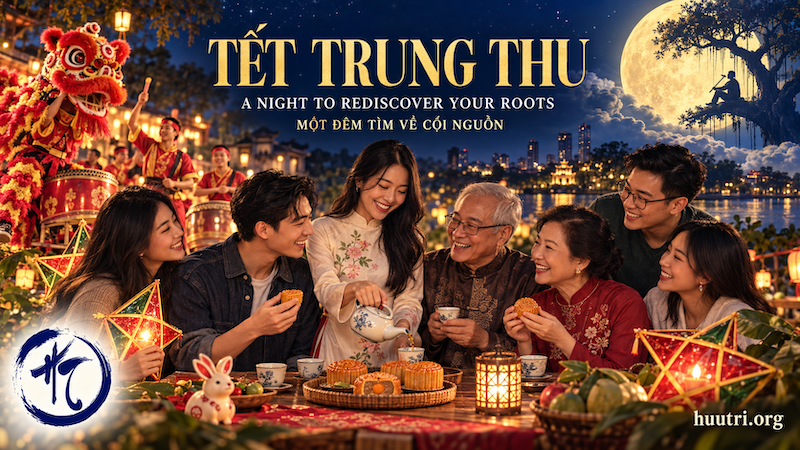
On Friday, September 25, 2026, Vietnamese families around the world will celebrate Tết Trung Thu, the Mid-Autumn Festival. You may remember it as the night of star-shaped lanterns, loud drums, lion dances, and mooncakes cut into small wedges. Or perhaps your family did not celebrate it and you are encountering the holiday for the first time. Either way, Tết Trung Thu offers a welcoming place to begin exploring Vietnamese culture because its meaning lives in familiar things: food, stories, light, and time spent with family.
For young Vietnamese Americans, learning about the festival can also answer a larger question: how do we stay connected to a homeland that may feel close through family but distant through language, geography, or experience? There is no single correct answer. A tradition becomes yours when you understand it, take part in it, and decide what you want to carry forward.
 Why the fifteenth night matters
Tết Trung Thu takes place on the fifteenth day of the eighth lunar month, when the moon appears full and bright. Across many Asian cultures, the round moon is associated with wholeness and reunion. In Vietnam, the holiday is connected to the autumn harvest, gratitude, ancestor remembrance, and family gathering. Over time, it also became especially beloved as a celebration for children, which is why it is sometimes called Tết Thiếu Nhi or the Children’s Festival and Tết Trông Trăng or the Moon Watching Festival.
The festival shares some customs with neighboring cultures, but Vietnamese families have shaped it through their own foods, legends, crafts, and community life. That mixture of shared history and distinctly Vietnamese practice is part of what makes Tết Trung Thu meaningful in the diaspora.
The Vietnamese story in the moon
If you look closely at the full moon, Vietnamese folklore invites you to imagine Chú Cuội sitting beneath a banyan tree. In one familiar version of the story, Cuội holds on to a magical banyan tree as it rises from the earth and carries him to the moon. Children parade with lanterns below, and the story turns the moon into a place filled with memory, humor, and longing for home.
You may also hear the Chinese legend of Chang’e, the moon goddess, because Mid-Autumn traditions have traveled and blended across East Asia for centuries. If you want to begin with a character closely associated with Vietnamese childhood, ask a parent or grandparent what they were told about Chú Cuội. Families often remember different versions, and comparing those versions can become its own lesson in oral tradition.
What the familiar traditions mean
The sights and tastes of Tết Trung Thu are enjoyable on their own, but each one can also open a door into Vietnamese history and family life.
Đèn ông sao. The five-pointed star lantern, traditionally made with bamboo and colored paper or cellophane, is one of the festival’s most recognizable Vietnamese images. Children carry lanterns through the evening streets, turning a family celebration into a community procession.
Múa lân. A lion dance announces itself before you see it: drums, cymbals, quick footsteps, and a painted lion moving through the crowd. The performance is associated with good fortune and festive energy. In Vietnamese celebrations, the smiling Ông Địa often teases and guides the lion.
Mâm cỗ and phá cỗ. Families may arrange mooncakes, pomelo, seasonal fruit, candies, and tea on a tray. Some place the food before the ancestral altar before everyone shares it. Children look forward to phá cỗ, the joyful moment when the display becomes a feast.
Bánh Trung Thu. Vietnamese mooncakes usually appear in two familiar forms. Bánh nướng has a baked golden crust and may contain sweet or savory fillings. Bánh dẻo has a soft white shell made from glutinous rice flour. Fillings vary widely, from mung bean and lotus seed to salted egg yolk or mixed nuts and seeds. Mooncakes are often sliced into small pieces and served with hot tea so everyone can share several flavors.
How the celebration changes in America
In Vietnam, lantern stalls, neighborhood processions, lion dances, and children’s programs can make Tết Trung Thu visible across an entire city. In the United States, the celebration often gathers around Vietnamese temples, churches, language schools, cultural organizations, and shopping districts. Little Saigon in Southern California and Vietnamese communities in Houston, Northern Virginia, San Jose, and other cities have helped the festival grow beyond individual households.
For many Vietnamese Americans, that shift matters. A public festival lets a child hear Vietnamese spoken around them, see a lion dance up close, and recognize that their family’s customs belong to a larger community. As adults, younger generations can return with different questions: What did our parents do in Vietnam? Which mooncake did our grandparents like? What disappeared when the family immigrated, and what did they rebuild here?
Ways to make the tradition your own
You do not need perfect Vietnamese or a detailed knowledge of history to take part. Begin with one or two actions that feel natural, then build from there.
- Ask an older relative what Tết Trung Thu looked, sounded, and tasted like when they were young. Record the conversation if they agree.
- Learn a few useful words, such as đèn ông sao for star lantern, múa lân for lion dance, bánh nướng for baked mooncake, and bánh dẻo for soft mooncake.
- Buy several mooncake flavors from a Vietnamese bakery, cut them into small wedges, and taste them with tea. Ask the staff which flavors are traditional and which are modern.
- Attend a community celebration, especially one that includes lantern making, a children’s procession, music, or a lion dance.
- Invite friends from outside the Vietnamese community. Explain one tradition in your own words and let the evening become a cultural exchange.
- Create a tradition that fits your life now, such as an annual moon-viewing dinner, a family photo under lantern light, or a video call with relatives in another state or in Vietnam.
Questions that can unlock family stories
- If you are unsure how to start a conversation with parents or grandparents, use specific questions. Small details often bring back the strongest memories.
- Did you make your own lantern or buy one, and what shape was it?
- Were lion dancers common in your neighborhood?
- Who bought the mooncakes, and which filling did the family choose?
- Did your family prepare a tray for the ancestors before eating?
- What part of Tết Trung Thu in America feels most like Vietnam to you?
A tradition can grow with you
As a child, Tết Trung Thu may be about receiving a lantern or waiting for the lion dance. As a young adult, it can become a way to understand migration, family memory, and the customs that survived across generations. You may keep some traditions exactly as your family practiced them and adapt others to fit life in America. Both choices can be meaningful when they are made with curiosity and respect.
On September 25, step outside and look at the moon. Share a mooncake. Call someone who remembers a different Tết Trung Thu from a different place. The festival does not ask you to choose between being Vietnamese and American. It gives you a night to see how both parts of your life can meet under the same moon.
-Lê Nguyễn Thanh Phương–