
High in the Andes of southern Colombia, near the Ecuadorian border, Las Lajas Sanctuary rises above the Guáitara River canyon. Its stone towers, pointed arches, and bridge across the gorge create an unforgettable sight. Yet the story behind this magnificent church begins with something much more intimate: a mother hearing her daughter speak for the first time.
According to Catholic tradition, the mother was María Mueses de Quiñónez, an Indigenous woman from the village of Potosí, near Ipiales. Her daughter, Rosa, is described in the traditional accounts as having been deaf from birth and unable to speak. Around 1754, their experiences at a rocky shelter became the foundation of devotion to Our Lady of the Rosary of Las Lajas.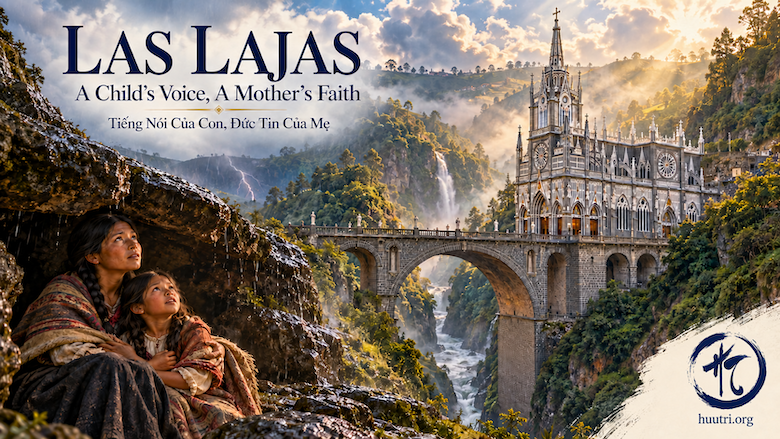
The miraculous events belong to a religious tradition preserved through generations. Details differ among accounts, so the story is best understood as the sanctuary’s devotional origin rather than an independently verified medical history.
In the best-known telling, María and Rosa were traveling between Ipiales and their home when a fierce storm overtook them. Seeking protection, they sheltered among the great slabs of rock beside the canyon.
Those flat stones—called lajas in Spanish—gave the sanctuary its name. The shelter was a natural rocky recess or cave near the river crossing. The grand church and bridge familiar from photographs would come much later.
While they rested near the rocks, Rosa suddenly spoke.
One familiar version preserves her words as:
“Mamita, la mestiza me llama.”
“Mama, the mestiza is calling me.”
The word mestiza traditionally describes a woman of mixed Indigenous and European ancestry. In the story, Rosa was referring to the woman she could see: the Virgin Mary, holding the infant Jesus.
For María, the astonishment was twofold. Her daughter was speaking, yet María initially could not see the figure the child described.
The longer account published by the Colombian Episcopal Conference separates these events into several visits. It describes María first entering the cave alone, praying to Our Lady of the Rosary, and fleeing after sensing someone touch her back. On a later visit with Rosa, the child spoke while pointing out a woman with a child. The familiar declaration that the woman was calling her came during another passing. Shorter versions combine these moments into the encounter during the storm.
Across these variations, the emotional center remains the same: in a place associated with fear and danger, a mother heard a voice she had never heard before.
The tradition continues beyond Rosa’s first words. María reportedly told others what had happened, but they did not believe her.
Later, Rosa disappeared from home. María searched anxiously, then remembered her daughter’s fascination with the woman at the cave. She hurried back to the gorge.
According to the devotional account, she found Rosa kneeling before Mary and interacting affectionately with the infant Jesus. This time, María herself could see them. Mother and daughter subsequently returned to the place, bringing wildflowers and candles as expressions of devotion.
Then the story takes a sorrowful turn.
Rosa is said to have become gravely ill and died. Overwhelmed with grief, María carried her daughter’s body back to the cave. At the place where she believed Mary had welcomed her child, she pleaded for the Virgin’s intercession.
The tradition recounts that Rosa returned to life.
Catholic retellings present this as a second miracle, distinct from the child’s first speech. María then went to Ipiales to tell the townspeople. A group accompanied her to the gorge, where they saw the image of Mary and the Child on the rock. The Colombian bishops’ account associates this gathering with September 15, 1754.
That image became the focus of the devotion. Today, it occupies the central position above the sanctuary’s main altar, on the natural rock itself. The church surrounds the place identified with the apparition, preserving the rock at the heart of its worship.
The magnificent sanctuary did not appear immediately. A modest shelter of wood and thatch first protected the place of prayer. As devotion spread, more substantial chapels and enlargements followed.
Construction of the present neo-Gothic sanctuary began in 1916, and its principal structure was completed in 1949. Building the bridge and supporting platform across the canyon required difficult engineering, sustained fundraising, and years of labor. Clergy, architects, local workers, and generations of devotees contributed to the extraordinary building visitors recognize today.
Its grandeur gives visible form to a story whose appeal remains deeply personal. A frightened traveler became a witness. A child who had never spoken called to her mother. A rocky shelter became a destination for people carrying gratitude, sorrow, and hope.
For believers, Las Lajas expresses trust in Mary’s maternal care and the possibility of divine mercy. For other visitors, it offers a moving encounter with Colombia’s religious heritage and the devotion that inspired such an exceptional church.
Before looking up at its towers, pause to remember the small human moment at the center of the tradition: a mother beside her daughter, listening in astonishment.
The church above the gorge began, the story tells us, with a child’s voice.
-Phan Hoàng Anh-