
From Space to the Ballot Box: Three American Astronauts Vote in the 2026 Midterm Elections
More than 250 miles above Earth, American astronauts exercised one of their most fundamental rights as citizens—proving that even outer space is not too far away to participate in American democracy.
An Election Day Unlike Any Other
On Tuesday, November 3, 2026, millions of Americans participated in the nation’s midterm elections. Some traveled to neighborhood polling stations, others mailed their ballots, and many voted early.
But three Americans cast their ballots from a location unlike any polling place on Earth: the International Space Station (ISS), orbiting approximately 250 miles (400 kilometers) above our planet.
NASA astronauts Anil Menon, Jessica Watkins, and Luke Delaney participated in the election without setting foot on American soil.
There were no voting lines, no election volunteers handing out ballots, and certainly no traditional voting booths. Instead, the astronauts used computers aboard the orbiting laboratory to complete electronic ballots and transmit them securely to election officials on Earth.
Their experience offers a fascinating glimpse into how modern technology can connect Americans to their civic responsibilities, even while traveling through space at approximately 17,500 miles per hour.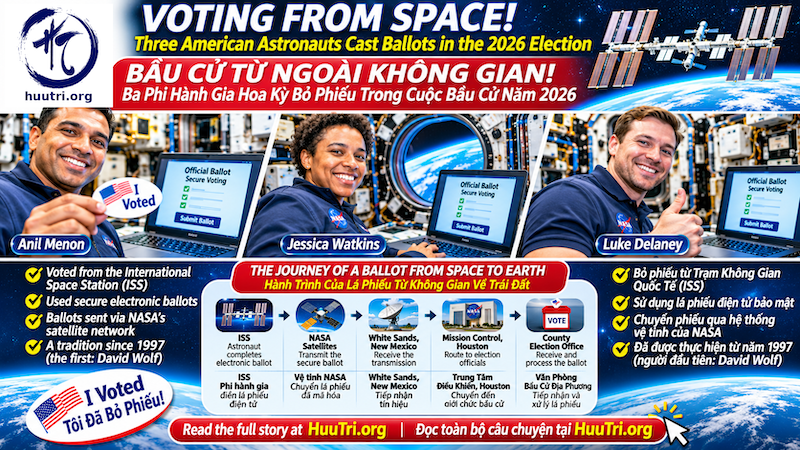
A Bedroom Becomes a Voting Booth in Space
NASA astronaut Anil Menon shared his unusual Election Day experience in a short video posted on November 3.
Floating inside the space station, Menon showed viewers the small private compartment that serves as his sleeping quarters.
For Election Day, it became his personal voting booth.
He explained that he used the computer inside his compartment to complete an electronic ballot and send it to Harris County, Texas, where NASA’s Johnson Space Center is located.
Menon also proudly displayed an “I Voted” sticker, the same familiar symbol worn by millions of Americans after casting their ballots.
In his social media post, he enthusiastically announced:
“Yes, you can even vote from space!”
Menon confirmed that all three American crew members aboard the ISS had the opportunity to vote electronically and securely transmit their ballots to election officials.
For an astronaut living hundreds of miles above Earth, an activity as ordinary as voting became an extraordinary experience worth sharing with the world.
Meet the Three Americans Who Voted From Space
Anil Menon: Menon arrived at the ISS in July 2026 aboard a Russian Soyuz spacecraft. He publicly demonstrated his voting process, showing how his sleeping quarters doubled as a polling station.
Jessica Watkins: Watkins arrived at the ISS in October 2026 aboard a SpaceX spacecraft. She shared the experience of exercising her voting rights while in orbit, reminding Americans that their voices can be heard even from space.
Luke Delaney: Delaney traveled to the ISS with Watkins in October 2026 as part of SpaceX Crew-13. He was the third American astronaut who participated in the midterm election from orbit.
How Does a Ballot Travel 250 Miles From Space to Earth?
It may sound like science fiction, but NASA has developed a process that allows astronauts to vote through secure electronic communication systems.
The procedure combines absentee voting, satellite communications, and encryption technology.
The Journey of a Ballot From Space. Based on NASA’s published voting procedure
- International Space Station: Astronaut completes an encrypted electronic absentee ballot
- NASA Relay Satellites: Ballot travels through NASA’s communications network
- White Sands, New Mexico: Ground antenna receives the transmission
- Mission Control, Houston: NASA routes the encrypted ballot to election officials
- County Election Office: Authorized officials receive and process the ballot. The ballot is encrypted to protect its contents. According to NASA, only the astronaut and the authorized election official can access the ballot.
This is not ordinary public internet voting. It is a specialized absentee-ballot process supported by NASA’s communications infrastructure and coordinated with local election authorities.
Nearly three decades before the 2026 midterm elections, astronaut David Wolf became the first American to vote from space.
In 1997, Texas passed legislation allowing eligible astronauts to vote while orbiting Earth.
Wolf cast his historic ballot while aboard Russia’s Mir space station, before the ISS began hosting permanent crews in 2000.
Years later, Wolf recalled that voting made him feel connected to his homeland while living far away from everything familiar.
His experience reminds us that voting is more than a legal procedure. For Americans working overseas, serving in the military, or living in space, it can also be an emotional connection to home.
NASA astronaut Kate Rubins subsequently voted from orbit in both 2016 and 2020, demonstrating that space voting has become an established part of American spaceflight.
What Do Astronauts Share With Americans Back on Earth?
Although astronauts live in an environment unlike anything most people will ever experience, their daily lives have surprising similarities to ours.
They work long hours, communicate with family, celebrate holidays, exercise, eat meals together, and follow important events happening back home.
Voting is another way they remain connected to American society.
In many respects, their situation resembles that of Americans living or working abroad, including military personnel, diplomats, international business professionals, and retirees spending extended periods outside the United States.
For Vietnamese Americans who maintain strong connections with relatives across the Pacific, this story also illustrates how technology can help overcome enormous distances.
A family member in Vietnam can communicate with loved ones in California through video calls. American citizens living abroad may be eligible to participate in U.S. elections through absentee voting. And now, Americans orbiting the Earth can exercise that same fundamental right.
Of course, the rules and procedures differ. Astronauts use a specialized NASA system, while eligible Americans living overseas generally follow the absentee-voting procedures established under federal and state law.
The common principle is that physical distance does not automatically eliminate an eligible citizen’s right to participate.
Five Fascinating Facts About Voting in Space
- The ISS travels approximately 17,500 miles per hour. An astronaut can circle Earth roughly every 90 minutes while continuing normal daily activities.
- Astronauts do not need to return to Earth to vote. They can arrange absentee voting through election officials.
- A sleeping compartment can become a polling booth. Anil Menon demonstrated exactly that on November 3, 2026.
- NASA uses encrypted communications. Ballots travel through specialized satellite and ground systems rather than being openly transmitted.
- Space voting is almost 30 years old. The first American cast a ballot from orbit in 1997, long before the smartphone era.
A Lesson for Americans of Every Generation
The story of three astronauts voting from space carries a message that reaches far beyond NASA and the technology that makes space travel possible.
American elections affect decisions about healthcare, Social Security, Medicare, taxation, public services, education, and the nation’s future. These matters are particularly relevant to older Americans, retirees, and their families.
The astronauts’ experience illustrates how voting procedures can accommodate citizens who cannot physically visit their local polling stations.
For older adults who face mobility challenges, Americans traveling abroad, or citizens temporarily living far from home, absentee and mail-voting options may offer ways to participate, subject to their state’s eligibility requirements and deadlines.
There is also something distinctly human about the image of an astronaut floating inside a spacecraft, filling out a ballot on a computer, and proudly displaying an “I Voted” sticker.
Despite the remarkable advances that allow humans to live and work in orbit, some traditions remain reassuringly familiar.
Anil Menon, Jessica Watkins, and Luke Delaney may have watched the Earth pass beneath them every 90 minutes, but on November 3, they shared an experience with millions of fellow Americans.
They participated in their country’s democratic process—even while living among the stars.
-Nguyễn Bách Khoa-
Sources and Further Reading
- NASA — How NASA Transmits Votes From the Space Station
- Reuters — Anil Menon Votes From Orbit, November 3, 2026
- com — NASA Astronauts Cast Ballots From the ISS
- AccuWeather — Out of This World, Still in the Vote