
The Kitchen God: Guardian of the Hearth
In traditional East Asian folk belief, the Kitchen God — known in China as Zao Jun or Zao Shen — is a household deity who lives above the stove. His role is both intimate and cosmic: he watches over the family’s daily life and reports their behavior to Heaven once a year.
The kitchen was historically the heart of the home — where food, warmth, and family life centered. So it made spiritual sense that a divine “witness” would reside there.
 Origin Myth: From Mortal Shame to Divine Duty
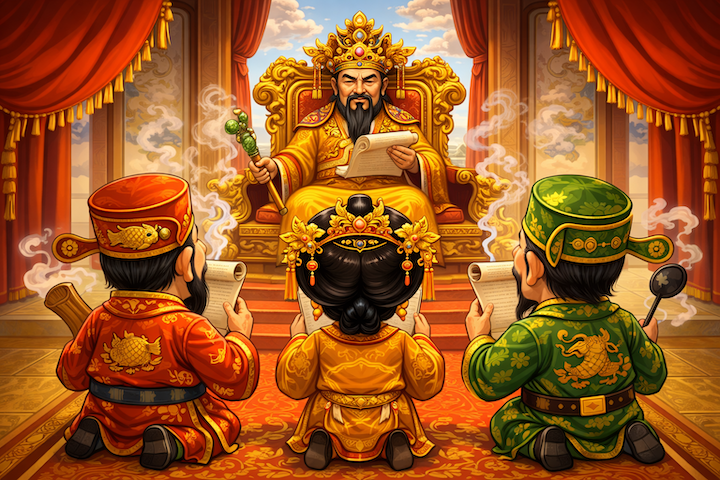
The most popular legend tells of a man named Zhang Lang (also called Zhang Dan). He left his loyal wife for a younger woman, squandered his fortune, and eventually fell into poverty and blindness. Reduced to begging, he unknowingly arrived at his former wife’s home. She recognized him and, despite everything, fed and cared for him.
Overcome with guilt and shame at her compassion, he threw himself into the kitchen fire. The Jade Emperor, moved by his remorse, spared his spirit and appointed him Kitchen God, tasked with observing families and reporting their deeds.
Moral theme: repentance, loyalty, and the belief that everyday actions matter in the eyes of Heaven.
Annual Ritual: The Send-Off to Heaven
Each year, near the Lunar New Year, families perform a ritual to send the Kitchen God back to Heaven to deliver his report.
Common Chinese practices include:
- Date: Usually the 23rd or 24th day of the 12th lunar month
- Offerings: Sticky sweets, honey, or candy
- Symbolism: Sweetness is meant to “sweeten his mouth” so he gives a favorable report
- Ritual act: Burning the paper image of the Kitchen God so his spirit can ascend to Heaven
- Return: A new image is installed on New Year’s Eve when he returns with blessings
The ritual blends humor and hope — a cosmic performance review for the household.
From One Kitchen God to Three: Vietnamese Táo Quân
In Vietnam, the Kitchen God tradition evolved into Táo Quân — often called Ông Công, Ông Táo.
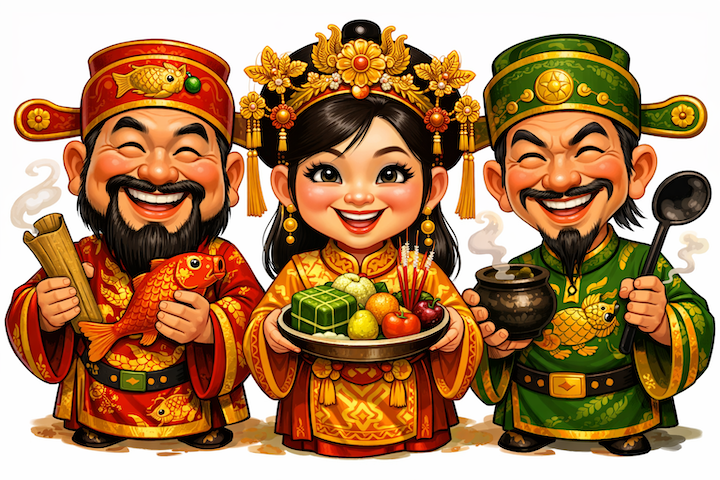
Instead of one deity, Vietnamese folklore speaks of three kitchen gods:
| Role | Meaning |
|---|---|
| Thổ Công | God of the land/home |
| Thổ Địa | God of the household |
| Thổ Kỳ | God of the kitchen |
Vietnamese Origin Legend
A Vietnamese tale mirrors the Chinese moral story but adds emotional depth:
A woman named Thị Nhi remarried after believing her husband had died. Years later, her first husband returned. To protect her new husband from scandal, she hid the first husband in a pile of straw, which the second husband unknowingly burned. Seeing him die, she jumped into the fire; her second husband followed in grief. Heaven, moved by their loyalty and sacrifice, turned them into the three Kitchen Gods.
Key Vietnamese themes:
Love, sacrifice, marital fidelity, and shared destiny.
December 23rd: The Great Send-Off in Vietnam
On the 23rd day of the 12th lunar month, Vietnamese families hold a farewell ceremony.
Unique Vietnamese elements:
- Live carp release 🐟
The gods ride carp to Heaven. Releasing carp into rivers symbolizes transformation (carp becoming dragons in folklore). - Paper hats and robes
Offerings include paper clothing for the three gods. - Savory foods
Unlike the Chinese sweet focus, Vietnamese offerings include full meals.
Difference from Chinese tradition:
China emphasizes sweet offerings and a single deity; Vietnam emphasizes three gods, carp as celestial transport, and a broader symbolic meal.
 Why Táo Quân Became Comedy in Vietnam
In modern Vietnam, Táo Quân leaped from the altar to national television through the year-end comedy show Gặp Nhau Cuối Năm (literally “Meeting at Year’s End”).
The Premise
The three Kitchen Gods report to Heaven about the past year on Earth. Their “heavenly report” becomes a satirical review of society.
Why satire works here
- Cultural cover – It’s framed as folklore, not direct criticism
- Symbolic distance – Critique is delivered through mythological characters
- Collective humor – Everyone recognizes the issues, so laughter becomes shared understanding
- Safe tradition – Because Táo Quân reporting is an old belief, the format feels culturally legitimate rather than politically confrontational
What gets mocked?
- Corruption
- Bureaucracy
- Wealth gaps
- Education problems
- Healthcare struggles
- Everyday frustrations of ordinary people
It is satire with a social conscience — laughter that carries truth.
Why This Matters to Young Vietnamese Americans
Táo Quân is more than superstition or entertainment.
It teaches that:
- Home life matters morally
- Daily actions are seen and remembered
- Compassion and loyalty carry spiritual weight
- Humor can speak truth when direct speech cannot
For young Vietnamese Americans, this tradition connects:
Ancient belief → Family ritual → Cultural identity → Modern social commentary
The Kitchen Gods remind us that even the most ordinary place — the kitchen — can be sacred, and even laughter can carry the voice of conscience.
Before Tết arrives with firecrackers and red envelopes, Táo Quân travels to Heaven — carrying not just incense smoke, but the story of how we lived the past year.
-Nguyễn Tường Khanh-