
In Westminster, Orange County, where bougainvillea spills over white fences and the air carries the scent of phở and ocean breeze, ông Hoà and bà Bình made a decision that surprised their children but felt perfectly natural to them.
In their late eighties, after more than six decades of marriage, they chose to move into an assisted living community together.
“We’ve cooked enough meals for a lifetime,” Bình had said with a playful smile.
“And washed enough dishes for three lifetimes,” Hoà added.
They were tired—but not of each other.
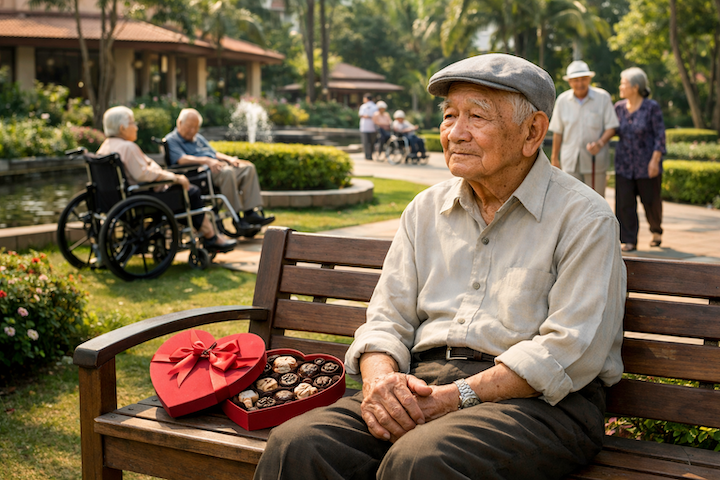
A New Beginning in Their Late Eighties
The community was bright and welcoming. There were no leaking faucets to fix, no groceries to haul, no heavy laundry baskets to carry. Meals were prepared on time. Medication was organized neatly. Activities filled the calendar.
They found friends who shared their love for hymns and morning devotionals. On Sundays, they attended Mass and Bible study in the small chapel downstairs. On weekday afternoons, they joined a group that sang old Vietnamese love songs from the 1950s and 60s.
For the first time in years, they felt light.
Free.
Secure.
They would sit in the courtyard at dusk, watching the California sky blush pink and gold.
“We planned well,” Hoà would say quietly.
“Yes,” Bình would nod. “God has been kind to us.”
They believed this was how their final chapter would unfold—side by side, peacefully.
The Subtle Change
Three years passed.
The first sign was small.
Bình told a story about their honeymoon in Đà Lạt—but the details were wrong. The hotel became a different hotel. The year changed. The location shifted.
Friends exchanged glances.
Then she repeated the same story the next day—with new facts again.
Whispers began.
“She makes things up.”
“She can’t keep her stories straight.”
Hoà felt a tightening in his chest.
He defended her at first. “She’s just mixing things up.”
But even he noticed the flip-flopping. The same memory told three different ways. Familiar names misplaced. Conversations repeated within minutes.
She looked perfectly fine. Her lab tests were normal. The doctor said her body was strong.
“How could something be wrong,” Hoà wondered, “when she looks so healthy?”
But slowly, invisibly, dementia was moving in. And with it, the early shadows of Alzheimer’s.
When Safety Becomes Fear
Then came the night she wandered out.
It was past 9 p.m. when police officers gently escorted her back to the community. She said she was “going home.”
But this was home.
It happened again weeks later.
The administration called Hoà into the office.
“We love Mrs. Bình,” they said carefully, “but her condition is progressing. We can’t accommodate her safely anymore. If she wanders again and something happens… we can’t take that risk.”
The words felt like a verdict.
Hoà had planned meticulously for retirement. Savings. Insurance. Stability. Dignity.
He never planned for this.
A Family’s Impossible Decision
Their children gathered around the dining table one Sunday afternoon.
They were good children—loving, responsible—but life had its own demands. Careers. Mortgages. Children under twelve. After-school activities. Soccer games. PTA meetings.
No one said it aloud, but everyone knew: full-time caregiving would overwhelm them.
Private 24/7 care in California would devastate their finances.
The most logical option was also the most painful one.
Vietnam.
In Hanoi, quality full-time home care was affordable. Round-the-clock supervision would keep Bình safe.
But for Hoà, Vietnam was not simply a country.
It was memory.
He had survived a reeducation camp there after the war. He had watched friends die from treatable illnesses—flu, malaria, stomach infections—while he held their hands.
The air itself felt heavy with ghosts.
Yet Bình no longer remembered those years. She barely remembered yesterday.
On good days, she smiled at Hoà and thought he was a kind man who visited often.
On bad days, she looked straight through him.
Letting Go of Pride
Bình moved first.
Hoà remained in Westminster for eight months, walking past empty chairs and quiet hallways.
The silence was louder than any argument they had ever had.
Finally, he packed two suitcases and boarded a flight to Hanoi.
Not because he wanted to relive the past.
But because love demanded presence.
The Man Who Remembers
He rented a modest condo nearby.
Each morning, he visited her.
He took her for short walks along shaded paths.
She would hold his hand naturally, instinctively, like muscle memory buried deeper than cognition.
She did not know his name.
But she trusted his touch.
Neighbors didn’t understand.
“Why bother?” one friend asked gently.
“She doesn’t know who you are. She doesn’t remember anything.”
Hoà smiled.
“It’s not for her,” he replied softly.
“It’s for me.”
He paused.
“I want to remember the memories we shared. So when she’s no longer here… I won’t forget the love. The struggles. The laughter. The forgiveness. The life.”
Valentine’s Day
On Valentine’s Day, he followed the routine they had kept for decades.
A short walk in the park.
A quiet cup of coffee.
Lunch at their favorite small restaurant.
And a box of dark chocolate with almonds.
He placed it gently in her hands.
She looked at it curiously.
He leaned closer and whispered:
“I know deep down in your heart, you remember you shared many beautiful Valentines with me. And today is another one for us.”
He squeezed her hand.
“Happy Valentine’s Day, Bình.”
She did not respond with recognition.
But she smiled.
And in that smile, Hoà saw sixty years of shared sunsets, children raised, wars survived, tears shed, and prayers answered.
Love, he realized, was never about being remembered.
It was about choosing—again and again—to stay.
Until the last Valentine.

-Lê Nguyễn Thanh Phương-