
For many adults over 55, retirement planning shifts from accumulation to tax efficiency, income stability, and legacy protection. One of the most powerful — yet often misunderstood — tools in this phase is a Roth IRA conversion.
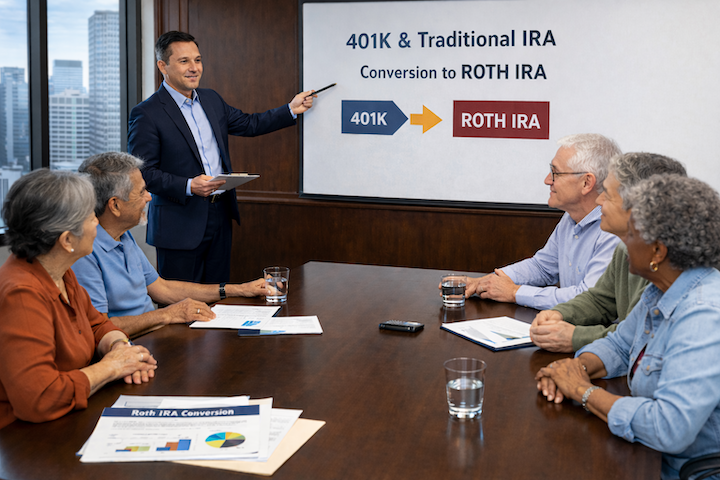
This comprehensive guide is designed specifically for the HuuTri.org 55+ community to help you understand how Roth conversions work, how Required Minimum Distribution (RMD) rules affect your planning, and how to make thoughtful long-term retirement decisions.
1) What Is a Roth IRA Conversion?
A Roth IRA conversion occurs when you move money from a pre-tax retirement account into a Roth IRA.
Eligible accounts typically include:
- Traditional IRA
- SEP IRA
- SIMPLE IRA (after required holding period)
- 401(k), 403(b), 457 (if eligible for rollover or in-plan conversion)
When you convert:
- The converted amount becomes taxable income in that year
- You pay ordinary income tax now
- Future qualified withdrawals become tax-free
In simple terms:
You voluntarily pay taxes now so future retirement income can be tax-free.
2) What Are the Benefits of a Roth IRA?
A. Tax-Free Growth
Once funds are inside a Roth IRA:
- Investment growth is tax-free
- Qualified withdrawals are tax-free
- There are no taxes on earnings if rules are met
This creates long-term tax certainty — something many retirees value in an uncertain tax environment.
B. No Required Minimum Distributions (RMDs)
One of the most powerful structural advantages of a Roth IRA is that it is not subject to Required Minimum Distributions (RMDs) during the original owner’s lifetime.
Current RMD Rules (Under SECURE Act 2.0)
RMD starting age depends on your birth year:
- Born 1951–1959 → RMDs begin at age 73
- Born 1960 or later → RMDs begin at age 75
Your first RMD must generally be taken by April 1 of the year after reaching your required age, and each year thereafter by December 31.
These rules apply to:
- Traditional IRAs
- 401(k) and most employer plans
But they do not apply to Roth IRAs during your lifetime.
Why This Matters
The absence of lifetime RMDs means:
- No forced taxable withdrawals
- Continued tax-free compounding
- Greater control over retirement income timing
- Better ability to manage Medicare premiums and tax brackets
For those born in 1960 or later, RMDs will not begin until age 75 — creating a longer planning window.
Simplified Infographic Guide
(For the HuuTri.org 55+ Community)
What Is a Roth IRA Conversion?
Move money from:
Traditional IRA / 401(k) Into a Roth IRA
- Pay taxes now
- Grow tax-free
- Withdraw tax-free later
RMD Rules You Must Know
| Birth Year | RMD Starts At |
|---|---|
| 1951–1959 | Age 73 |
| 1960 or later | Age 75 |
Roth IRAs = No lifetime RMDs
Why Roth IRA Is Powerful After 55
- Tax-free growth
- No lifetime RMDs
- More retirement income control
- Better Medicare planning
- Strong estate planning tool
Best Time to Consider Conversion
The “Tax Gap Years”:
- Retirement → Age 73 or 75
- Often lower income years
- Ideal time for gradual conversions
Who Should Consider It?
- Expect higher future tax rates
- Large Traditional IRA balance
- Want to reduce future RMDs
- Can pay taxes from outside funds
- Planning to delay Social Security
Smart Strategy
Convert gradually:
- Stay within your tax bracket
- Reduce future RMD shock
- Smooth lifetime tax burden
3) What Are the Rules of a Roth IRA Conversion?
Rule 1: You Pay Tax on the Converted Amount
If you convert $100,000, that $100,000 is added to your taxable income for the year.
Large conversions can push you into higher tax brackets if not carefully planned.
Rule 2: No Income Limit on Conversions
Unlike Roth contributions, there are no income limits on Roth conversions.
Rule 3: The 5-Year Rule
Each conversion has a 5-year clock for penalty-free access if you are under age 59½.
For most retirees over 59½, penalties are not a concern — but earnings must meet the 5-year rule for tax-free treatment.
Rule 4: Medicare and Social Security Impact
Large conversions may:
- Increase Medicare Part B and D premiums (IRMAA)
- Increase the taxable portion of Social Security
- Raise your overall effective tax rate
Conversion planning must consider these factors.
4) Who Should Consider a Roth IRA Conversion?
You may benefit if:
- You expect tax rates to rise
- You have large pre-tax retirement balances
- You want to reduce future RMD exposure
- You have liquidity to pay taxes
- You value estate tax efficiency
It may not be ideal if:
- You need immediate access to funds
- You cannot afford the tax bill
- Conversion pushes you into much higher brackets
- It triggers excessive Medicare premium increases
5) When Is the Best Time to Convert?
For many retirees, the optimal window is:
Between retirement and RMD age (73 or 75).
For someone born in 1962:
- Retire at 62
- RMD begins at 75
- That creates 13 years of tax-planning opportunity
Without planning → Large RMDs at 75
With gradual conversions → Smaller future RMDs and smoother tax exposure
6) Strategies to Maximize Roth Conversion Benefits
1. Bracket-Filling Strategy
Convert enough each year to fill your current tax bracket without spilling into the next.
2. Convert During Market Declines
Lower asset values mean lower tax cost. Future recovery becomes tax-free.
3. Pay Taxes with Outside Cash
Preserves more money inside the Roth to grow tax-free.
4. Coordinate with Social Security
Delaying benefits until 70 may allow larger conversions at lower effective tax rates.
5. Monitor Medicare IRMAA Thresholds
Conversions today affect Medicare premiums two years later.
7) Final Perspective for the HuuTri.org 55+ Community
A Roth IRA conversion is not just an investment move — it is a multi-year tax strategy.
For adults over 55, it can:
- Reduce lifetime taxes
- Minimize or smooth RMD impact
- Improve Medicare premium planning
- Provide tax-free retirement income
- Strengthen estate flexibility
Especially for those born in 1960 or later, the age 75 RMD rule creates an extended and valuable planning window.
But success requires:
- Multi-year tax modeling
- Careful bracket management
- Coordination with Social Security and Medicare
- Professional guidance when appropriate
Bottom Line
Roth conversions are about control.
Control over:
- Taxes
- Timing
- Retirement income
- Legacy planning
For many in the HuuTri.org 55+ community, a well-planned Roth IRA conversion strategy can transform taxable retirement savings into tax-free lifetime flexibility.
-Phan Trần Hương-
Official IRS Resources on Roth IRA & Conversion Rules
- Roth IRAs — IRS Overview
The IRS page describing Roth IRA basics, qualified distributions, and account rules.
🔗 Roth IRAs | Internal Revenue Service — https://www.irs.gov/retirement-plans/roth-iras - Retirement Plans FAQs — Roth Conversions & Recharacterization
Answers about whether Roth IRA conversions can be “recharacterized” (they cannot after 2018).
🔗 Retirement Plans FAQs regarding IRAs — https://www.irs.gov/retirement-plans/retirement-plans-faqs-regarding-iras - Publication 590-B (Distributions from IRAs)
IRS publication explaining the 5-year rule for conversions and potential early-distribution taxes/penalties.
🔗 Publication 590-B (2024), IRS — https://www.irs.gov/publications/p590b/pdf/p590b.pdf - Publication 590-A (IRA Contributions & Conversions)
IRS official publication covering how conversions are treated for contribution purposes.
🔗 Publication 590-A (2025), IRS — https://www.irs.gov/pub/irs-pdf/p590a.pdf - Instructions for IRS Form 8606
IRS instructions for reporting Roth conversions and nondeductible IRA amounts — useful for conversion tax reporting.
🔗 Instructions for Form 8606 (2024), IRS — https://www.irs.gov/instructions/i8606 - Topic No. 451, IRAs & Required Minimum Distributions
IRS topical guide covering how RMDs apply (and how they don’t apply to Roth IRAs).
🔗 Topic No. 451: IRAs & RMDs, IRS — https://www.irs.gov/taxtopics/tc451
Supporting Official Clarifications
- Retirement Plans FAQs — RMDs & Roth IRAs
Explains required minimum distributions (RMDs) are not required from Roth IRAs for original owners.
🔗 Retirement Plans FAQs about distributions, IRS — https://www.irs.gov/retirement-plans/retirement-plans-faqs-regarding-iras-distributions-withdrawals - Roth Account Options in Employer Plans
IRS official resource on Roth accounts in workplace retirement plans (Roth 401(k), etc.).
🔗 Roth account in your retirement plan (IRS) — https://www.irs.gov/retirement-plans/roth-acct-in-your-retirement-plan
Notes for Context (IRS-linked but explanatory)
These pages are not IRS official documents but are widely accepted explanations based on IRS guidance:
- Fidelity’s explanation of the 5-year rule & qualified distributions — https://www.fidelity.com/learning-center/personal-finance/retirement/roth-ira-5-year-rule
- Vanguard’s breakdown of 5-year conversion holding periods — https://investor.vanguard.com/investor-resources-education/iras/ira-withdrawal-rules