
Why “36 Phố Phường” Still Defines the Soul of Hanoi
Walk into Hanoi’s Old Quarter early in the morning and the city seems to awaken one doorway at a time.
A woman sets out tiny stools beside a steaming pot of phở. A shopkeeper lifts the metal shutters of a narrow storefront. Motorbikes begin weaving through lanes that seem far too small for modern traffic. Somewhere, coffee drips slowly through a phin, while the smell of incense escapes from a temple hidden between shops.
Above it all are balconies, weathered shutters, tiled roofs and the unmistakably narrow façades of Hanoi’s old nhà ống — tube houses.
To a visitor, it can look wonderfully chaotic.
But Hanoi’s Old Quarter was never random.
Behind its maze of streets is an economic and social system that evolved over centuries — one so deeply rooted in the history of Thăng Long that the names of the streets themselves became a record of how generations of Hanoians lived and worked.
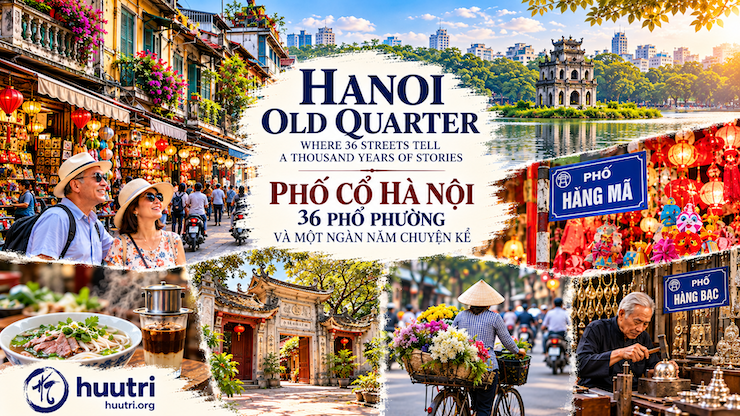
This is Hà Nội 36 Phố Phường — Hanoi’s legendary 36 Streets and Guilds.
 From Thăng Long to the Old Quarter
The story reaches back more than a thousand years.
In 1010, Emperor Lý Thái Tổ moved the Vietnamese capital to Đại La and renamed it Thăng Long — “Ascending Dragon.” As the imperial capital developed, artisans and merchants from villages throughout the Red River Delta were drawn toward the city.
The commercial neighborhoods that evolved outside the imperial citadel became places where goods were produced, traded and transported. Hanoi’s location near the Red River helped make the area particularly advantageous for commerce.
But these craftsmen did not necessarily arrive as isolated individuals.
People from the same village, or those practicing the same craft, often settled and worked near one another. A community of silversmiths might occupy one area. Sellers of silk another. Craftsmen working with bamboo, metal, paper or leather established themselves elsewhere.
Gradually, these concentrations developed into phường — communities or guilds associated with particular trades.
And this is where Hanoi’s remarkable street names begin.
Why Is It Called “36 Phố Phường”?
The expression “Hà Nội 36 phố phường” is so familiar that it is easy to assume there were exactly 36 streets.
The history is more complicated — and more interesting.
Phố generally refers to a street or commercial street.
Phường, historically, could refer to a community or guild of people engaged in the same trade, as well as an administrative area.
Vietnam’s official tourism information describes the old phường as places where people practicing the same craft or selling the same merchandise gathered together — reflecting the traditional expression “buôn có bạn, bán có phường.”
The famous number 36 should therefore not necessarily be interpreted as an exact street count. Historical sources and modern interpretations differ, and the Old Quarter eventually contained considerably more than 36 streets. The expression became a conventional and almost poetic way of describing the old commercial quarters of Thăng Long.
In other words, “36 phố phường” is as much a cultural idea as a number.
It describes a Hanoi where commerce, craftsmanship, neighborhood and community were woven together.
The Secret Is in the Word “Hàng”
Once visitors understand one Vietnamese word, the Old Quarter suddenly becomes easier to read:
Hàng
Hàng can mean goods or merchandise.
Traditionally, many streets were identified by the product manufactured or sold there. The word following Hàng essentially told customers what they could expect to find.
That turned Hanoi into something resembling a medieval commercial directory written directly onto the map.
Hàng Bạc — silver and silversmithing.
Hàng Mã — votive paper goods.
Hàng Chiếu — woven mats.
Hàng Thiếc — tinware and metal goods.
Hàng Tre — bamboo products.
Hàng Đường — sugar and sweets.
Hàng Gai — historically associated with hemp and later famous for silk and textiles.
Hàng Buồm — sails and goods associated with river commerce.
Hàng Đào — historically associated with dyed fabrics and silk.
The street name was therefore more than an address.
It was an advertisement.
If you needed silver, you knew where to go. If you needed mats, paper offerings, bamboo products or textiles, an entire community of specialists could be found concentrated in one area. Hanoi cultural authorities describe precisely this pattern: guild streets came to carry the names of their products, services or trades.
Imagine the Old Quarter centuries ago without Google Maps, street directories or shopping centers.
The name itself told you what was sold there.
The Streets Were Also Communities
The guild system was about more than commerce.
Craftsmen arriving from the same villages often brought their customs, religious practices and community relationships with them. Guilds established communal houses and places of worship associated with their villages and patron figures.
So a phố Hàng could function simultaneously as workplace, marketplace and neighborhood.
Shop downstairs.
Family upstairs or behind.
Workshop farther inside.
A small courtyard brought sunlight and ventilation into the long building.
This contributed to one of Hanoi’s most recognizable architectural forms: the tube house, characterized by a remarkably narrow street frontage but considerable depth. Official tourism information notes that many traditional houses dating especially from the eighteenth and nineteenth centuries combined storefronts, living spaces, mezzanines and interior courtyards within these elongated structures.
The architecture itself tells another chapter of Hanoi’s commercial history.
Street frontage was precious.
So houses became narrow — and grew inward.
Then Hanoi Changed
Dynasties came and went.
The French colonial period transformed parts of Hanoi’s urban landscape. Streets were widened or reorganized, sidewalks and new buildings appeared, and commercial patterns evolved. The Old Quarter nevertheless remained an important trading center.
Then came wars, economic transformation and eventually Đổi Mới and Vietnam’s rapid integration into the global economy.
The merchandise changed.
The street names did not.
And that creates one of the most fascinating experiences in modern Hanoi.
You can walk down a street carrying the name of a commodity that may barely be sold there anymore.
Some traditional concentrations remain recognizable. Hàng Bạc continues to have jewelry businesses; Hàng Mã remains famous for paper offerings and increasingly elaborate seasonal decorations. Elsewhere, restaurants, fashion stores, hotels, cafés, tour agencies and souvenir shops have replaced much of the original trade.
Yet the names remain like historical fingerprints.
Hanoi has preserved portions of its economic history in its street signs.
How the World Sees Hanoi’s Old Quarter Today
For international travelers, the Old Quarter has become one of the defining images of Hanoi.
It offers something increasingly difficult to find in rapidly modernizing Asian capitals: a historic district that is still intensely alive.
It is not simply an architectural museum.
People still live here.
People still cook on sidewalks, worship in small temples, deliver merchandise by motorbike, drink coffee in tiny shops, argue over parking spaces, prepare food before sunrise and conduct business from houses that may have served generations of merchants.
International recognition increasingly extends beyond architecture to the neighborhood’s living culture. In 2026, the Michelin Guide described Hanoi’s Old Quarter as one of the world’s great food capitals, emphasizing how its history of commerce remains embedded in its streets and food traditions.
Tourists come looking for Hàng Mã’s colors, Hàng Bạc’s jewelry shops, bowls of phở and bún chả, sidewalk coffee, hidden temples, Đồng Xuân Market and the organized confusion of scooters, pedestrians and vendors.
But perhaps what fascinates outsiders most is the juxtaposition.
Ancient shrine. Modern coffee shop.
Old tube house. Boutique hotel.
Street vendor. Smartphone payment.
Traditional bánh cuốn shop. International traveler filming it for social media.
That contradiction has become part of Hanoi itself.
Is Modernism Destroying the Charm of the Old Quarter?
This is the more difficult question.
And the answer may be:
Yes — and no.
There are legitimate reasons for concern.
Tourism creates demand for hotels, restaurants, bars, souvenir stores and entertainment businesses. Property values rise. Traditional craftsmen disappear as younger generations choose different careers. Historic interiors are renovated. Old façades compete with modern signs, air conditioners, electrical wiring and commercial advertising.
A street once associated with one specialized craft can gradually become another row of cafés and tourism businesses.
At some point, preservation can become merely cosmetic: keep an old façade, put an international-style business behind it, and call the neighborhood historic.
If that happens everywhere, the Old Quarter risks becoming a stage set of old Hanoi rather than old Hanoi itself.
But there is another side to the argument.
Hanoi’s Old Quarter Was Never Frozen in Time
This is perhaps the most important point.
The Old Quarter survived precisely because it changed.
It was built around commerce.
Merchants adapted to customers. Crafts changed. Products disappeared. New products replaced them. Buildings were rebuilt. Families moved. New communities arrived.
Even historically, the district absorbed outside influences. Chinese merchants contributed to its commercial development; French colonial urbanization changed its architecture and infrastructure; later generations introduced entirely new businesses.
So demanding that the Old Quarter remain exactly as it appeared 100 or 200 years ago would itself be historically artificial.
The challenge isn’t stopping modernization.
The challenge is deciding what should never be lost while modernization continues.
Preserve the narrow streets.
Protect important tube houses.
Maintain đình, temples and historic structures.
Encourage surviving traditional crafts.
Document the stories behind the Hàng streets.
Keep local food traditions alive.
Most importantly, allow ordinary Hanoians to continue living and working there.
Because once residents disappear and every building becomes a hotel, souvenir shop or attraction, something much more important than architecture disappears.
The neighborhood loses its memory.
Perhaps the Chaos Is the Charm
Visitors sometimes complain that Hanoi’s Old Quarter is too crowded.
Too many motorbikes.
Too many signs.
Too many vendors.
Too much noise.
Too much commerce.
But consider the irony.
Commerce is exactly why this neighborhood exists.
For hundreds of years, people came here to manufacture things, sell things, buy things, eat, negotiate, deliver merchandise and make a living.
A completely quiet, perfectly restored Old Quarter might photograph beautifully.
But historically, it would be strangely inaccurate.
Hanoi’s Old Quarter was never supposed to be quiet.
It was Kẻ Chợ — the marketplace.
It was meant to trade.
It was meant to move.
It was meant to live.
36 Phố Phường: More Than a Tourist Destination
Perhaps the best way to experience Hanoi’s Old Quarter is therefore not to treat it as a checklist.
Don’t simply photograph Hàng Mã and leave.
Look at the street signs.
Ask what Hàng means.
Notice how narrow the houses are.
Look beyond a modern storefront and you may discover an old courtyard.
Look between two shops and you may find a tiny temple.
Ask an elderly shopkeeper what the street sold when they were young.
Then suddenly 36 phố phường becomes understandable.
It is not really about thirty-six streets.
It is about generations of Vietnamese who came from different villages carrying skills in their hands — silversmiths, textile merchants, metalworkers, bamboo craftsmen, food sellers and countless others — and together created one of Southeast Asia’s great commercial neighborhoods.
More than a thousand years after Thăng Long became the capital, their trades may be disappearing.
Their street names remain.
And every morning, Hanoi opens its doors and begins trading again.
That may ultimately be the secret of the Old Quarter’s survival:
Hanoi does not preserve its past by refusing to change.
It preserves its past by carrying pieces of it forward.
-Lê Nguyễn Thanh Phương-