
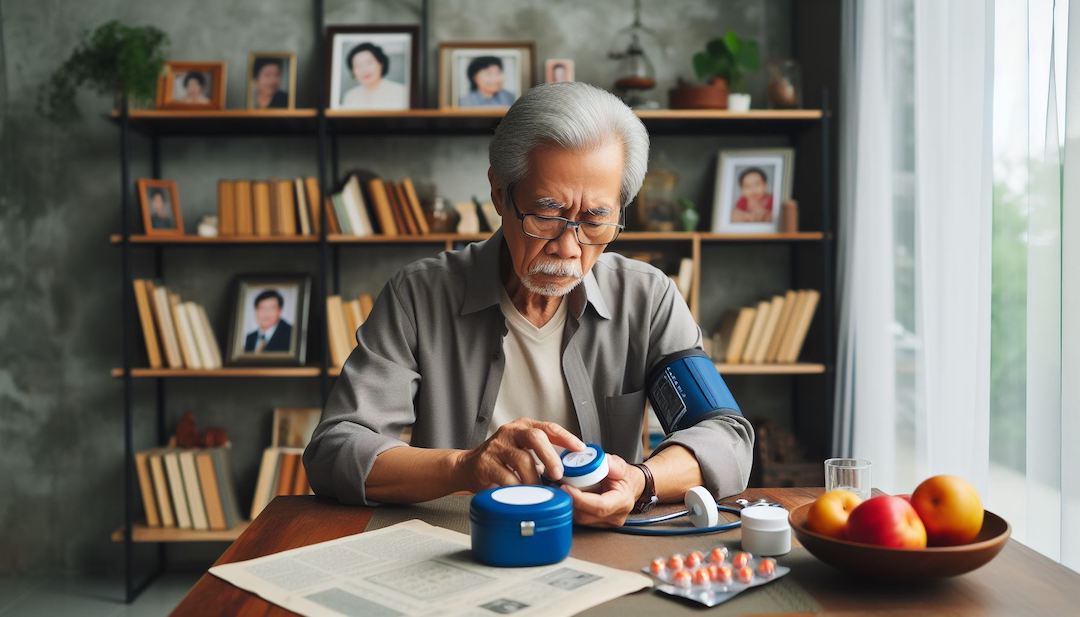
Every morning, without fail—weekdays, weekends, holidays—Bác Ba follows a ritual. He admits he doesn’t sleep much, but when dawn comes, he plugs in the kettle, boils some water, and makes himself a cup of green tea, cooled with a splash of cold water. After a few sips to soothe his throat and warm his stomach, he puts on his reading glasses, sits down at the small kitchen table, and begins his routine.
He rolls up his sleeve, places his left arm on the table at chest height, and wraps the blood pressure cuff snugly around his upper arm. He presses the button on a small gray machine his son sent him, and the quiet room fills with the soft whirring sound of the pump. The cuff inflates, squeezes, then slowly deflates. The machine beeps and flashes its numbers. Bác Ba can barely hear it—his hearing has faded over the years—but he carefully writes down the results on a slip of paper. He hasn’t missed a day since the monitor arrived.
“Back then, I used to walk to the pharmacy to check my blood pressure,” he explains. His doctor had told him his blood pressure was high and insisted on medication and daily monitoring. Without his own machine, he could only get a reading when he went to pick up prescriptions. “Not very convenient,” he admits. Now, with the home monitor, he checks at the same time each morning. “Much better.”
Bác Ba, who prefers not to give his real name, is in his 80s now. He came to the United States with one of the very first waves of Vietnamese refugees after 1975.
When asked whether the medication and daily walks around the neighborhood have helped, he just shakes his head. “It’s the same for everyone. Old age brings illness—you can’t escape it.” He points to a plastic pill organizer, neatly divided into seven compartments, Monday through Sunday. Each slot is filled with pills of all shapes and sizes: capsules, tablets, round ones, long ones, even tiny ones no bigger than a peppercorn.
He sighs. “It’s tough. But what choice do we have?”
Like so many who fled Vietnam in the early days, Bác Ba and his family were resettled by a church group in California’s Silicon Valley. When government assistance ended, he worked tirelessly—“cày ngày chưa đủ, tranh thủ cày đêm,” as the saying goes, meaning “working days wasn’t enough, so we worked nights too.” He supported his family here, and he sent money back home to relatives who needed it even more. Eventually, retirement came—along with worsening health. Yet he still says, “I’m luckier than many.”
And he’s right. He’s not alone. Countless seniors in America—many long retired—spend their days juggling medications, doctor’s appointments, and lab visits. Some undergo dialysis, chemotherapy, or radiation several times a week. Others are in and out of hospitals so often that it feels like a revolving door.
Taking another sip of his green tea, which he insists is “good for health,” Bác Ba rattles off a list of conditions that plague him. Finally, he shrugs: “Whatever disease people have, I’ve got it too. Not missing a single one.” He excuses himself to shuffle down the hallway, muttering that he can’t sit too long. On his notepad, the last number written down reads: 139/89.
Bác Ba has high blood pressure—better known as hypertension.
The Numbers Behind Blood Pressure
Most of us have heard the golden standard: 120/80 mmHg. That’s the ideal blood pressure for a healthy adult—the pressure your blood exerts on artery walls as your heart pumps. But it’s really more of a goalpost than a fixed rule, since blood pressure varies by age, sex, family history, and lifestyle.
In the U.S., about 232 million adults have readings above 120/80 mmHg. Of these, 112 million fall into the “elevated” range (120–129/80), and 120 million are at or above 130/80, or already on medication.
Why is it so hard to keep blood pressure under control? The reasons are easy to see: processed foods packed with salt and sugar, sedentary lifestyles, endless hours in front of the TV, alcohol, and—perhaps most damaging of all—stress.
Consider just one simple breakfast: a ham-and-cheese sandwich on rye bread.
- Rye bread: 170–300 mg sodium per slice
- Ham: 275–365 mg sodium per serving
- Cheese: 130–350 mg sodium per slice
Even at the low end, that’s 745 mg of sodium in one meal—nearly half of the 1,500 mg per day recommended by the American Heart Association for heart health. And most Americans consume around 3,400 mg daily—more than double the safe limit.
New Guidelines: Drink Less, Live Longer
In August, the American Heart Association and the American College of Cardiology released updated guidelines for preventing and managing high blood pressure. The biggest takeaway?
Cut the Alcohol
Research shows heavy drinking raises blood pressure and damages the brain’s blood vessels, leading to memory loss, cognitive decline, and even dementia. The recommendation: no more than two drinks per day for men, and just one for women.
Dr. Daniel W. Jones, chair of the guideline-writing committee, summed it up:
“These updated guidelines bring together the latest research to help all health care providers—from primary care to specialists—better diagnose and manage high blood pressure.”
But the advice goes beyond alcohol. Doctors emphasize a healthy lifestyle: balanced nutrition with lean protein, fruits, and vegetables; regular physical activity; maintaining a healthy weight; and managing stress. If lifestyle changes don’t lower blood pressure within 3–6 months, medication may be necessary—even for readings as “low” as 130/80.
High blood pressure remains the number one preventable risk factor for heart disease, stroke, kidney disease, and dementia.
Bác Ba’s Struggle
When asked what his doctor advises, Bác Ba only shakes his head. “It’s not easy. Cutting down on salt after a lifetime of salty food—it’s tough.” He laughs softly. “I quit smoking after decades. That was a huge victory. But now they want me to give up my beer too? What’s left?”
Still, he admits that these days he only drinks socially, when gathering with old friends. “That’s when we raise a glass,” he says.
For him, each morning’s ritual with the blood pressure monitor is more than just numbers. It’s a reminder—of age, of survival, of resilience, and of gratitude that he’s still here, still able to sip green tea and face another day.
— By Duc Ha, written for Huutri.org
Note: The document “New Guidelines for Blood Pressure Management by the American Heart Association and the American College of Cardiology” was used in this article.