
From ancient temples to modern trading floors, gold has held a special place in human economies and imaginations. Its stability, rarity, and beauty made it the perfect medium of exchange for centuries. By the 19th and 20th centuries, these qualities culminated in the gold standard, where paper money could be exchanged for gold at a fixed rate. After World War II, that evolved into the Bretton Woods system, which made the U.S. dollar the global anchor of value.
 The Bretton Woods System: Gold, the Dollar, and Global Stability
In 1944, 44 Allied nations gathered in Bretton Woods, New Hampshire, to create a stable postwar monetary order. They agreed that each currency would be pegged to the U.S. dollar, and the dollar itself would be convertible into gold at $35 per ounce. Because the U.S. already held most of the world’s gold reserves—over two-thirds—the dollar became the de facto global reserve currency.
The system restored international confidence, fueled global trade, and stabilized exchange rates for nearly three decades. Yet by the late 1960s, U.S. spending on the Vietnam War and social programs strained its reserves, forcing a historic decision in 1971.
The Nixon Shock: Ending the Gold Standard
Facing inflation and dwindling gold reserves, President Richard Nixon suspended the dollar’s convertibility into gold on August 15, 1971, in what became known as the Nixon Shock. The move ended the Bretton Woods system and marked the beginning of today’s fiat currency era—where money derives its value from government trust rather than gold. It also created new currency volatility and reshaped global economic and political power.
Who Owns America’s Gold—and Where It’s Stored
The U.S. Department of the Treasury owns America’s gold under the Gold Reserve Act of 1934, which transferred all monetary gold from the Federal Reserve. The Executive Order 6102 (1933) had already required Americans to turn in most private gold holdings, greatly increasing national reserves.
Today, U.S. gold is mainly stored at Fort Knox (Kentucky), West Point (New York), and Denver (Colorado). The Federal Reserve Bank of New York also safeguards thousands of tons of gold—mostly owned by foreign governments and international institutions.
How the U.S. Amassed So Much Gold
The U.S. acquired its massive gold reserves through domestic mining, foreign purchases, and trade surpluses:
- Domestic Mining: The California Gold Rush (1848–1855) and later discoveries in Colorado, Nevada, and Alaska made the U.S. one of the world’s top gold producers.
- Foreign Acquisitions: During World Wars I and II, the U.S. received huge gold inflows from Europe in exchange for weapons, goods, and financial assistance.
- Trade Surpluses: Under Bretton Woods, the U.S. exported more than it imported, earning gold from trading partners seeking to settle their dollar surpluses.
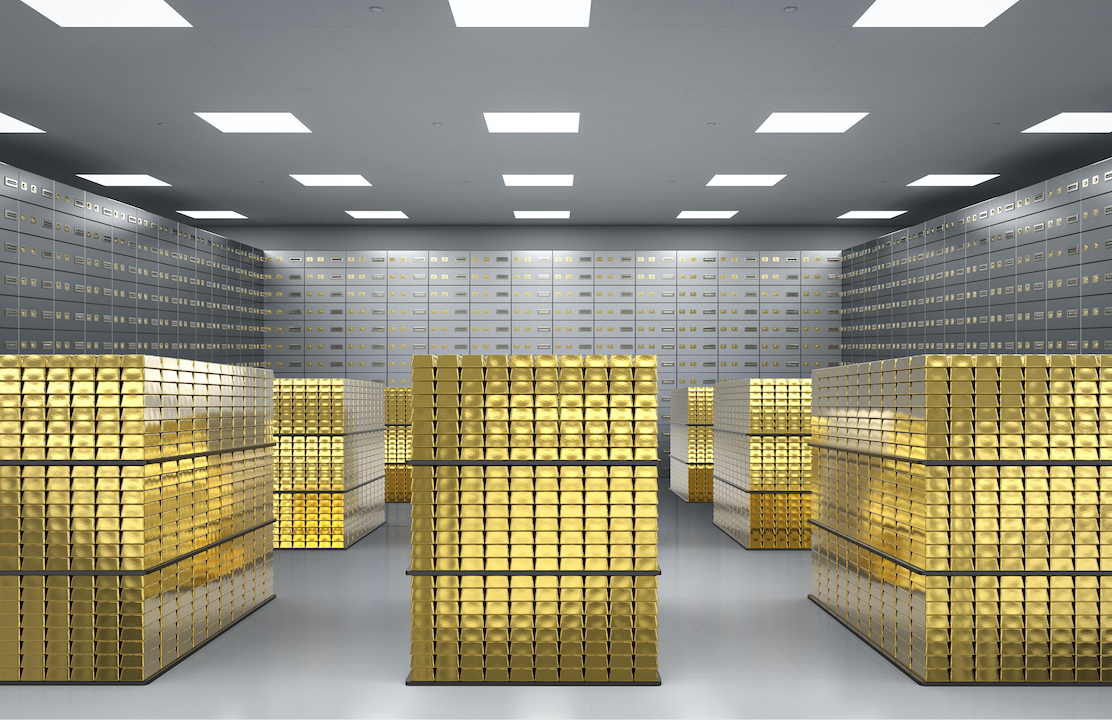
By 1949, the U.S. held about 20,000 metric tons of gold—nearly two-thirds of global reserves.
Top 10 Gold-Holding Nations (as of 2025)
- United States — 8,133.5 tons
- Germany — 3,350.2 tons
- Italy — 2,451.8 tons
- France — 2,437.0 tons
- China — 2,332.7 tons
- Russia — 2,298.5 tons
- Switzerland — 1,039.9 tons
- Japan — 900.0 tons
- India — 845.9 tons
- Netherlands — 634.7 tons
(Source: IMF, World Gold Council, central bank reports.)
Gold’s Value Then and Now
- 1973: ~$97 per ounce
- October 2025: ~$4,000–$4,300 per ounce
That’s about a 40-fold increase in nominal value since the 1970s. (However, the U.S. Treasury still values its gold at the old statutory rate of $42.22 per ounce.)
Why Gold Is So Expensive Today
Recent price spikes are fueled by:
- Lower interest rates, making gold more appealing.
- Global instability, from wars to political uncertainty.
- Tariff tensions between the U.S. and China, disrupting markets.
- Record central bank purchases, especially in Asia.
China’s Rush to Buy Gold
China’s central bank has been a leading buyer, aiming to:
- Reduce dependence on U.S. dollars and Treasuries.
- Strengthen the yuan’s credibility in global trade.
- Hedge against sanctions and economic shocks.
China’s large-scale accumulation doesn’t mean the yuan lacks value; rather, it’s a strategic safeguard to enhance its financial independence.
Why Tariff Wars Boost Gold Prices
Trade tariffs raise costs and stir recession fears. As the U.S.–China trade conflict intensifies, investors turn to gold as a hedge against inflation, currency swings, and market turmoil—driving demand and prices even higher.
What Retirees Should Do in a Volatile Economy
For retirees and those nearing retirement, uncertainty can be unsettling—but panic-selling stocks for gold isn’t the answer. Gold can be a smart hedge but not a full replacement for diversified investments. Experts recommend:
- Diversify your portfolio across assets — include stocks, bonds, and a modest percentage (5–10%) in precious metals like gold.
- Avoid emotional moves. Selling during downturns can lock in losses.
- Hold cash or short-term Treasuries for flexibility and stability.
- Rebalance annually rather than chasing short-term gains.
Gold shines brightest during turmoil—but financial security in retirement still depends on balance, patience, and discipline.
-Nguyễn Bách Khoa-
Sources & Further Reading
- World Gold Council – Official gold reserves by country (IMF IFS)
- Federal Reserve History – Nixon ends dollar/gold convertibility; Bretton Woods overview
- U.S. Treasury – Status Report of U.S. Government Gold Reserve
- New York Federal Reserve – Gold vault and custody holdings
- Historical Gold Prices – Macrotrends & World Bank data
- World Gold Council – Central Bank Gold Demand & Trends