
We’re only six months away from one of the world’s biggest sporting events: the FIFA World Cup. The opening match will take place on June 11, 2026 at the legendary Estadio Azteca in Mexico City, where Mexico will face South Africa to kick off a thrilling journey: 104 fierce matches filled with sweat, tension, heartbreak, and—hopefully—no bloodshed. All of this for the chance to raise the 6.175-kg World Cup trophy, made with 4.93 kg of solid 18-karat gold.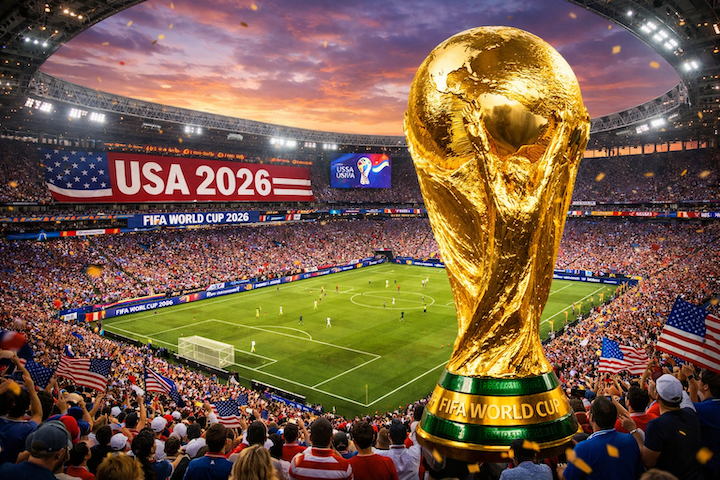
For the first time ever, 48 national teams will compete across 16 host cities:
United States (11): Atlanta, Boston, Dallas, Houston, Kansas City, Los Angeles, Miami, New York/New Jersey, Philadelphia, San Francisco/Bay Area, Seattle
Canada (2): Toronto, Vancouver
Mexico (3): Guadalajara, Mexico City, Monterrey
The scale is enormous—millions of fans traveling across borders—creating a security and operational challenge unlike anything the U.S. Department of Homeland Security and FIFA have ever managed. For context, the 1994 World Cup held in the U.S. drew nearly 3.6 million spectators. In 2026, attendance is projected to hit five to six million or more.
A massive undertaking, to say the least.
Traveling to the Games: The Visa Question
The tournament draw and opening ceremony celebrations have already begun in Washington, D.C., and soccer lovers everywhere are buzzing with excitement. If you want to see the action live—feel the stadium shake, cheer with thousands, smile or cry with every goal—there’s only one way: get a visa to the U.S., Canada, or Mexico.
Along the way, fans can visit different cities and reconnect with family and friends abroad. Of course, some may prefer to stay home with a cold beer, shout at the TV, and curse whenever the ball bounces off the crossbar. But here’s a bonus for American fans: the time zones across the U.S. only range three hours apart, which means no late-night games like previous World Cups.
For retirees living in the U.S., traveling to Canada or Mexico is relatively simple—just a valid passport will do. But tickets? That’s another story. Official prices start around $60 for basic seating and soar to about $6,000 for the final match. On the resale market—expect far higher.
Then there’s the matter of health. Penalty shootouts are not for the faint-hearted—especially those managing high blood pressure, cholesterol, diabetes, or joint pain. The thrill may be worth it, but it’s strong medicine.
Many seniors today certainly remember the 1994 World Cup in the United States — back when everyone was still young, energized, and strong as ever. Some may have even been among the lucky fans who sat inside the Rose Bowl Stadium in Pasadena on July 17, 1994, witnessing the dramatic final between Brazil and Italy.
After 90 minutes of regulation and extra time with no goals scored, the match had to be decided by penalty kicks. Brazil sank four shots and missed one; Italy took five but missed three — giving Brazil the 3–2 victory. It’s impossible to fully describe those intense, heart-pounding moments as each team stepped up to the penalty spot, one after another, with the whole world holding its breath.
Now, 32 years later, who knows — we might see a thrilling déjà vu in 2026. But of course, after decades of hard work, responsibilities, and taking care of family, our once-mighty youthful stamina isn’t quite what it used to be. So we must be practical — or as the saying goes, “cut the cloth according to the coat.”
If we don’t go, we’ll probably regret it. But if we do go, it’s quite a journey — traveling across the U.S., Mexico, and Canada — not to mention the financial cost, which can be a real burden for those living on a modest retirement income. Yes, a credit card may get you through any gate with a simple swipe — but paying off that balance later is the real headache, a tough pill to swallow.
A key requirement when applying for a U.S. visa is submitting your social media history from the past five years, along with detailed personal background information. In recent years, individuals with ties to terrorism, criminal gangs, or extremist organizations were allowed into the U.S. without thorough vetting, leading to incidents of armed robberies and shootings that jeopardized public safety. Because of that, soccer fans traveling to the World Cup must present a “clean” record — free from criminal conduct or any association with drugs, terrorism, or extremist ideologies. Especially disqualifying are anti-Semitic views or hostile political stances against the current administration in Washington, D.C.
Whether you come from a visa-required country or a Visa Waiver Program country, everyone must meet the same security standards. Those from visa-exempt countries can simply complete the online application and receive an electronic visa (e-visa) without attending an interview at a U.S. consulate.
Some may argue that political views are private matters and unrelated to soccer — so why screen for them? But if the White House demands it, and it becomes official policy, then there is no way around it.
In short, if you clear this visa hurdle, 99.9% of the process is done. The rest is just the financial challenge. Unfortunately, fans from countries like Laos, Myanmar, or Cuba may not be so lucky — they will most likely end up cheering from home in front of the TV. The new “Chief of Security” in the U.S. has recently ordered entry restrictions on travelers from 39 countries. However, once a fan is approved for the 2026 World Cup, chances are high they’ll also be welcome back for the 2028 Olympics in Los Angeles.
How Can We Truly Know a Person?
U.S. security agencies work tirelessly to identify dangerous individuals, but human nature — what someone thinks or hides inside — is not always visible. Take the 9/11 attacks as an example: 19 extremists with legal U.S. visas — business, tourist, and student visas — hijacked four commercial aircraft. Two brought down the Twin Towers of the World Trade Center, one destroyed a wing of the Pentagon, and the fourth, Flight 93, crashed into a field in Pennsylvania after passengers fought back, killing everyone onboard. These attackers had terrorism training, but back then U.S. immigration authorities failed to detect the threat, compounded by poor coordination among security agencies.
More recently, the gunman responsible for killing two students and injuring nine others at Brown University in Rhode Island — and a professor at MIT — was of Portuguese origin. He entered the U.S. on a student visa and later obtained permanent residency through the green card lottery program.
In short, Vietnamese from abroad traveling to the U.S. will suddenly become Việt kiều from France, Germany, Japan, Vietnam, and beyond — sitting side-by-side with Vietnamese-Americans, passionately debating soccer and “bóng tròn” with no clear winner. Soon Los Angeles, Bolsa, San Francisco, Houston, Seattle, and more will be filled with different Vietnamese accents, expressions, and slang that may sound unfamiliar or confusing to locals.
Hopefully, those differences remain harmless — confined to friendly teasing over food and drinks — while everyone’s hearts beat together for the World Cup.
The World Cup Final will take place at MetLife Stadium in East Rutherford, New Jersey, on Sunday, July 19, 2026.
Vietnamese fans attending should avoid waving flags or wearing politically charged colors that could cause unnecessary confrontations. Authorities can and will remove disruptive spectators—even deport them if needed.
Tickets, from basic to VIP hospitality packages, are already available at:
https://www.fifa.com/en/tickets
– Đức Hà- Written exclusively for HuuTri.org