
On February 3, 1913, the Sixteenth Amendment to the U.S. Constitution was ratified, giving Congress the explicit power to levy income taxes on individuals and corporations without apportioning tax burdens among the states. Before this amendment, direct federal taxes were rare and legally contentious. The 16th Amendment changed everything.
“The Congress shall have power to lay and collect taxes on incomes, from whatever source derived, without apportionment among the several States…”
— Text of the 16th Amendment
This shift established the modern income tax system — the backbone of federal revenue for more than a century.
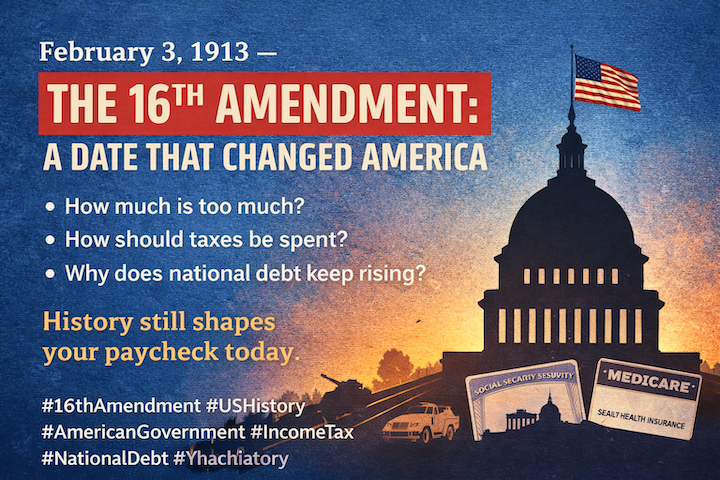
Why the 16th Amendment Matters Today
In the 112 years since ratification, the federal income tax has reshaped what the U.S. government can and cannot do. In essence, it made the modern federal government possible.
From a Small Government to a Giant Institution
Prior to 1913, the U.S. government relied primarily on tariffs, excise taxes, and land sales. Federal spending was limited, military engagements were smaller, and social programs were virtually non-existent. After the 16th Amendment:
- The federal government gained stable revenue capable of supporting large standing institutions.
- Progressive taxation allowed the government to scale spending according to national priorities (wars, infrastructure, social programs, etc.).
- Social safety nets like Social Security (1935), Medicare (1965), and other entitlement programs became possible because income tax revenue was steady and reliable.
Without this amendment, the United States would not have the modern governmental footprint it has today — from national defense to disaster relief to public health.
Pros and Cons: Government vs. Taxpayers
A century of income taxation has yielded both positive impacts and serious debates.
Pros for Government
- Stable and flexible revenue source: Allows long-term budget planning.
- Progressive taxation: Higher earners contribute more, enabling redistribution for public benefit.
- Large-scale public services: Infrastructure, education, research, defense, and welfare depend on federal taxes.
Pros for Taxpayers
- Public goods and services: Highways, public safety, scientific research, and health programs.
- Safety nets: Social Security, unemployment insurance, Medicaid/Medicare support millions.
- Economic stabilization: Fiscal policy can buffer recessions via tax policy and spending.
Cons for Government
- Complex bureaucracy: Tax code complexity creates administrative costs and compliance burdens.
- Potential inefficiencies: Programs funded by taxpayer dollars sometimes lack oversight.
Cons for Taxpayers
- High tax burden for many: Progressive rates can feel punitive to certain income groups
- Perceived misuse of funds: Controversies over “wasteful” spending generate distrust.
- Compliance complexity: Millions of Americans pay accountants just to file.
How Tax Dollars Have Been Used Over the Decades
After the 16th Amendment, the federal income tax became the engine of modern governance:
1910s-1940s
- World War I & II dramatically increased deficits and required large tax revenues.
- Infrastructure and economic mobilization.
1950s-1970s
- Expansion of social programs and scientific funding (NASA, education).
- Cold War military buildup.
1980s-1990s
- Tax rate reforms under Presidents Reagan, George H.W. Bush, and Clinton.
- Budget surpluses in late 1990s.
2000s-2010s
- War spending (Afghanistan/Iraq), tax cuts, financial crisis of 2008 increased deficits.
- Growth of entitlement spending (Medicare/Medicaid).
2020s
- COVID-19 relief spending, rising healthcare costs, and demographic shifts increase fiscal pressures.
Tax revenue has been crucial for national defense, public health, disaster response, education, research, and social security systems.
Controversies: Abuse and Misuse of Taxpayer Dollars
The question of waste, fraud, abuse, and inefficiency has been central to political debates:
- Earmarks and pork-barrel spending: Members of Congress have been criticized for directing funds to pet projects with dubious public benefit.
- Defense spending overruns: Cost overruns on major systems, weapons, and projects have angered taxpayers.
- Corporate subsidies: Critics say some tax dollars subsidize already profitable industries without sufficient public return.
- Mismanagement and lack of oversight: Government Accountability Office (GAO) regularly reports billions in improper payments.
These controversies fuel calls for tax reform, spending discipline, and transparent budgeting.
Why Does the U.S. Still Have Massive National Debt?
If taxes fund government, why the debt?
Key Reasons
- Outlays exceed revenues: Even today, federal spending (on entitlements, defense, interest on debt) often outpaces tax collections.
- Mandatory programs: Social Security, Medicare, and Medicaid obligations grow faster than tax revenues due to aging demographics.
- Economic cycles: Recessions reduce tax revenue while increasing spending on safety nets.
- Tax cuts without offsets: Major tax cuts (e.g., 1980s, 2000s, 2017) reduced revenues without equivalent cuts in spending.
- Interest on existing debt: The government must pay interest, which adds to the deficit if not fully covered.
The result: U.S. public debt has climbed into the tens of trillions of dollars — not because income tax failed, but because spending commitments continually grew faster than revenue.
A Legacy Still Being Written
The ratification of the 16th Amendment fundamentally changed the United States. It made possible a federal government capable of large-scale action, from world wars to social safety nets. It also introduced enduring tensions between taxation, spending, public needs, and individual liberty.
Modern debates — over tax rates, government waste, national debt, and fiscal responsibility — reflect the ongoing challenge of balancing a powerful, service-oriented government with the taxpayers who fund it.
-Phan Trần Hương-