
It’s hard to say what things look like outside other countries’ diplomatic offices, but if you’ve seen videos or photos taken outside the U.S. Consulate General in Saigon, one thing is clear: every single day, long lines of people slowly move forward, step by step, toward the security gate.
They are there to submit visa applications, attend interviews, or—if fortunate—receive approval to travel to the United States. Some come for tourism, others through family sponsorship, all chasing what many still call the “American Dream” when they finally set foot on this promised land.
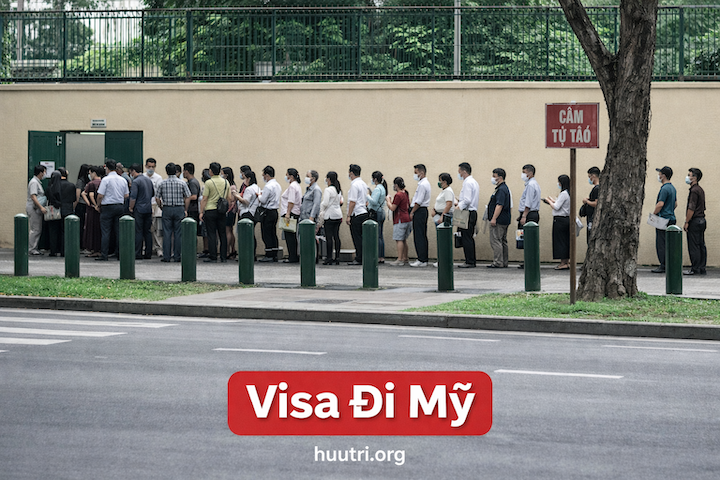 Regardless of whether they are applying, interviewing, getting approved, or even denied, Vietnamese applicants today are still considered more fortunate than citizens of many other countries. There’s no easy explanation for this—it’s simply the current reality of U.S. visa access.
It’s also worth noting that today’s U.S. Consulate in Saigon stands on the same grounds as the former U.S. Embassy on Thống Nhất Street before 1975.
Visa Costs
According to the U.S. Department of State, the application fee for a U.S. tourist visa (B1/B2) is $185. There is also a potential additional charge of $250, known as the Visa Integrity and Border Security Fee, though it has not yet been implemented.
Beyond that, applicants may face additional expenses such as medical exams, vaccinations, and fees paid to organizations like the International Organization for Migration (IOM).
In short, visiting the U.S.—even just to see family—can be quite expensive. That said, many in Vietnam today are financially well-off, sometimes even more so than overseas Vietnamese. Evidence of this can be seen in the number of travelers flying to Las Vegas for entertainment shows, or families taking weekend shopping trips to Singapore or Hong Kong. Hawaii, too, regularly welcomes visitors from Vietnam for beach vacations.
Visa Bond Requirement
At present, Vietnamese travelers do not face major obstacles when applying for U.S. tourist visas—unlike neighboring Cambodia.
In Cambodia’s case, travelers are now required to pay a $15,000 Visa Bond, which is refunded only if they leave the U.S. on time. Similar policies have been introduced for countries such as Ethiopia, Georgia, Grenada, Lesotho, Mauritius, Mongolia, Mozambique, Nicaragua, Papua New Guinea, Seychelles, and Tunisia, effective April 2.
According to U.S. State Department officials, the Visa Bond program has proven highly effective, reducing visa overstays significantly. Statistics show that 97% of travelers return home as scheduled.
This policy also helps reduce costs for U.S. taxpayers. Tracking, detaining, and deporting individuals who overstay visas can cost an average of $18,000 per person, totaling up to $800 million annually.
Still, that remaining 3% reflects individuals who knowingly take the risk—traveling to the U.S. with the intention of staying illegally. If caught and deported, some may even face detention in third countries, regardless of their nationality.
Countries Under Visa Bond Programs
In addition to the 12 newly listed countries, another 38 countries were previously announced in January 2026 as subject to the Visa Bond requirement. These include nations across Africa, Asia, the Caribbean, and beyond.
Meanwhile, travelers from countries in the Visa Waiver Program (VWP) can enter the U.S. without a visa—but if they have previously visited countries such as Cuba, Iran, Iraq, North Korea, Sudan, Syria, or Yemen, they lose that privilege and must apply for a visa like everyone else.
Travel Restrictions
Interestingly, Iran does not appear on the Visa Bond list, despite ongoing geopolitical tensions. That’s because Iran—and several other countries including Afghanistan, Myanmar, Libya, Somalia, Syria, and Yemen—are under full travel bans, meaning their citizens are generally not allowed entry into the U.S. for any reason.
In special cases, individuals must apply through third countries, such as Turkey. For example, even if a Vietnamese citizen later acquires Iranian citizenship, they would effectively lose access to U.S. visas altogether.
Nearby Laos is also subject to restrictions, while immigrant visa processing for Thai citizens has reportedly been paused.
Non-Tourist Visas & “Service Brokers”
For non-tourist visas—such as family sponsorship, student visas, work visas, or medical travel—the total cost can exceed $4,000, not including travel expenses, accommodation, or unofficial service fees.
So-called “visa brokers” often promise 100% approval, but if an applicant is denied, there is little they can do—leaving applicants with financial losses and no results.
The “Golden Card” Program
The current administration has also introduced a “Golden Card” immigration program, allowing individuals or families to bypass lengthy processes.
The requirement? A direct contribution of $1–2 million to the U.S. Treasury, non-refundable.
Reports claim that over 700,000 applications were submitted when the program launched, generating more than $1.3 billion in funds—though these figures remain unverified.
Voluntary Departure Program
Alongside entry policies, the U.S. government has also implemented structured exit programs.
Individuals who previously entered the U.S. illegally—particularly through migrant caravans from South America, Mexico, or Canada—can now voluntarily return to their home countries.
Through the U.S. Customs and Border Protection (CBP) system, participants receive:
- $2,600 cash assistance
- A free one-way plane ticket
The process is handled through a mobile app, making it relatively straightforward.
Giving Up U.S. Citizenship
For those who already hold U.S. citizenship but decide to leave permanently, the process has recently become more affordable.
Previously, the fee to renounce citizenship was $2,350. It has now been reduced by about 80% to $450—perhaps to make the process more accessible for those who choose to return home.
-Đức Hà-
Exclusive for Huutri.org
Final Note
For the most accurate and up-to-date information on visa policies, applicants should consult directly with local U.S. consulates or visit the official U.S. Department of State website.