
The 2026 FIFA World Cup has arrived at a dream final: defending champion Argentina against European champion Spain.
Although the question was originally what it would take for these teams to reach the final, they have now done it. Argentina defeated England 2–1 in a dramatic semifinal comeback, while Spain eliminated France 2–0. They meet Sunday, July 19, at 3:00 p.m. Eastern Time at New York New Jersey Stadium in East Rutherford—the home of the NFL’s Giants and Jets. Match information
This is much more than Lionel Messi against Lamine Yamal. It is a fascinating confrontation between two nations that share a language and centuries of history—but developed very different soccer identities.
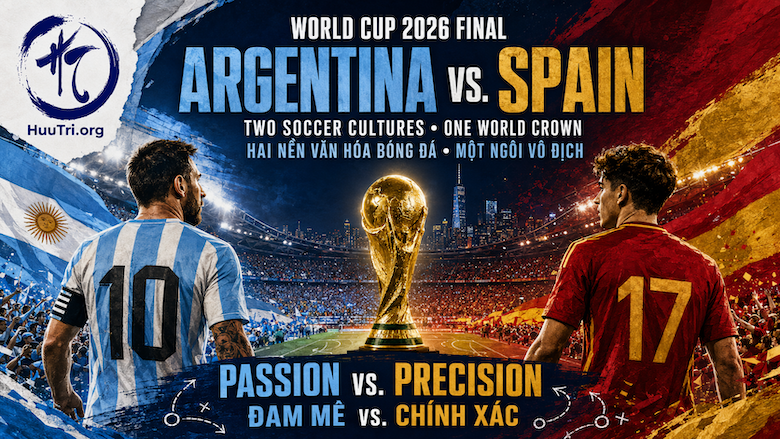 Argentina: Soccer as emotion, identity and survival
In Argentina, soccer is not simply entertainment. It is a language through which people express neighborhood loyalty, family history, national pride and, sometimes, heartbreak.
The sport was introduced during the late 19th century, largely through British immigrants, railway workers and schools. But Argentina quickly transformed the imported game into something distinctly Argentine.
Its soccer culture grew from the barrios—working-class neighborhoods where children learned to play in streets and improvised fields known as potreros. These small, uneven spaces rewarded balance, imagination and the ability to escape several defenders with the ball.
That tradition helped create the Argentine concept of the gambeta: the daring, unpredictable dribble associated with Diego Maradona and Lionel Messi.
The Albiceleste legacy
Argentina’s national team is called La Albiceleste, referring to the white and sky-blue colors of its uniform and national flag.
Before the 2026 final, Argentina had won three World Cups:
- 1978, led by Mario Kempes on home soil
- 1986, inspired by Diego Maradona
- 2022, led by Lionel Messi
Argentina also entered this tournament as the 2024 Copa América champion. It has won that competition a record 16 times and has appeared in seven World Cup finals, counting 2026. Argentina team history
Each Argentine championship became associated with a national hero. Kempes represented power and determination. Maradona became a symbol of rebellion and working-class pride. Messi represents persistence—the quiet genius who endured years of criticism before finally delivering the World Cup in 2022.
Argentina’s soccer personality
Argentina traditionally combines:
- Creative individual skill
- Tactical flexibility
- Aggressive, emotionally intense defending
- Psychological resilience
- A willingness to suffer without surrendering
Its players often describe the national team as a family. That unity has been one of coach Lionel Scaloni’s greatest achievements.
Argentina’s semifinal against England captured that personality perfectly. After falling behind, Enzo Fernández equalized in the 85th minute. Substitute Lautaro Martínez then headed home Messi’s cross in stoppage time to complete a 2–1 comeback. Semifinal report
Argentina did not merely outplay England. It outlasted it emotionally.
Spain: From beautiful possession to modern attacking football
Spain’s soccer identity is shaped by a different environment.
The country possesses powerful regional traditions—Catalan, Basque, Andalusian, Galician and Castilian—and historically, supporters often identified more strongly with clubs such as Real Madrid, Barcelona and Athletic Bilbao than with the national team.
Spain had brilliant players for generations but repeatedly disappointed at major tournaments. The national team acquired a reputation for playing attractive soccer without surviving the pressure of knockout matches.
That changed between 2008 and 2012.
The golden generation
With players such as Xavi Hernández, Andrés Iniesta, Iker Casillas, Sergio Ramos, Xabi Alonso and David Villa, Spain won:
- UEFA Euro 2008
- The 2010 FIFA World Cup
- UEFA Euro 2012
No European men’s national team had previously won three consecutive major championships.
The team became famous for tiki-taka: short passing, constant movement, positional intelligence and patient control of possession. Spain’s 2010 World Cup victory, sealed by Iniesta’s extra-time goal against the Netherlands, remains its only previous world championship.
But the modern Spanish team is not simply a copy of 2010.
A more direct version of La Roja
Today’s Spain—known as La Roja, “The Red”—still values possession, but it plays faster and more vertically.
Its current identity includes:
- High pressing immediately after losing the ball
- Quick passing triangles
- Wingers stretching the field
- Midfielders arriving late in the penalty area
- Greater speed and directness than the 2010 team
Captain Rodri provides control and tactical balance. Around him, Spain combines technically gifted midfielders with explosive wide players, particularly Lamine Yamal.
Spain enters the final on a remarkable 37-match unbeaten run in regulation and extra time, tying one of the longest such runs in international soccer. During its recent rise, Spain won the 2023 Nations League and Euro 2024. Final preview and unbeaten run
What it took to reach the final
The expanded 48-team World Cup required both finalists to survive eight matches instead of the seven played by finalists under the previous format.
| Requirement | Argentina | Spain |
|---|---|---|
| Group stage | Manage expectations as defending champion | Establish possession and pressing rhythm |
| Early knockout rounds | Protect Messi while maintaining midfield balance | Break down teams defending in compact formations |
| Quarterfinal | Survive pressure and manage decisive moments | Defeat Belgium 2–1 |
| Semifinal | Come from behind to defeat England 2–1 | Control France and win 2–0 |
| Defining quality | Emotional resilience | Tactical control |
Argentina’s journey depended on experience, substitutions and the belief that a match is never finished. Spain’s depended on depth, defensive organization and its ability to control both the ball and the geography of the field.
The matchup that could decide the final
1. Spain’s press against Argentina’s experience
Spain will try to recover the ball within seconds of losing it. If Argentina’s midfield becomes trapped near its own penalty area, Spain can dominate possession and create repeated attacks.
But pressing Messi is dangerous. One successful pass through Spain’s first defensive line could leave him facing open space.
2. Rodri’s positioning against Messi
Rodri may have the most difficult tactical assignment on the field. He must control the midfield while closing the spaces where Messi receives the ball.
Messi no longer spends every minute running at defenders. Instead, he walks, observes and waits for the defense to lose its shape. Then he appears in the one area Spain has temporarily forgotten.
3. Lamine Yamal against Argentina’s left side
Yamal can hold the width, draw multiple defenders and create room for teammates making central runs. Argentina must decide whether to double-team him—which opens space elsewhere—or trust one defender against one of the world’s most unpredictable young attackers.
4. The substitutes
Both semifinals demonstrated the importance of squad depth. Lautaro Martínez changed Argentina’s match from the bench. Spain can introduce technically gifted players without abandoning its system.
In a final shaped by summer heat, hydration breaks and possibly extra time, the strongest bench may become more important than the starting lineup.
Messi vs. Yamal: The irresistible storyline
Messi is 39. Yamal is 19.
One represents the closing chapter of an extraordinary career; the other may be beginning a new era.
The connection is almost cinematic. When Yamal was a baby, Messi posed with him during a charity calendar photoshoot in Barcelona. Nearly two decades later, they will face each other in a World Cup final.
Yamal was born in Spain to a Moroccan father and an Equatorial Guinean mother. His rise from the diverse working-class neighborhood of Rocafonda has made him a symbol of modern, multicultural Spain. Yamal’s story
For American fans, it resembles a sporting movie: the established legend facing the young prodigy who once admired him.
Fun facts for fans
- Argentina is attempting to become the first nation since Brazil in 1962 to win consecutive men’s World Cups.
- Spain could become only the sixth country to win the men’s World Cup more than once.
- The two countries share deep historical connections. Millions of Argentines have Spanish ancestry, and Messi spent most of his club career in Spain with Barcelona.
- Argentina’s supporters are famous for cábalas—superstitious rituals involving clothing, food, seating arrangements or the location where they watch matches.
- Argentina President Javier Milei reportedly plans to watch the final from the same residence and wear the same jacket he associated with the team’s previous victories.
- The semifinal between Argentina and England averaged more than 15 million English-language viewers in the United States and peaked above 22 million—evidence of the tournament’s extraordinary American reach. U.S. audience figures
- For the first time, the World Cup winner will receive personalized American-style championship rings in addition to medals and the trophy. Championship-ring announcement
- The final is also expected to feature the first major halftime entertainment show in World Cup history—another unmistakably American influence.
Why U.S. fans may feel divided
American fans without a direct connection to either nation may choose their side according to personality.
Root for Argentina if you love:
- Messi and the possibility of a legendary farewell
- Emotional comebacks
- Underdog spirit, even from a defending champion
- Fans who treat every match like a matter of national destiny
Root for Spain if you love:
- Fast, technically precise team soccer
- Youth and multicultural identity
- High pressing and midfield control
- The beginning of a new generation
The final should also resonate strongly with Spanish-speaking communities throughout the United States. Argentina represents the passionate South American tradition, while Spain represents the European origin of the language and a new multicultural generation.
Prediction: Spain 2–1 Argentina after extra time
My analytical prediction gives Spain a narrow advantage—approximately 55% to 45%.
Spain has been the more consistently balanced team. Its press, midfield control, defensive record and 37-match unbeaten run suggest that it can dictate long stretches of the final. Argentina has occasionally allowed opponents too much space in midfield, precisely where Spain is strongest.
However, the numbers cannot fully measure Argentina’s greatest advantages: Messi, goalkeeper Emiliano Martínez, Scaloni’s substitutions and the team’s extraordinary emotional durability.
The likely pattern is Spain controlling more possession while Argentina creates fewer—but potentially more dangerous—chances. If Spain scores first and continues attacking, it should win. If the match reaches a penalty shootout, Argentina’s experience and Emiliano Martínez’s intimidating presence could reverse the advantage.
Final prediction: Spain 2–1 Argentina after extra time.
But there is an equally compelling alternative ending: Messi creates one final moment of genius, Argentina survives on penalties, and the greatest player of his generation leaves the World Cup with consecutive championships.
Either outcome would produce a fitting conclusion—one team completing a dynasty, the other announcing the arrival of a new era.
-Lê Nguyên Vũ-