
In the heart of Hanoi, only a short walk from Hoàn Kiếm Lake and the maze of streets that form the Old Quarter, two weathered Gothic towers rise unexpectedly above the city.
This is St. Joseph’s Cathedral of Hanoi — Nhà Thờ Lớn Hà Nội.
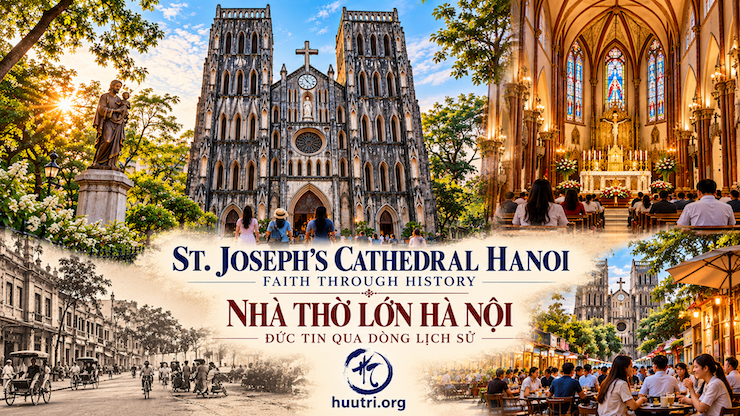 To a first-time visitor, the cathedral may appear to be a beautiful remnant of French colonial Hanoi. To Vietnamese Catholics, however, it represents something much deeper: generations of faith, hardship, survival and renewal.
And to understand Hanoi itself, the cathedral cannot be viewed only as a church.
Its story touches Buddhism and Catholicism, the ancient capital of Thăng Long, French colonial rule, the wars of the 20th century, the great migration of 1954, decades of political and religious change, and finally the emergence of modern Hanoi.
It is, in many ways, a building where several chapters of Vietnamese history meet.
Before the Cathedral: The Sacred Ground of Thăng Long
Long before the bells of St. Joseph’s Cathedral rang across Hanoi, this area was associated with one of the great Buddhist landmarks of medieval Thăng Long.
In 1057, during the reign of Emperor Lý Thánh Tông, the Báo Thiên Tower was erected as part of a major Buddhist religious complex. Historical accounts remember the tower as one of the celebrated treasures of Đại Việt. Over subsequent centuries, however, warfare, storms, destruction and political upheaval severely damaged the complex, and the great tower eventually disappeared.
That earlier history matters.
St. Joseph’s Cathedral therefore occupies ground that had already carried religious and cultural significance for centuries before Catholicism became firmly established in Hanoi.
The transition from the remnants of a Buddhist complex to a Catholic cathedral also reflects one of the more complicated chapters of Vietnamese history. The cathedral arose during the expansion of French colonial power, and its construction cannot be separated entirely from that political environment.
Rather than hiding that complexity, it makes the cathedral’s story more meaningful. The site illustrates how Hanoi has repeatedly changed while preserving layers of its past.
Catholicism Comes to Vietnam
Christianity did not arrive in Vietnam with the construction of St. Joseph’s Cathedral.
Catholic missionaries had been active in Vietnam for centuries before the French colonial period. By the 17th century, substantial Catholic communities had developed in northern Vietnam, particularly throughout the Red River Delta.
Over generations, Vietnamese Catholicism gradually developed its own identity.
Although the religion originated outside Vietnam, its congregations increasingly consisted of Vietnamese families, Vietnamese priests, catechists and religious communities. Catholicism became part of the country’s religious landscape long before St. Joseph’s Cathedral appeared on Hanoi’s skyline.
Saint Joseph also acquired particular importance in Vietnamese Catholic tradition. Church and Vietnamese tourism sources record that Pope Innocent XI designated Saint Joseph as a patron of the missions in this region in 1678. The future Hanoi cathedral would consequently bear his name.
Building a Cathedral in Hanoi
The modern cathedral emerged during a period of enormous political transformation.
Following the expansion of French control over Hanoi in the late 19th century, Bishop Paul-François Puginier, Apostolic Vicar of Western Tonkin, oversaw the construction of a permanent cathedral.
Construction took place primarily during the 1880s, with the present church completed in 1886 and consecrated at Christmas. Sources differ slightly over the precise construction dates and whether later inauguration celebrations should be dated to 1886 or 1887, but the cathedral standing today essentially dates from this period.
The church was dedicated to Saint Joseph — Thánh Giuse.
As Catholic institutions developed around it, the area became known as Nhà Chung, literally associated with the church or ecclesiastical community. Nearby institutions eventually included the archbishop’s residence, religious communities and seminaries.
In 1924, when the Apostolic Vicariate was renamed for Hanoi and its ecclesiastical center was established there, St. Joseph’s became the cathedral church of the Catholic jurisdiction centered on the capital.
Its importance was no longer merely architectural.
It had become the spiritual center of Catholic Hanoi.
A Piece of Medieval Europe in Tropical Hanoi
Architecturally, St. Joseph’s Cathedral is one of Hanoi’s most recognizable examples of Gothic Revival, or Neo-Gothic, architecture.
Its façade is dominated by two tall square bell towers flanking a central entrance. Pointed arches, elongated windows, vaulted spaces and vertical architectural lines draw the eye upward — characteristic elements inherited from European Gothic church architecture.
Vietnam’s National Authority of Tourism describes its design as modeled after the Gothic tradition associated with Notre-Dame de Paris.
Yet after more than a century beneath Hanoi’s tropical sun, monsoon rain, humidity and pollution, the cathedral no longer looks like a newly transplanted European building.
Its darkened walls and aged façade have become part of its character.
The cathedral now feels strangely indigenous to the streets surrounding it.
Motorbikes pass beneath its towers. Vendors prepare food nearby. Young Hanoians gather around cafés drinking trà chanh. Wedding couples pose for photographs on the plaza while worshippers quietly enter for Mass.
The European architecture has become part of a distinctly Vietnamese urban scene.
Faith Before the Wars
By the early 20th century, the Catholic community surrounding the cathedral had become substantial.
According to the Archdiocese of Hanoi, by 1892 Hanoi had 13 parishes with roughly 49,000 Catholics, while the cathedral parish itself numbered approximately 3,000. By 1940, the cathedral parish reportedly operated seven schools and served more than 8,000 Catholics.
The cathedral was therefore far more than a Sunday worship space.
It belonged to an ecosystem of schools, religious formation, charitable activities, clergy, religious orders and Catholic families.
Then came decades of war.
War, Revolution and the Great Turning Point of 1954
Vietnam endured almost continuous upheaval through much of the middle of the 20th century: Japanese occupation, the August Revolution, the First Indochina War and eventually the division of the country following the 1954 Geneva Accords.
For northern Vietnamese Catholics, 1954 was transformative.
Large numbers of Catholics left North Vietnam during the migration that followed partition, moving south along with priests, religious communities and other northerners.
The Archdiocese of Hanoi describes the period as one of profound disruption. The number of clergy serving the archdiocese fell dramatically, and institutions responsible for training priests were also affected.
Yet not everyone left.
Catholic communities remained throughout Hanoi and northern Vietnam.
For those who stayed, churches such as St. Joseph’s acquired another layer of meaning.
They represented continuity.
Families continued passing their faith from parents to children under very different political and social circumstances from those that had existed before 1954.
A Cathedral Through the Vietnam War
The decades that followed were difficult for organized religious life in North Vietnam.
Church institutions faced significant restrictions, clergy numbers declined sharply, properties and religious activities came under state control, and Catholic institutional life became much more limited than it had been before partition. Historical Catholic accounts describe arrests, property seizures and tight restrictions during portions of this period.
At the same time, Hanoi itself lived through war.
During the American war years, air raids and bombing transformed daily life in the capital. Yet the cathedral survived the conflict and remained standing even as Hanoi underwent extraordinary hardship. Vietnam’s Government Committee for Religious Affairs notes the cathedral’s survival through the destructive wars affecting the city.
Its two towers therefore became silent witnesses to one of the most turbulent periods in modern Vietnamese history.
Renewal
The situation gradually changed in the later decades of the 20th century.
Religious activities became increasingly visible again, particularly during the period of economic and social reform associated with Đổi Mới.
By the 1990s, the cathedral had re-emerged prominently as a center of public Catholic worship. Christmas celebrations, Holy Week, Easter, weddings, ordinations and ordinary Sunday Masses once again brought large congregations into the cathedral and surrounding streets.
Today St. Joseph’s remains the cathedral of the Roman Catholic Archdiocese of Hanoi.
On important feast days, the building itself may not be large enough to contain everyone attending. Worshippers can gather outside the doors and across the plaza while the sound of hymns and prayers carries into the surrounding streets.
The scene is remarkably different from the cathedral’s quieter periods in the 20th century.
What St. Joseph’s Means to Catholics of Northern Vietnam
For many northern Vietnamese Catholics, Nhà Thờ Lớn represents more than ecclesiastical authority.
It represents continuity of faith.
The Catholic communities of northern Vietnam have lived through imperial rule, colonialism, anti-colonial revolution, partition, migration, war, political restrictions, economic hardship and modernization.
The cathedral survived alongside them.
That is why an elderly Catholic entering St. Joseph’s may experience the building very differently from a tourist photographing its façade.
One sees architecture.
The other may see family history.
A grandparent may have prayed there before 1954. A relative may have left Hanoi for the South. Another family member may have remained in the North. Baptisms, marriages, funerals and Christmas celebrations connected generations to the same faith even when Vietnamese history separated families geographically and politically.
In that sense, the cathedral is not merely made of brick and stone.
It is also made of memory.
From Colonial Monument to Vietnamese Institution
There is another important distinction.
St. Joseph’s Cathedral was constructed during French colonial expansion, but Vietnamese Catholicism should not simply be equated with French colonialism.
The two histories intersect, but they are not identical.
Catholic communities existed in Vietnam well before France established colonial control, and Vietnamese Catholics experienced the same wars, political transformations, migrations and hardships that shaped the broader population.
Over generations, the cathedral itself also underwent a transformation of meaning.
A building constructed under colonial conditions gradually became the spiritual home of Vietnamese clergy and Vietnamese congregations.
Today prayers are spoken in Vietnamese.
Vietnamese hymns fill the nave.
Vietnamese priests celebrate Mass before Vietnamese families.
And Vietnamese Catholics commemorate their own saints and martyrs within a worldwide Catholic tradition.
The architecture may be European.
The life inside it is unmistakably Vietnamese.
What the Cathedral Means to Vietnam Today
Modern Hanoi has, in a sense, adopted the cathedral.
One does not have to be Catholic to recognize Nhà Thờ Lớn.
It has become one of the visual symbols of the capital, alongside Hoàn Kiếm Lake, the Old Quarter, Văn Miếu and other historic landmarks.
Perhaps even more interesting is what happens outside its doors.
Young people meet friends beneath its towers. Cafés fill the surrounding streets. Visitors photograph its façade. Catholics attend Mass while non-Catholics sit nearby drinking coffee or trà chanh.
The sacred and secular coexist within a few meters of one another.
That coexistence says something about contemporary Vietnam.
The country contains Buddhist pagodas, Catholic churches, ancestral temples, Protestant congregations, Cao Đài temples, mosques and many other forms of religious practice and cultural memory.
St. Joseph’s Cathedral belongs within that larger mosaic.
A Cathedral That Has Become Part of Hanoi
Walk toward Nhà Thờ Lớn in the early morning and the neighborhood feels almost intimate.
The streets slowly awaken. Bells may sound above the rooftops. Worshippers disappear through the cathedral doors while cafés prepare for another day.
Return at night and everything changes.
Lights illuminate the façade. Young people gather on the plaza. Motorbikes flow through nearby streets. Restaurants and cafés buzz with conversation.
And above everything stand the same two Gothic towers that have watched Hanoi for more than a century.
They have witnessed colonialism and independence.
Migration and separation.
War and peace.
Restrictions and religious renewal.
Old Hanoi and a rapidly modernizing capital.
Perhaps that is the greatest significance of St. Joseph’s Cathedral.
It began as a cathedral built during a colonial era, but history did not leave it there.
Vietnamese Catholics made it their spiritual home. Hanoi incorporated it into the identity of the city. Generations grew up beneath its bells.
Today, St. Joseph’s Cathedral is simultaneously a Catholic sanctuary, an architectural landmark, a witness to difficult history and a living piece of Vietnamese culture.
For travelers, it is worth seeing.
For historians, it is worth studying.
And for generations of Vietnamese Catholics — particularly those whose families trace their faith to northern Vietnam — Nhà Thờ Lớn Hà Nội is a reminder that buildings can survive political systems and wars, but faith and memory are carried forward by people.
-Lê Nguyễn Thanh Phương-