
A personal scandal involving one of the world’s most influential technology executives has escalated into a potential national security crisis.
Jensen Huang, the 63-year-old Taiwanese-born American billionaire and co-founder and CEO of NVIDIA, has acknowledged an extramarital affair amid reports that the woman involved was identified by U.S. intelligence as an asset working for China’s intelligence services.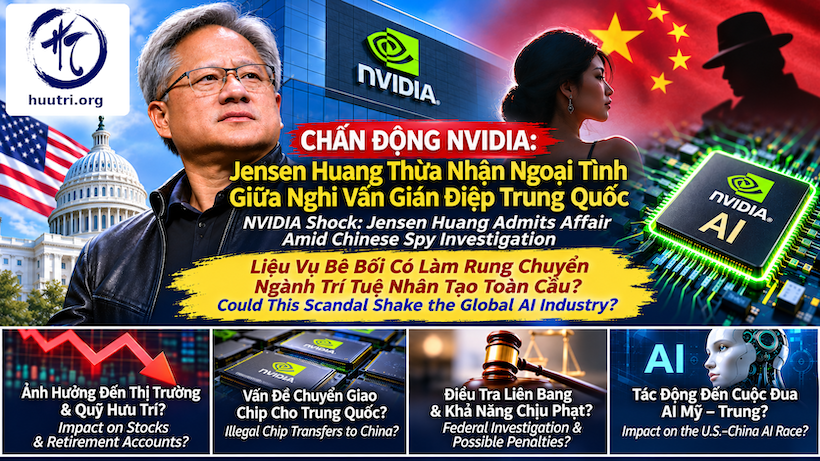
On November 8, NVIDIA’s board of directors announced an independent investigation into reports that Huang had been targeted by a foreign intelligence operation. The controversy raises questions extending far beyond his personal conduct: Could Chinese intelligence have gained access to sensitive American AI technology, corporate information, or decisions concerning advanced semiconductor exports?
And what would happen to NVIDIA, the American technology industry, and the global AI economy if investigators discovered that restricted chips or confidential information had reached China through improper channels?
An important distinction: Huang has admitted marital infidelity, but there is no publicly established finding that he knowingly cooperated with Chinese intelligence, disclosed classified information, or illegally transferred advanced chips to China. NVIDIA says it currently has no reason to believe national security or its trade secrets were compromised.
- The Affair That Sparked a National Security Investigation
According to reporting by The New York Times, subsequently covered by Reuters and the Associated Press, the woman at the center of the controversy is Alice Huang, a Chinese businesswoman and former executive at Singapore-based data center company Megaspeed.
Alice Huang, who is not related to Jensen Huang, reportedly developed a close relationship with the NVIDIA chief executive. U.S. intelligence officials reportedly assessed that she was working for China’s Ministry of State Security, the country’s principal civilian intelligence agency.
The reported intelligence operation allegedly sought to obtain information about NVIDIA and potentially influence decisions affecting China’s access to advanced American AI chips.
In a November 8 message to NVIDIA employees, Jensen Huang acknowledged being unfaithful to his wife, apologized to his family and colleagues, and accepted responsibility for his conduct.
He also pledged full cooperation with the company’s independent investigation and reaffirmed his commitment to American national security.
The central question is no longer simply whether Huang engaged in an inappropriate relationship. It is whether that relationship created an opportunity for foreign intelligence to obtain sensitive commercial or technological information.
A personal relationship with someone suspected of espionage does not itself establish knowing participation in espionage.
- Who Is Alice Huang, and Why Is Megaspeed Under Scrutiny?
Alice Huang reportedly worked as a television reporter in China before entering the technology business and becoming an executive at Megaspeed.
Megaspeed operates in the AI infrastructure sector, purchasing advanced computing equipment and providing data center services.
According to reporting citing The New York Times, Megaspeed purchased more than $4.8 billion in NVIDIA chips over approximately two years, making it a significant customer in Southeast Asia.
That commercial relationship matters because U.S. authorities have scrutinized whether Megaspeed helped Chinese businesses obtain access to advanced AI computing capabilities despite American export restrictions.
A company can potentially provide Chinese customers access to computing resources through overseas data centers without physically shipping every processor into mainland China. Whether particular transactions violate U.S. law depends on the applicable regulations, end users, destinations, licensing requirements, and other facts.
The investigation therefore involves two distinct questions:
- Did Alice Huang attempt to obtain confidential information or influence Jensen Huang on behalf of Chinese intelligence?
- Did Megaspeed or related businesses improperly facilitate access to restricted NVIDIA technology?
Neither question has been publicly resolved, and evidence of one would not automatically prove the other.
- NVIDIA Launches Independent Investigation as Congress Demands Answers
NVIDIA’s board announced that independent directors, assisted by outside legal counsel, would oversee its inquiry.
The company emphasized that it had no current reason to believe American national security or NVIDIA’s proprietary information had been compromised. Huang will continue serving as CEO during the investigation.
Meanwhile, three Republican congressional committee chairs have requested a closed-door briefing with Huang on November 18, 2026.
The lawmakers are seeking answers about the reported relationship, NVIDIA’s security protocols, and the possibility that foreign intelligence services attempted to influence access to advanced U.S. technology.
President Donald Trump has publicly praised Huang and expressed confidence in his accomplishments, while Secretary of State Marco Rubio declined to discuss the matter publicly.
The congressional inquiry and NVIDIA’s board investigation are significant, but they should not be confused with a public finding of criminal wrongdoing by Huang.
- What If NVIDIA Chips Were Secretly Supplied to China?
This is potentially the most consequential aspect of the controversy.
NVIDIA produces some of the world’s most advanced AI processors, including the H100, H200, Blackwell and newer generations of computing technology. These chips power large AI models, advanced data centers, scientific research and other applications.
They can also support military-relevant computing, intelligence analysis and cybersecurity operations.
However, selling NVIDIA chips to China is not automatically illegal. The United States has imposed different restrictions on different semiconductor models, customers and end uses.
For example, in January 2026, the U.S. Commerce Department adopted a policy allowing certain H200 exports to China to be reviewed individually, subject to licensing and security requirements.
The critical issue is whether chips were transferred in violation of applicable export controls, whether buyers concealed prohibited end users, or whether confidential technology was improperly disclosed.
If investigators establish that restricted processors were knowingly diverted to prohibited Chinese customers, several consequences could follow.
Federal investigations and financial penalties: The Department of Commerce could examine export-control violations. Depending on the evidence, civil penalties, restrictions on export privileges, or criminal proceedings could become possible.
Personal liability for executives: If prosecutors established that senior executives knowingly participated in illegal transfers, individual liability could arise. An executive’s personal relationship with a suspected intelligence operative, however, would not be sufficient by itself to establish criminal responsibility.
Stricter international chip controls: Washington could increase scrutiny of intermediaries, data centers and distributors in Singapore and other countries where American technology is resold or used to provide computing services.
Damage to NVIDIA’s reputation: Customers, shareholders and government agencies could demand more extensive security audits and stronger corporate governance.
The financial and legal implications would depend heavily on what was transferred, who authorized it, and whether the transactions violated the rules in effect at the time.
- How Could the Scandal Shake the $4 Trillion-Plus NVIDIA Empire?
NVIDIA is more than a semiconductor manufacturer. It is a foundational supplier to the modern AI economy.
Its technology is used by companies such as Microsoft, Google, Amazon and Meta to train and operate increasingly sophisticated AI systems.
According to reporting by The Washington Post, NVIDIA’s market valuation exceeds $4.5 trillion, illustrating its extraordinary importance to global investors.
The investigation creates three potential areas of disruption.
Leadership uncertainty
Jensen Huang co-founded NVIDIA in 1993 and has become closely associated with its technological direction, corporate culture and commercial relationships.
If the controversy leads to restrictions on his duties, an extended investigation or an eventual leadership change, investors could reassess the company’s management risk.
That does not mean NVIDIA would suddenly lose its technological advantage. Its engineering teams, patents, software ecosystem and long-term customer contracts would remain valuable.
Nevertheless, Huang’s central role makes leadership uncertainty especially consequential.
Investor confidence and retirement portfolios
Millions of Americans have exposure to NVIDIA, directly through individual shares or indirectly through index funds, mutual funds and retirement accounts.
A prolonged investigation could increase share-price volatility, particularly if it produces new questions about export compliance, financial disclosures or executive oversight.
For older Americans approaching retirement, the concern extends beyond NVIDIA stock itself. Significant price movements in a company of NVIDIA’s size can influence technology-heavy investment portfolios.
Investors should distinguish between a short-term reputational crisis and a lasting deterioration in a company’s earnings or competitive position.
AI infrastructure spending
Major technology companies have committed enormous sums to AI infrastructure.
A serious disruption at NVIDIA could complicate procurement plans for data centers, cloud providers and AI developers.
However, an executive scandal alone would not necessarily interrupt chip production or deliveries. The larger risk would arise if government restrictions, legal proceedings or compliance failures affected NVIDIA’s ability to sell products to important customers.
- Could Competitors Benefit From NVIDIA’s Troubles?
Advanced Micro Devices (AMD)
AMD could benefit if major customers accelerate diversification away from NVIDIA. Its Instinct accelerator products compete in AI computing, although switching platforms involves technical and operational costs.
Google’s custom Tensor Processing Units could become more strategically important as cloud customers evaluate alternatives to NVIDIA-powered infrastructure.
Huawei
Chinese semiconductor developers, including Huawei, could gain additional incentives and government support to expand domestic AI computing capabilities.
Other chip designers, cloud providers and specialized AI infrastructure companies could also benefit from a broader movement toward supplier diversification.
Yet NVIDIA has substantial advantages in software, developer adoption, networking and integrated systems. Competitors cannot necessarily replace those capabilities quickly.
- Three Possible Outcomes for NVIDIA and the AI Industry
The following scenarios are analytical possibilities, not predictions or findings of wrongdoing.
Scenario 1: No security breach established
Limited disruption
Investigators find no evidence that confidential information was compromised or export rules violated.
NVIDIA may still face reputational damage, stronger internal controls and scrutiny of executive conduct, but its commercial operations could continue largely unchanged.
Scenario 2: Compliance failures discovered
Significant disruption
Investigators identify weaknesses in customer screening, transactions or information security, without establishing that Huang knowingly assisted espionage.
Potential consequences include penalties, expanded audits, stricter export controls and increased operating costs.
Scenario 3: Deliberate illegal transfers proven
Severe disruption
Authorities establish that restricted technology or sensitive information was knowingly transferred to prohibited recipients, with involvement by senior personnel.
This could trigger major legal action, executive departures, government restrictions and substantial damage to NVIDIA’s standing with customers and investors.
The third scenario would be the most serious, but there is currently no publicly established evidence that Jensen Huang knowingly engaged in such conduct.
- The Larger Issue: America’s AI Leadership and National Security
The NVIDIA controversy illustrates a difficult challenge confronting the United States.
America wants its semiconductor companies to remain global market leaders, but the government also wants to prevent its most advanced technology from strengthening foreign military and intelligence capabilities.
Those objectives can conflict.
Restricting exports may protect sensitive capabilities, but overly broad restrictions can also reduce American companies’ revenue and encourage foreign competitors to develop alternative technologies.
Allowing more international sales can support American commercial leadership, but may create additional opportunities for diversion through third-party companies.
NVIDIA itself has warned investors that changing export regulations can disrupt supply chains, increase compliance costs and reduce demand for its products.
SEC
The current investigation could intensify debate over whether existing safeguards are adequate, especially when foreign intelligence agencies allegedly target executives who influence corporate strategy and government policy.
It also raises an important corporate governance question: How should companies protect sensitive technology when their most powerful executives maintain extensive international business relationships?
The answer may involve stronger security procedures, independent compliance reviews, and clearer separation between commercial decision-making and access to sensitive information.
- What Should American Investors and Technology Workers Watch Next?
For investors, technology employees and retirees, the most important developments will be the actual findings rather than speculation surrounding Huang’s personal life.
Several developments deserve attention:
- November 18 congressional briefing: Whether lawmakers receive satisfactory explanations about NVIDIA’s security practices and the reported relationship.
- Independent investigation: Whether NVIDIA discloses evidence of information-security breaches or changes to executive oversight.
- Megaspeed transactions: Whether authorities identify prohibited chip diversions, unlawful end users or other export-control violations.
- Federal enforcement: Whether the Commerce Department or Justice Department announces formal action.
- Corporate leadership: Whether Huang remains in full control of NVIDIA and whether the company makes governance changes.
For investors nearing retirement, this is also a reminder of the risks associated with concentrating too much of a portfolio in a single company or technology sector.
Diversification and periodic portfolio reviews can help reduce exposure to unexpected corporate crises.
Conclusion: A Personal Scandal With Potential Global Consequences
Jensen Huang helped transform NVIDIA from a graphics-chip company into one of the most influential businesses in the world.
Today, its technology is central to the global race for artificial intelligence leadership.
His admitted extramarital affair has now become intertwined with allegations of Chinese intelligence activity, concerns about sensitive technology and questions about America’s semiconductor export policies.
But the distinction between allegations and proven misconduct remains essential.
A foreign intelligence service’s attempt to target a powerful executive does not establish that the executive knowingly assisted it. Likewise, the sale of chips to an overseas customer does not automatically establish that those chips were illegally transferred to China.
If investigators ultimately uncover deliberate transfers of restricted technology or sensitive information, the consequences could extend far beyond Jensen Huang and NVIDIA—potentially reshaping American export policy, corporate security practices and the competitive balance of the global AI industry.
Until then, the case remains an unfolding investigation, not a verdict.
For American readers, the central question is whether the country’s most strategically important technology companies have adequate safeguards to protect their innovations while competing in a global marketplace.
HuuTri.org will continue following developments concerning NVIDIA, Jensen Huang, the congressional inquiry and the potential implications for American technology leadership, investors and retirement security.
-Lê Nguyên Vũ-
Sources and further reading
- NVIDIA Board of Directors — Official Statement, November 8, 2026
- Reuters — NVIDIA Investigation and Espionage Allegations
- Associated Press — Huang’s Admission and NVIDIA Board Investigation
- Reuters — Congressional Request for November 18 Briefing
- S. Commerce Department — 2026 Semiconductor Export Licensing Policy
Editorial note: This report separates confirmed statements, allegations attributed to news organizations, and hypothetical industry consequences. Information reflects reporting available on November 8, 2026.