
Could a personal relationship become a weapon in the U.S.–China artificial intelligence rivalry? And could a corporate competitor benefit from a scandal involving the leader of the world’s most strategically important AI chip company?
These are legitimate questions for a geopolitical risk analysis. However, the three scenarios proposed involve serious allegations against identifiable individuals and a company. They must be evaluated as hypotheses, not reported as established events.
The central distinction is between what is technologically and strategically plausible, what is supported by evidence, and what remains speculation.
For readers of HuuTri.org, the larger story is potentially more consequential than any alleged affair: the struggle for control of advanced computing, semiconductor technology, corporate leadership, and America’s position in the global AI industry.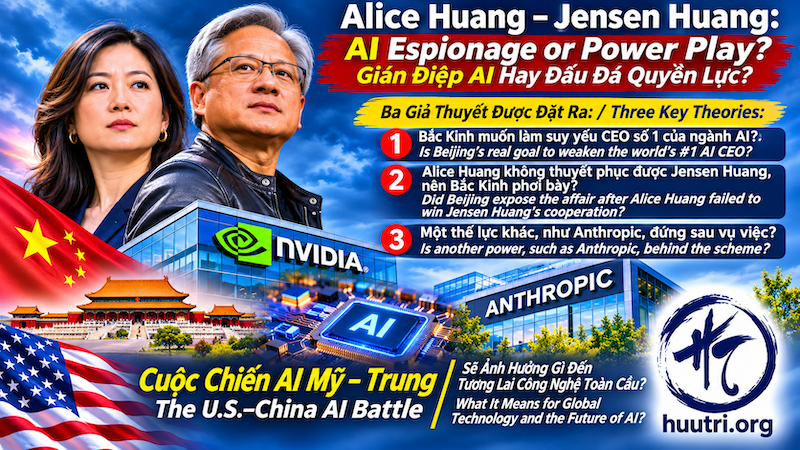
What the latest reporting establishes
Major news organizations, including Reuters, the Associated Press, and The Washington Post, report that Jensen Huang resigned as Nvidia CEO on November 12, 2026, following revelations involving extramarital relationships and an investigation into possible foreign intelligence activity. Nvidia’s CFO, Colette Kress, has assumed the interim CEO position.
Alice Huang, a former executive at Singapore-based Megaspeed International, has been identified in reporting as a person suspected by U.S. intelligence of providing information to Beijing. Megaspeed’s business involved access to Nvidia GPUs and computing capacity for AI customers.
Importantly, U.S. Attorney General Todd Blanche stated on November 12 that the Justice Department had not reached a conclusion that Alice Huang was a Chinese spy. Beijing denies the allegations, and Nvidia has said it has no reason to believe company secrets or national security were compromised.
That leaves three important questions: Was the intended target Nvidia’s technology, Jensen Huang’s personal influence, or both? Who benefited from his resignation? And is there evidence of a coordinated effort to force his departure?
Theory 1: Was Beijing’s real objective to weaken Jensen Huang rather than steal Nvidia’s chips?
Strategically plausible — unproven
The conventional interpretation of this controversy is that an intelligence operation would seek access to advanced Nvidia GPUs, chip designs, or confidential business information.
But that interpretation may be too narrow.
An intelligence service does not necessarily need to steal a technology if it can disrupt the organization responsible for developing it.
Nvidia’s dominance extends beyond physical semiconductors. Its competitive advantages include CUDA, GPU networking, developer adoption, enterprise software, and an ecosystem that supports AI development across cloud providers and research laboratories.
Jensen Huang has been unusually central to that ecosystem. As Nvidia’s co-founder and longtime chief executive, he was both its technological strategist and its public representative in negotiations involving governments, major customers, and international markets.
From a strategic perspective, weakening such a leader could create several advantages for a geopolitical rival.
First, leadership disruption could slow decisions about future chip architectures, capital allocation, international distribution, and export-control compliance.
Second, uncertainty surrounding Nvidia’s management could affect investor confidence and make customers accelerate efforts to diversify away from Nvidia.
Third, a scandal involving possible foreign intelligence activity could invite congressional scrutiny and additional government oversight, consuming executive attention and increasing compliance costs.
Fourth, China could use the resulting uncertainty to strengthen domestic alternatives, including Huawei’s Ascend ecosystem and Chinese AI infrastructure providers.
However, a crucial distinction remains: the fact that China might benefit from instability at Nvidia does not establish that Beijing engineered the instability.
China also has an interest in Nvidia’s continued commercial availability. Disrupting Nvidia could make American export restrictions stricter, reduce Chinese access to computing capacity, and encourage even stronger U.S. semiconductor security measures.
Assessment
The leadership-disruption theory is credible as a possible strategic objective, particularly because influence operations can target decision-making rather than physical technology. But available reporting does not establish that removing Jensen Huang was Alice Huang’s assignment or Beijing’s primary objective.
A more conservative hypothesis is that intelligence collection, access to computing resources, and cultivation of influence could have operated simultaneously.
Theory 2: Did Beijing expose the relationship after Alice Huang failed to secure Jensen Huang’s cooperation?
Possible mechanism — no demonstrated evidence
This theory proposes that Alice Huang was initially expected to influence Jensen Huang’s decisions concerning Chinese access to advanced AI chips. When that effort failed, Beijing allegedly chose to expose the relationship, turning an unsuccessful intelligence effort into a reputational attack.
The logic resembles a recognized intelligence concept: an intimate relationship can create opportunities for coercion, blackmail, or reputational pressure.
In theory, an intelligence service could pursue two outcomes. If the target cooperates, the service gains information or influence. If the target refuses, compromising information might be used to damage the target’s credibility.
But there are serious weaknesses in applying that model to this case.
The first weakness is attribution. There is no publicly established evidence that Beijing deliberately disclosed the relationship. Reporting about U.S. intelligence surveillance and investigative findings does not, by itself, show that Chinese officials initiated the exposure.
The second weakness is the alleged failure to cooperate. No verified public record establishes that Alice Huang demanded classified chip information or preferential access from Jensen Huang, or that he refused such a request.
The third weakness is operational cost. Public exposure could destroy a valuable intelligence relationship, reveal methods, invite investigation into Megaspeed’s business, and expose wider networks.
In fact, Reuters reported that Singapore investigated Alice Huang and barred her from re-entering the country. That illustrates how public disclosure can impose substantial costs on the suspected intermediary as well as the target.
Reuters
An alternative explanation deserves equal attention: U.S. authorities may have uncovered the relationship while investigating potential chip-export violations, with subsequent reporting and corporate governance concerns leading to Huang’s resignation.
Assessment
The blackmail or retaliation scenario is theoretically possible, but it depends on two facts that have not been demonstrated: that Jensen Huang rejected an improper request and that Beijing orchestrated the disclosure.
Without evidence of those events, the theory remains substantially more speculative than the broader possibility of an intelligence-gathering operation.
Theory 3: Was Alice Huang framed by another powerful player — and did Anthropic benefit?
Highly speculative — unsupported
The third theory is the most provocative: perhaps Beijing was not the principal actor. Instead, another organization allegedly exploited Alice Huang’s relationship with Jensen Huang to undermine Nvidia’s leadership.
The suggested suspect is Anthropic, developer of the Claude AI models, because its highly anticipated public offering coincided with Huang’s resignation.
But the timeline reveals a critical correction.
Anthropic did not begin public stock trading on November 12, the day Jensen Huang resigned. Reuters reported that morning that trading was expected the following week. Fortune subsequently reported that Huang’s resignation could actually complicate Anthropic’s IPO.
The more significant finding is that Anthropic and Nvidia are not simply competitors.
The complicated relationship between Anthropic and Nvidia
Anthropic
Develops Claude, a family of frontier AI models. Its primary business involves AI software, model development, enterprise adoption, and AI services.
Nvidia
Supplies the GPU hardware, networking infrastructure, and software ecosystem that power much of the world’s AI training and inference.
Anthropic competes for AI customers and investment capital, while Nvidia supplies much of the computing infrastructure that makes advanced AI models possible.
Their interests are therefore interconnected.
Fortune reported that Nvidia had committed approximately $10 billion to Anthropic’s IPO-related private placement, while Anthropic had committed substantial spending on Nvidia’s advanced computing capacity.
This relationship weakens the proposed motive for Anthropic to engineer Huang’s removal.
A destabilized Nvidia could threaten Anthropic’s infrastructure planning, investor confidence, and financing arrangements. Indeed, the timing of Huang’s resignation introduces uncertainty just as Anthropic prepares to enter the public markets.
It is possible for a company to benefit indirectly from a competitor’s difficulties. But benefiting from an event is not evidence of having caused it.
What would be required to substantiate the theory?
An investigation would need to uncover independently verifiable evidence, such as communications demonstrating coordination, financial transfers connected to the disclosures, credible insider testimony, or forensic records showing that a third party deliberately fabricated or planted intelligence allegations.
No credible evidence identified in the reporting reviewed for this article establishes that Anthropic orchestrated a campaign against Jensen Huang, fabricated allegations about Alice Huang, or coordinated with any intelligence service.
Assessment
The Anthropic theory is not supported by the available evidence. The company’s commercial dependence on Nvidia, its investment relationship, and the IPO timeline all undermine the proposed explanation.
The coincidence is worth examining as a matter of market timing, but it cannot reasonably be treated as evidence of a corporate conspiracy.
The larger strategic issue: China may not need Nvidia’s secrets to benefit from Nvidia’s instability
The most consequential possibility is not necessarily that someone stole chip designs.
It is that the United States could lose strategic momentum through a combination of corporate disruption, political pressure, regulatory uncertainty, and changes in its AI investment environment.
Consider the different ways such a crisis might affect the competitive landscape.
Potential strategic consequences — analytical scenarios, not forecasts
| Development | Possible consequence |
| Leadership transition at Nvidia | Temporary disruption to strategic decision-making and customer relationships |
| Tighter U.S. export controls | Reduced Chinese access to Nvidia GPUs, but stronger incentives for Chinese semiconductor substitution |
| Loss of investor confidence | Potentially higher financing costs across the AI infrastructure sector |
| Expansion of Chinese AI chip development | Greater domestic investment in accelerators, interconnects, software frameworks, and semiconductor manufacturing |
| Greater adoption of non-Nvidia hardware | More competition from AMD, custom ASICs, Google TPUs, and Amazon Trainium |
China’s challenge, however, remains much broader than replacing one American CEO.
Developing competitive AI infrastructure requires semiconductor manufacturing capacity, high-bandwidth memory, advanced packaging, networking, compiler optimization, software compatibility, energy infrastructure, and sustained research investment.
Even a significant disruption at Nvidia would not automatically close those technological gaps.
Likewise, Jensen Huang’s departure does not erase Nvidia’s patents, engineers, CUDA ecosystem, intellectual property, or customer contracts.
The company is far larger than one individual, although the transition away from its founding leader creates meaningful governance and execution risks.
Which theory deserves the most scrutiny?
The following assessment distinguishes strategic plausibility from evidentiary support.
| Theory | Strategic plausibility | Evidence for the specific allegation |
| 1. Beijing sought to weaken Nvidia’s leadership | Moderate | Not established |
| 2. Beijing exposed the affair after a failed influence attempt | Possible, but dependent on multiple assumptions | Not established |
| 3. Anthropic orchestrated the scandal and framed Alice Huang | Weak based on currently known incentives | No credible supporting evidence identified |
These are qualitative judgments, not numerical probabilities or intelligence findings.
Five questions investigators should prioritize
- What exactly did Alice Huang communicate to Beijing, if anything? Was it information about chip availability, Nvidia’s commercial strategy, U.S. export policy, or confidential technology?
- What was the relationship between Megaspeed’s GPU operations and Chinese customers? Did computing services or physical shipments violate U.S. export restrictions?
- Who first disclosed the relationship, and through what process? A documented disclosure timeline could distinguish investigative reporting, government intelligence activity, internal corporate actions, and deliberate information operations.
- Was there any attempt to influence Jensen Huang’s decisions? Investigators would need evidence of specific requests, proposed arrangements, threats, or exchanges—not simply proof of a personal relationship.
- How resilient is Nvidia without its founder as CEO? Investors should monitor management continuity, product roadmaps, customer commitments, export-policy developments, and the company’s ability to retain key engineering talent.
Conclusion: The most dangerous weapon in the AI race may be uncertainty
The controversy surrounding Alice Huang and Jensen Huang illustrates a vulnerability that advanced technology alone cannot solve.
A company may have the world’s most powerful chips, an enormous engineering workforce, and billions of dollars invested in innovation. Yet its leadership can still become vulnerable to personal misconduct, influence operations, reputational damage, and failures of corporate governance.
The first two theories deserve examination because intelligence agencies have historically used personal relationships and access to influential decision-makers as opportunities for information collection and coercion. But neither Beijing’s alleged objective to remove Huang nor its supposed role in exposing the relationship has been demonstrated.
The third theory, involving Anthropic, currently lacks a credible evidentiary foundation and is contradicted in important respects by the companies’ commercial relationship and the IPO timeline.
For American policymakers, technology executives, and investors, the lesson is broader: protecting America’s AI leadership requires protecting not only semiconductor technology, but also the institutions, executives, supply chains, and governance systems responsible for developing it.
The unanswered question is not simply whether Alice Huang was gathering intelligence.
It is whether the scandal will ultimately alter the balance of technological power between the United States and China—and whether America’s AI industry can maintain its momentum through a major leadership crisis.
That outcome will be measured in future chip generations, AI infrastructure investments, export-control decisions, and corporate performance—not in speculation alone.
-Nguyễn Bách Khoa-