
A Simple Guide for Vietnamese Families in California, Texas, Florida, Georgia, Arizona & Oregon
Many Vietnamese American families spend years preparing financially for retirement—buying homes, saving money, enrolling in Medicare, purchasing insurance, and caring for children and grandchildren. Yet one of the most important subjects is often postponed because it feels too sensitive to discuss: who will make medical decisions when you can no longer speak for yourself?
This “Healthcare Directive” series by HuuTri.org was created to help Vietnamese American seniors better understand Living Wills, Healthcare Directives, Medical Power of Attorney, hospice care, DNR orders, and other important end-of-life medical decisions. Written in practical and easy-to-understand language for families living in California, Texas, Florida, Georgia, Arizona, Oregon, and many other states, this series aims to help readers prepare in advance to protect their dignity, reduce family conflict, and preserve their right to make decisions during some of the most difficult moments of life.
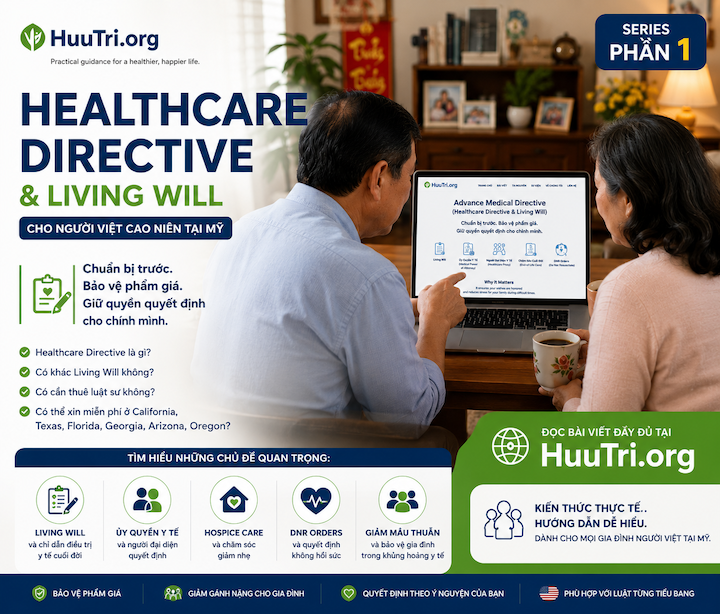
What Is a Healthcare Directive? Is It Different from a Living Will?
There is one reality many Vietnamese American families only discover when a parent or loved one is suddenly hospitalized:
Money, property, insurance, and Medicare may all have been carefully planned.
But the most important medical decisions near the end of life were never discussed.
If one day:
- your loved one is no longer mentally alert,
- suffers a stroke,
- falls into a coma,
- develops dementia,
- or can no longer communicate,
then who will make decisions on their behalf?
And what will those decisions be based on?
That is when a Healthcare Directive becomes critically important.
What Is a Healthcare Directive?
A Healthcare Directive (Advance Healthcare Directive) is a legal document that allows a person to:
- Clearly state their medical treatment wishes before they lose the ability to make decisions.
- Appoint a healthcare representative to speak on their behalf.
In other words, a Healthcare Directive answers two major questions:
- “What do I want?”
- “Who will speak for me?”
Is a Living Will the Same as a Healthcare Directive?
Not exactly.
A Living Will usually focuses only on:
- whether you want a ventilator,
- CPR or resuscitation,
- feeding tubes,
- life-prolonging treatment,
- or comfort and pain management care.
A Healthcare Directive is often broader.
Today, many states use one combined document that includes:
- Living Will
- Medical Power of Attorney
- Healthcare Proxy
- Appointment of a healthcare agent
- End-of-life care instructions
- Organ donation wishes
- Spiritual or religious care preferences
This modern approach helps reduce confusion for hospitals and family members.
Does Every State Have Different Rules?
Yes.
In the United States, Healthcare Directive laws are regulated individually by each state.
That means:
- each state has different forms,
- different witness requirements,
- different notarization rules,
- and even different document names.
California
Uses the term:
Advance Health Care Directive
California commonly uses one combined document that includes:
- living will,
- healthcare agent,
- and end-of-life care instructions.
Texas
Texas often separates documents into:
- Directive to Physicians
- Medical Power of Attorney
Florida
Florida uses:
- Living Will
- Designation of Health Care Surrogate
Georgia, Arizona & Oregon
Each state has:
- its own forms,
- certification requirements,
- and witness/notary rules.
Is Hiring an Attorney Required?
No.
This is one of the biggest misconceptions many people have.
Many assume:
“A Living Will is expensive and requires an attorney.”
In reality:
Most states provide free legal Healthcare Directive forms.
People can:
- download the forms,
- fill out the information,
- sign them,
- obtain witnesses or notarization,
- and legally use them.
For many middle-income families and older adults with limited income, this is an important first step.
When Should You Hire an Attorney?
An attorney may be very helpful if:
- there is family conflict,
- significant assets are involved,
- there are prior marriages,
- stepchildren or blended families,
- trust or estate planning needs,
- complicated medical wishes,
- or a desire to create a comprehensive end-of-life plan.
However, if finances are limited:
A free but clearly written Healthcare Directive is still far better than having nothing at all.
How Can You Obtain a Free Healthcare Directive?
Many seniors believe:
“I cannot afford an attorney, so I probably cannot complete these documents.”
That is not true.
Many hospitals, community organizations, and state agencies provide them free of charge.
Where Can You Get One?
1. State Government Websites
Many states provide official free forms, usually including:
- downloadable PDFs,
- signing instructions,
- witness/notary requirements.
2. Hospitals
Many hospitals have:
- social workers,
- patient advocates,
- care coordinators,
who help patients complete Healthcare Directives free of charge.
3. Hospice Organizations
Hospice organizations often help families with:
- advance directives,
- DNR forms,
- end-of-life planning,
- and family guidance.
4. Senior Centers & Community Organizations
Many senior centers offer:
- free workshops,
- educational classes,
- and Vietnamese-language assistance.
5. Legal Aid Programs
Low-income seniors may qualify for:
- free legal consultation,
- or low-cost assistance.
Coming in Part 2
In the next installment of this series, HuuTri.org will address a question that confuses many Vietnamese families:
Should a Healthcare Directive be combined with a Living Will, or kept as separate documents?
We will discuss:
- the advantages and disadvantages of each approach,
- why many families experience conflict when documents are inconsistent,
- what happens if a patient changes their mind at the last minute,
- and which documents hospitals typically rely on when disagreements arise among family members.
This is one of the most emotional and practical issues many families only face after a medical crisis has already happened.
— Nguyen Bach Khoa —
Sources for Further Reading
Official & Educational Resources on Healthcare Directives, Living Wills & Advance Care Planning
- National Institute on Aging – Advance Care Planning: Advance Directives for Health Care
Comprehensive federal overview explaining advance directives, living wills, healthcare proxies, and why advance care planning is important for older adults. - CaringInfo – Free Advance Directive Forms by State
Free downloadable Healthcare Directive and Living Will forms for all 50 states, including California, Texas, Florida, Georgia, Arizona, and Oregon. - AARP – Free Printable Advance Directive Forms by State
Easy-to-understand explanations of Living Wills, Healthcare Power of Attorney, and state-specific forms for seniors and caregivers. - National Resource Center on Psychiatric Advance Directives – State-by-State Information
State-by-state legal information and forms regarding advance directives and healthcare decision-making. - PREPARE for Your Care – Advance Directive Program
Free step-by-step planning tools created by the University of California to help families discuss and complete advance directives. - Hospice Foundation of America – Advance Directive Resources by State
Educational hospice and end-of-life planning resources, including links to state directive forms. - Compassus – Advance Directives and Living Will Information
Practical explanations of Healthcare Directives, Living Wills, witness/notary requirements, and state-by-state resources. - StatPearls / NIH – Advance Directives
Medical and legal overview discussing ethics, surrogate decision-making, DNR, feeding tubes, and end-of-life treatment planning. - ADvancing States – State-by-State Advance Directive Resources
State-specific links and information regarding advance directive laws and forms. - Everplans – State-by-State Advance Directive Forms
Additional state form directory with explanations of Living Wills and Healthcare Proxy documents.