
In Part 2, HuuTri.org explored some of the most practical—and emotional—issues surrounding Healthcare Directives and Living Wills. We explained the differences between using a combined document versus multiple separate forms, the risks of conflicts between old and updated documents, and what may happen when a patient changes their wishes at the last minute. Part 2 also showed that, in many cases, hospitals do not rely solely on paperwork—they also consider the patient’s most recent statements, mental capacity, and the legally designated healthcare agent.
But beyond all the legal considerations, there is something even more important that many Vietnamese families are often unprepared for the family conversation itself.
Because even the most complete Healthcare Directive can become meaningless if:
- the healthcare agent does not truly understand the parents’ wishes,
- family members have never openly discussed these issues,
- or everyone only begins talking about hospice care, DNR orders, or end-of-life decisions after a crisis has already happened.
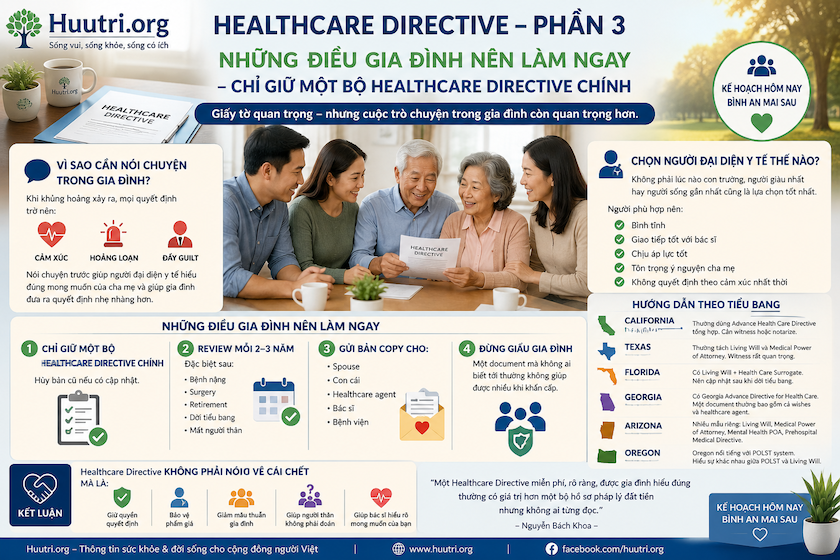
Part 3 focuses on the human side behind the legal documents—how to choose the right healthcare agent, how to reduce family conflict, and the practical steps older adults should begin preparing today so their loved ones will not be forced to guess during the most difficult moments of life.
What Should Families Do?
Many Vietnamese families avoid talking about:
- serious illness,
- end-of-life care,
- hospice,
- ventilators,
- or DNR orders,
because they believe discussing these subjects may bring bad luck.
But when a crisis happens, every decision suddenly becomes:
- emotional,
- overwhelming,
- and filled with guilt.
The Most Important Thing Is Not Just the Documents
It is:
the family conversation.
The healthcare agent must understand:
- the parents’ values,
- what dignity means to them,
- what they fear most,
- whether they want life prolonged at all costs,
- their religious beliefs,
- and their wishes for the end of life.
How Should You Choose a Healthcare Agent?
The best choice is not always:
- the oldest child,
- the wealthiest child,
- or the child who lives closest.
The right person should be someone who:
- remains calm under pressure,
- communicates well with doctors,
- handles stress effectively,
- respects the parents’ wishes,
- and does not make decisions based purely on emotions.
Important Steps Families Should Take Now
1. Keep Only One Primary Healthcare Directive
Destroy outdated copies whenever updates are made.
2. Review the Documents Every 2–3 Years
Especially after:
- a major illness,
- surgery,
- retirement,
- moving to another state,
- or the loss of a loved one.
3. Provide Copies To:
- spouse,
- children,
- healthcare agent,
- doctors,
- and hospitals.
4. Do Not Keep It Secret From the Family
A document nobody knows exists often provides little help during an emergency.
Guidance for States Where Many Vietnamese-Americans Reside
California
- Commonly uses a combined Advance Health Care Directive.
- Free forms are widely available.
- Usually requires witnesses or notarization.
- Many California hospitals provide assistance free of charge.
Texas
- Often separates the Living Will and Medical Power of Attorney.
- Witness requirements are very important.
- Texas is relatively strict regarding legal formalities.
Florida
- Uses both a Living Will and a Health Care Surrogate designation.
- Retirees relocating to Florida should update their documents after moving.
Georgia
- Uses the Georgia Advance Directive for Health Care.
- One document often includes both treatment preferences and healthcare agent designation.
Arizona
Arizona offers several separate forms, including:
- Living Will,
- Medical Power of Attorney,
- Mental Health Power of Attorney,
- and Prehospital Medical Directive.
Oregon
- Oregon is known for its POLST system.
- Older adults should understand the difference between a POLST and a Living Will.
A Healthcare Directive Is Not About Death
It is about:
- preserving your right to decide,
- protecting your dignity,
- reducing family conflict,
- preventing loved ones from having to guess,
- and helping doctors clearly understand the patient’s wishes.
Many families only begin learning about these documents:
- in the ICU,
- during hospice care,
- or after a sudden stroke.
By then, everything becomes far more difficult.
A free, clearly written Healthcare Directive that the family fully understands…
is often more valuable than an expensive legal file that nobody has ever read.
— Nguyen Bach Khoa —
Sources for Further Reading
Official & Educational Resources on Healthcare Directives, Living Wills & Advance Care Planning
- National Institute on Aging – Advance Care Planning: Advance Directives for Health Care
Comprehensive federal overview explaining advance directives, living wills, healthcare proxies, and why advance care planning is important for older adults. - CaringInfo – Free Advance Directive Forms by State
Free downloadable Healthcare Directive and Living Will forms for all 50 states, including California, Texas, Florida, Georgia, Arizona, and Oregon. - AARP – Free Printable Advance Directive Forms by State
Easy-to-understand explanations of Living Wills, Healthcare Power of Attorney, and state-specific forms for seniors and caregivers. - National Resource Center on Psychiatric Advance Directives – State-by-State Information
State-by-state legal information and forms regarding advance directives and healthcare decision-making. - PREPARE for Your Care – Advance Directive Program
Free step-by-step planning tools created by the University of California to help families discuss and complete advance directives. - Hospice Foundation of America – Advance Directive Resources by State
Educational hospice and end-of-life planning resources, including links to state directive forms. - Compassus – Advance Directives and Living Will Information
Practical explanations of Healthcare Directives, Living Wills, witness/notary requirements, and state-by-state resources. - StatPearls / NIH – Advance Directives
Medical and legal overview discussing ethics, surrogate decision-making, DNR, feeding tubes, and end-of-life treatment planning. - ADvancing States – State-by-State Advance Directive Resources
State-specific links and information regarding advance directive laws and forms. - Everplans – State-by-State Advance Directive Forms
Additional state form directory with explanations of Living Wills and Healthcare Proxy documents.