
A balanced look at opportunity and risk
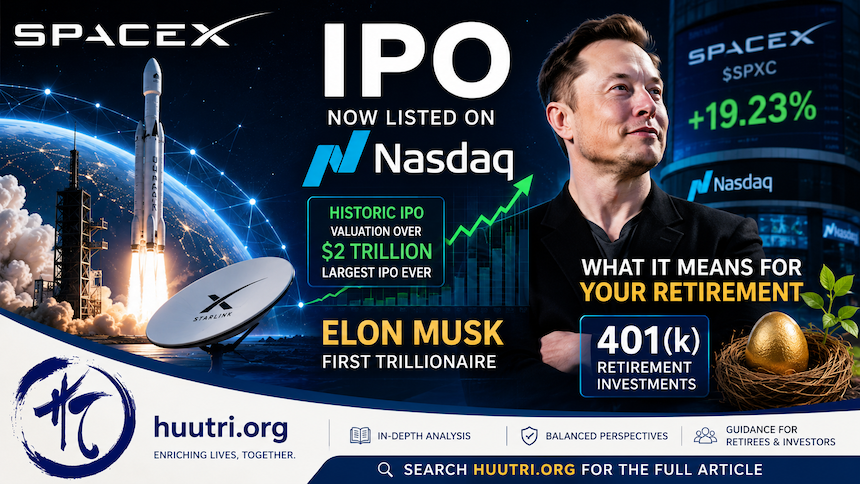
June 2026 marked a historic moment on Wall Street. Elon Musk’s SpaceX went public with an estimated valuation of approximately $1.77 trillion, making it the largest IPO in world history. Within its first trading day, SpaceX’s market value surpassed $2 trillion, helping Elon Musk become the first person in history whose net worth exceeded $1 trillion.
For many Americans approaching retirement, this story is about much more than Elon Musk or missions to Mars. It is also about their 401(k) plans, IRAs, pension funds, and investment portfolios that increasingly depend on the performance of technology companies.
The key question is:
Is SpaceX the next Apple or Microsoft—a transformational investment opportunity—or is it an example of excessive optimism that retirees should approach cautiously?
What Is SpaceX?
Founded in 2002 by Elon Musk, SpaceX was created with the goal of dramatically reducing the cost of launching rockets and ultimately making human settlement on Mars possible.
Today, SpaceX is far more than a space exploration company.
Its businesses include:
- Starlink satellite internet services
- The Starship spacecraft program
- NASA and U.S. Department of Defense contracts
- The world’s largest satellite network
- Emerging AI and data-driven initiatives through collaborations with Musk’s broader technology ecosystem
SpaceX’s Financial Position Before the IPO
According to its IPO filings:
| Metric | 2025 |
|---|---|
| Revenue | $18.67 Billion |
| Pre-IPO Valuation | Approximately $1.75 Trillion |
| Capital Raised | $75 Billion |
One of the most debated aspects of the IPO was valuation.
SpaceX was valued at nearly 94 times its annual revenue, significantly higher than most large technology companies today.
This valuation alone has divided analysts and investors into two opposing camps.
What Happened After the IPO?
SpaceX shares were offered at $135 per share.
On the first trading day:
- Shares gained approximately 19%
- Market capitalization exceeded $2 trillion
- SpaceX became the largest IPO in history
- Elon Musk’s net worth surpassed $1 trillion
Demand was extraordinary. Reports indicated that institutional and retail investors submitted orders exceeding $250 billion.
Why Is SpaceX the Largest IPO Ever?
The previous record belonged to Saudi Aramco, which debuted in 2019 with a valuation of approximately $1.7 trillion.
SpaceX surpassed that record immediately upon its public debut.
Several factors contributed to its enormous valuation.
1. Starlink’s Rapid Growth
Starlink has become SpaceX’s largest source of revenue.
Its satellite-based internet service now serves millions of customers worldwide, including businesses, governments, military organizations, and consumers in remote areas.
2. Limited Competition
Very few companies in the world can:
- Launch and recover reusable rockets
- Operate a global satellite communications network
- Secure major contracts with NASA and the U.S. government
This competitive advantage has helped justify a premium valuation.
3. The AI Narrative
Many investors no longer view SpaceX strictly as a space company.
Instead, they see it as:
- A data company
- A telecommunications company
- An AI infrastructure company
- A future transportation company
This broader vision has significantly boosted investor enthusiasm.
How Did Elon Musk Become the First Trillionaire?
Musk owns a substantial stake in SpaceX.
When the company’s market value exceeded $2 trillion, the value of his SpaceX holdings combined with his ownership in Tesla pushed his estimated net worth beyond $1 trillion.
However, investors should remember that most of Musk’s wealth exists on paper.
The majority of his fortune consists of stock ownership rather than cash. If stock prices decline significantly, his net worth could fall just as rapidly.
Why Is the IPO So Controversial?
1. Is the Valuation Too High?
Critics point out that:
- Revenue was approximately $18.67 billion
- Market value approached $2 trillion
This means investors are paying for future expectations rather than current earnings.
The company must deliver extraordinary growth for years to justify today’s valuation.
2. Elon Musk’s Control
IPO filings indicate that Musk continues to control more than 85% of voting power.
This level of control raises concerns among institutional investors about corporate governance and shareholder rights.
3. Governance and ESG Concerns
Some governance analysts argue that shareholders have limited influence over company decisions.
As a result, certain ESG-focused funds may limit or avoid investing in SpaceX.
Why Should Retirees Pay Attention?
Most retirees will never purchase SpaceX shares directly.
However, many already own:
- S&P 500 index funds
- Nasdaq funds
- Technology-focused mutual funds
- 401(k) retirement accounts
As large technology companies increasingly dominate U.S. stock market indexes, retirement savings become more closely tied to the success—or failure—of these companies.
Some critics worry that ordinary workers may unknowingly bear the risks associated with increasingly expensive technology valuations.
If AI Is the Future, Why Are Some Investors Skeptical?
This is perhaps the most important question.
Many investors believe AI will transform society much like the internet did in the 1990s and 2000s.
History suggests they may be correct.
However, history also teaches another lesson:
Not every company associated with a revolutionary technology becomes a successful investment.
During the dot-com era:
- Amazon survived and prospered.
- Hundreds of other internet companies disappeared.
Today’s skeptics argue that investors may be overestimating how quickly AI will generate profits.
Their concerns include:
- Massive AI-related spending
- Uncertain long-term profitability
- Excessive investor expectations
In other words, AI may indeed change the world, but that does not guarantee that every AI-related stock will produce attractive returns.
Reasons for Optimism
✓ Industry-leading technology
✓ Strong revenue growth from Starlink
✓ Long-term government contracts
✓ Potential AI and data opportunities
✓ Competitive advantages that are difficult to replicate
Reasons for Caution
✗ Extremely high valuation
✗ Heavy dependence on Elon Musk
✗ Capital-intensive business model
✗ Potential stock-price volatility
✗ Significant uncertainty surrounding future AI profitability
What Should Retirees Do?
For most retirees and pre-retirees, SpaceX should not represent a large portion of an investment portfolio.
A prudent strategy typically includes:
- Broadly diversified index funds
- Bonds and income-producing assets
- Cash reserves for near-term expenses
- Limited exposure to high-growth investments such as SpaceX
Retirees do not need to chase every technological trend to achieve financial success.
The primary goals remain:
- Preserving capital
- Generating reliable income
- Managing risk
- Maintaining sustainable long-term growth
SpaceX is unquestionably one of the most remarkable companies of our era.
It has transformed the space industry, built a global satellite communications network, and positioned itself at the intersection of aerospace, telecommunications, and artificial intelligence.
Yet for retirees, the question is not:
“Is SpaceX an extraordinary company?”
Rather, it is:
“Has the market already priced in too much future success?”
Investment history teaches that even great companies can become poor investments when purchased at excessively high valuations.
For retirees, balancing growth with capital preservation remains far more important than chasing the most exciting story on Wall Street.
-Lê Nguyên Vũ-