
Few individuals have shaped modern investing more profoundly than Warren Buffett. Known as the “Oracle of Omaha,” Buffett built one of the greatest fortunes in history while living a lifestyle that often resembles that of an upper-middle-class retiree rather than a billionaire.
As of the mid-2020s, Buffett has consistently ranked among the world’s wealthiest individuals, with a net worth exceeding $100 billion. Yet his story is not primarily about money. It is about discipline, patience, character, and the belief that wealth carries responsibility.
Early Life: A Boy Fascinated by Business
Warren Edward Buffett was born on August 30, 1930, in Omaha.
From an early age, he displayed an unusual fascination with numbers and business.
By age 6:
- He bought six-packs of Coca-Cola and sold individual bottles for a profit.
- Sold chewing gum door-to-door.
- Kept detailed records of earnings.
By age 11:
- Purchased his first stock shares.
By age 13:
- Filed his first income tax return.
- Claimed his bicycle as a business expense because he used it for newspaper delivery.
By age 14:
- Purchased farmland using profits from his paper route.
Buffett often jokes that he was “born interested in business.”
The Mentor Who Changed His Life
The most important turning point came when Buffett discovered the writings of Benjamin Graham, author of the classic investment book The Intelligent Investor.
Graham taught:
- Buy businesses, not stock certificates.
- Focus on intrinsic value.
- Ignore market emotions.
- Think long-term.
Buffett later attended Columbia Business School specifically to study under Graham.
After graduation, Graham hired Buffett to work at his investment firm in New York.
Buffett would later say:
“I’m 85% Graham and 15% Fisher.”
The Beginning of His Fortune
In 1956, Buffett returned to Omaha and started Buffett Partnership Ltd.
He began managing money for family and friends.
His investment results were extraordinary.
While the stock market averaged roughly 10% annually, Buffett’s partnerships generated returns far above market averages.
One of his most important purchases was a struggling New England textile company called:
Berkshire Hathaway
Originally, Buffett bought shares because they were cheap.
Over time he transformed Berkshire into a holding company that acquired:
- Insurance companies
- Railroads
- Energy businesses
- Manufacturing companies
- Consumer brands
The company’s major investments have included:
- Coca-Cola
- American Express
- Apple
- Bank of America
His secret was surprisingly simple:
Buy Great Businesses
Not trendy stocks.
Not quick profits.
Not speculation.
Instead:
- Strong management
- Durable competitive advantages
- Predictable earnings
- Long-term ownership
Buffett’s favorite holding period became famous:
“Forever.”
Becoming the Richest Man in the World
For many years Buffett ranked among the top three richest people on Earth alongside:
- Bill Gates
- Jeff Bezos
In several periods during the late 2000s and again during certain market fluctuations, Buffett briefly rose to the #1 position on global wealth rankings as Berkshire Hathaway stock surged while other fortunes declined.
What made this remarkable was that Buffett never founded a revolutionary technology company.
Unlike many billionaires:
- He did not invent a product.
- He did not build a social media platform.
- He did not create a software empire.
He became wealthy primarily through:
Compounding
Buffett often says:
“My wealth has come from a combination of living in America, some lucky genes, and compound interest.”
A Billionaire Who Lives in the Same House
One of the most surprising facts about Buffett is where he lives.
He still resides in the Omaha house he purchased in 1958 for $31,500.
Today it would be considered comfortable and valuable, but it is nowhere near the size or extravagance associated with modern billionaires.
He has repeatedly said that:
- The house meets his needs.
- Larger homes would not make him happier.
- Too many possessions create unnecessary complications.
Why His Children Went to Public School
Many people assume Buffett’s children grew up with luxury.
The opposite is closer to the truth.
His children:
- Attended public schools.
- Lived in ordinary neighborhoods.
- Rode school buses.
- Experienced a relatively normal Midwestern upbringing.
Buffett wanted them to understand:
- Work has value.
- Money must be earned.
- Privilege should not replace responsibility.
His late wife Susan shared this philosophy.
The family intentionally avoided creating an atmosphere where children expected wealth to solve every problem.
The Volkswagen Story
One of the most famous examples of Buffett’s frugality involved his car.
For many years Buffett drove an older Volkswagen.
Even after becoming a billionaire, he continued driving modest vehicles and replacing them only when necessary.
His children saw firsthand that:
- Wealth did not require showing off.
- Status symbols were unimportant.
- Character mattered more than possessions.
Buffett has often said that he values freedom far more than luxury.
Marriage, Family, and Values
Susan Buffett: The Great Partner
Susan Thompson Buffett married Buffett in 1952.
They had three children:
Susan Alice Buffett
Active in education and philanthropy.
Howard Graham Buffett
A farmer, conservationist, and humanitarian.
Peter Buffett
An Emmy Award-winning musician and social entrepreneur.
None became Wall Street investors in the Buffett mold.
Instead, all three devoted significant portions of their lives to philanthropy.
Buffett has expressed pride that his children chose service rather than simply managing wealth.
His Second Wife: Astrid Menks
Astrid Menks entered Buffett’s life after Susan moved to California.
Susan and Astrid maintained a friendly relationship.
In an unconventional arrangement:
- Susan remained married to Warren.
- Astrid became Buffett’s daily companion.
- The three remained close.
Following Susan’s death in 2004, Buffett married Astrid in 2006.
Astrid has largely shared Buffett’s modest lifestyle and commitment to philanthropy.
The Philosophy of Being Rich
Buffett’s philosophy can be summarized as:
1. Money Is a Tool
Money creates options.
It is not the goal itself.
2. Time Is More Valuable Than Money
Once basic needs are met, time becomes the scarce asset.
3. Reputation Is Priceless
One famous Buffett quote:
“It takes 20 years to build a reputation and five minutes to ruin it.”
4. Avoid Debt
Particularly high-interest consumer debt.
5. Invest in Yourself
Buffett repeatedly says the best investment is self-improvement.
6. Live Below Your Means
His own life is the best example.
How Much Will His Children Inherit?
Buffett’s estate plan evolved over time.
Although his children are financially secure, Buffett has repeatedly stated that he does not believe in dynastic wealth.
His most famous statement:
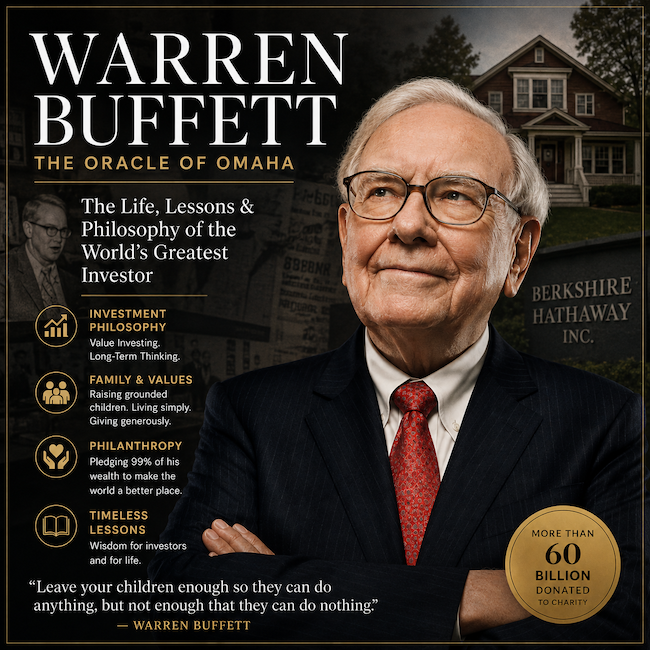
“Leave your children enough so they can do anything, but not enough that they can do nothing.”
His children will oversee charitable distributions after his death, but the overwhelming majority of Buffett’s wealth will not remain in the family.
The Gates Foundation and Philanthropy
Bill & Melinda Gates Foundation became one of the primary recipients of Buffett’s charitable gifts beginning in 2006.
Over the years, Buffett donated tens of billions of dollars to the foundation.
Combined with donations to foundations run by his children, his total charitable giving has exceeded $60 billion.
In 2021, Buffett stepped down as a trustee of the Gates Foundation, stating that his participation was no longer necessary and that the foundation was functioning effectively without his active oversight.
Later, Buffett revised his estate plans so that future posthumous charitable distributions would be directed by his children rather than automatically flowing to the Gates Foundation.
The 99% Pledge
Buffett has publicly pledged that:
More than 99% of his wealth will go to philanthropy.
He has said repeatedly that society helped create the conditions that allowed him to accumulate enormous wealth and that most of that wealth should ultimately return to society.
This makes him one of the largest philanthropists in human history.
The “8-8-8” Lifestyle Idea
The “8-8-8” concept—8 hours of work, 8 hours of sleep, and 8 hours for family, learning, recreation, and personal growth—is often associated with balanced living.
While Buffett has never formally promoted it as a personal doctrine, his daily routine reflects many of its principles:
- Read extensively.
- Think deeply.
- Work selectively.
- Protect personal time.
- Maintain healthy routines.
He has long emphasized that success comes from consistent habits rather than dramatic efforts.
Buffett’s Legacy
Warren Buffett’s greatest lesson may not be how to become rich.
It may be how to remain grounded after becoming rich.
Despite building one of the largest fortunes in history, he:
- Lived in the same home for decades.
- Drove modest cars.
- Sent his children to public schools.
- Refused to create a family dynasty.
- Committed more than 99% of his wealth to charity.
His life demonstrates that wealth and simplicity are not opposites.
For Buffett, true success has never been measured by how much money one keeps, but by how wisely one earns it, uses it, and ultimately gives it away.
-Lê Nguyễn Thanh Phương-