
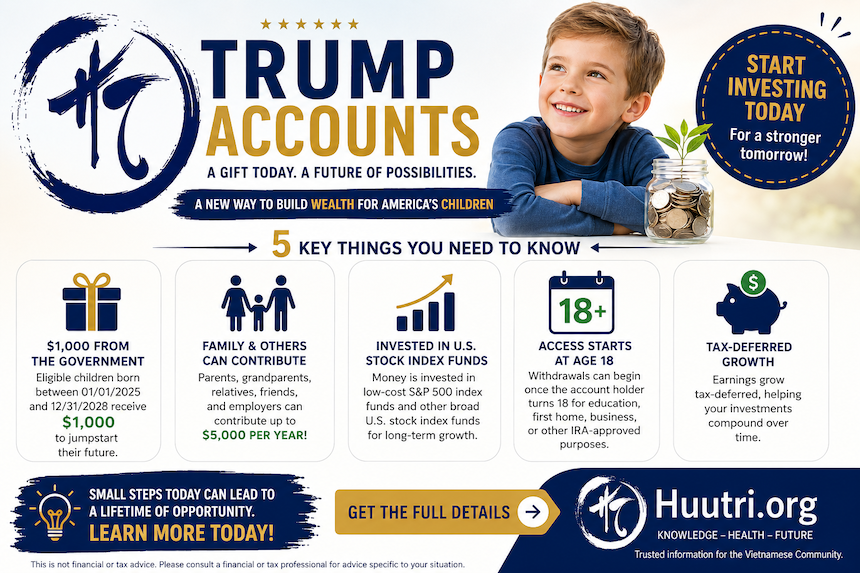
The new Trump Accounts (legally known as 530A Trump Accounts) officially became available on July 4, 2026, as one of the family wealth-building provisions in the One Big Beautiful Bill Act (OBBBA). They are designed to give children a long-term investment account beginning at birth or during childhood.
Here’s how the program works.
 Who qualifies?
There are two groups of children.
Group 1 – Eligible for the $1,000 government contribution
A child must:
- Be a U.S. citizen
- Have a Social Security Number
- Be born between January 1, 2025 and December 31, 2028
The federal government deposits $1,000 into the account once it is opened.
Group 2 – All other children
Any U.S. citizen under age 18 may have a Trump Account opened.
However:
- They do not receive the $1,000 government seed money.
- Family members may still contribute to the account.
Who funds the account?
Several parties can contribute.
| Contributor | Amount |
|---|---|
| U.S. Treasury | $1,000 one-time (eligible newborns only) |
| Parents | Up to annual contribution limit |
| Grandparents | Allowed |
| Friends/Relatives | Allowed |
| Employers | Up to $2,500 annually |
| Charities/Foundations | May contribute under special rules |
The combined private contribution limit is generally $5,000 per child per year. Employer contributions count toward that limit, while the government’s $1,000 does not.
Who manages the money?
The government does not actively manage the investments.
Instead:
- Treasury oversees the program.
- Private financial institutions administer the accounts.
- Initial administration is handled through BNY Mellon.
- Additional financial companies are expected to participate over time.
What investments are allowed?
Unlike an IRA or brokerage account, investment choices are intentionally limited.
The money must be invested in:
- S&P 500 index funds
- Broad U.S. stock index mutual funds
- Broad U.S. stock index ETFs
The purpose is to keep fees low and encourage long-term investing.
Examples include:
- State Street S&P 500 Index Fund
- Other qualifying low-cost index funds approved under Treasury regulations
Individual stocks are not permitted.
Does the account grow tax-free?
Not exactly.
It is more accurate to say the account grows tax-deferred, similar to a Traditional IRA.
That means:
- No annual tax on dividends.
- No annual tax on capital gains.
- Taxes generally apply when money is withdrawn.
This differs from a Roth IRA, where qualified withdrawals are tax-free.
When can money be withdrawn?
The child cannot freely access the money during childhood.
Beginning January 1 of the calendar year in which the child turns 18, withdrawals become possible under the applicable rules, and the account transitions to treatment similar to a Traditional IRA.
Are withdrawals restricted?
Yes.
Congress intended the money to help young adults begin building wealth.
Early withdrawals around age 18 are generally intended for purposes such as:
- College or vocational education
- Purchasing a first home
- Starting a business
After the account transitions into a Traditional IRA framework, later retirement withdrawals follow IRA tax rules.
How much could the account grow?
Since the accounts invest in the stock market, future returns are unknown.
Below are illustrations assuming an 8% annual return, close to the long-term historical average of the S&P 500 before inflation. Actual results could be much higher or lower.
Example 1 — Government contributes only $1,000
Initial deposit:
- Government: $1,000
- No additional contributions
At age 18:
Approximately $4,000
At age 65 (if never touched):
Approximately $150,000
Example 2 — Parents contribute $5,000 every year
Starting balance:
- Government: $1,000
Parents invest:
- $5,000 annually for 18 years
Total contributions:
$91,000
Estimated value at age 18:
About $195,000–$205,000
If left invested until age 65:
Potentially $7–8 million, assuming an 8% annual return and no withdrawals.
Example 3 — Employer contributes $2,500 annually
Government:
- $1,000
Employer:
- $2,500 annually
Total contributions:
$46,000
Estimated value at age 18:
Approximately $95,000–105,000
Example 4 — Parents contribute $2,500 and employer contributes $2,500
Annual contributions:
- Parents: $2,500
- Employer: $2,500
Combined:
$5,000 annually (the current annual limit)
Estimated age-18 value:
Again approximately $195,000–205,000.
What happens after age 18?
Beginning in the year the beneficiary turns 18:
- The special Trump Account rules largely end.
- The account is treated like a Traditional IRA under federal tax law.
- Investment growth continues tax-deferred unless money is withdrawn.
Advantages
- Government provides a $1,000 head start for eligible newborns.
- Encourages investing from birth.
- Low-cost index fund investing.
- Tax-deferred growth.
- Family members and employers can contribute.
- May create significant wealth over several decades.
Potential disadvantages
- Investment choices are very limited.
- Growth is not tax-free.
- Withdrawals are generally taxable.
- Annual contribution limit is relatively low.
- Children born before 2025 do not receive the federal $1,000 seed contribution.
- For families focused primarily on education savings or tax-free retirement income, alternatives such as a 529 plan or Roth IRA (when eligible) may provide more favorable tax treatment.
Bottom line
The Trump Account is best viewed as a government-seeded, tax-deferred investment account for children. The federal government gives eligible newborns $1,000, and families, employers, and others can add up to $5,000 per year. The money is invested in diversified U.S. stock index funds, cannot generally be accessed until age 18, and then transitions to treatment similar to a Traditional IRA. Over many decades, even relatively modest annual contributions have the potential to compound into substantial retirement savings, although future investment returns are never guaranteed.
-Nguyễn Bách Khoa-