
As sweltering summer heat spreads across the United States—and the feverish excitement of World Cup matches sweeps from one host city to another—why not escape for a while and immerse yourself in Punta Cana’s brilliant blue waters and refreshing ocean breezes?
The Dominican Republic, or República Dominicana, lies in the Caribbean, only about a two-and-a-half-hour flight from Miami, Florida. Of course, travelers departing from California will need to add another five hours or so. The Dominican Republic occupies the eastern side of the island, while Haiti lies to the west. A heavily fortified border separates the two countries, intended to prevent impoverished workers and criminal gangs from Haiti from crossing into the Dominican Republic in search of jobs and a new life.
 The moment travelers step outside Punta Cana International Airport—airport code PUJ—they are warmly welcomed by a powerful blast of hot air. Even lightweight, breathable clothing carefully chosen for the tropical weather quickly becomes soaked with perspiration.
Amid the noise and commotion of an airport in a developing country, the shuttle driver is already waiting, holding up a sign bearing the arriving traveler’s name. A handshake, a cheerful “Hola,” and traveler and driver immediately exchange friendly smiles. The driver grabs the suitcase and leads the way to the vehicle.
Climbing into the air-conditioned van brings an immediate sigh of relief. Cool air fills the vehicle, temporarily pushing the oppressive heat outside. Because this is a shared shuttle, however, the van must wait for one or two more passengers before departing. Travelers who prefer something more luxurious can reserve a private SUV and leave immediately—but it may cost two or three times as much. Those of us who live within our means are perfectly happy to share the ride with travelers from around the world. After all, what is the rush to reach the hotel?
The drive along Boulevard Turístico del Este, also known as Highway 105, takes approximately 30 to 45 minutes, depending on which hotel each passenger has booked.
There is actually a Sheraton less than a five-minute walk from the airport. However, since the beach is about 45 minutes away, most guests would probably think twice before making that journey on foot. One advantage is that the luxurious BlueMall Punta Cana, known for its designer boutiques, is located next to the hotel. Visitors can also browse local shops and observe the daily rhythm of Dominican life—sometimes lively and energetic, sometimes relaxed and unhurried—among people who are predominantly dark-skinned and strongly built.
But we came to Punta Cana to relax and recharge, not to shop. That means choosing a hotel with the ocean right outside and its own private beach. Nearly every property along Highway 105 is rated four or five stars. Some are called hotels, others resorts, while those that include accommodations, meals, and drinks are known as all-inclusive resorts.
The All-Inclusive Resort
When booking a shuttle, guests must provide the name of their resort so the driver knows where to drop off each passenger. The first guest gets off, the van continues to the second stop, and the third passenger—whose hotel is usually the farthest away—is dropped off last.
At last, the all-inclusive resort comes into view. As soon as the van door opens, a staff member rushes over to help carry the luggage to the reception desk. After only five or ten minutes of check-in formalities, the guest receives a room key and heads toward the accommodations—usually accompanied by a cheerful, friendly uniformed employee who helps with the luggage all the way to the door.
Because the stay is all-inclusive, guests can go straight to the buffet for something to eat. The room may be near the restaurant or quite a distance away, but the walk along pathways lined with flowers, tropical plants, and carefully maintained landscaping creates a peaceful, almost countryside-like feeling.
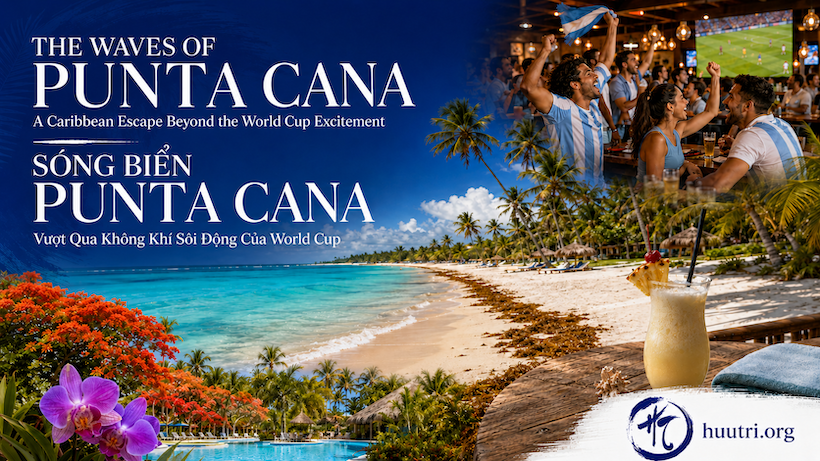
Sea breezes carry the salty scent of the ocean, coral, and seaweed, leaving the spirit light and refreshed. Here and there, flamboyant trees burst into fiery red blossoms beneath a deep blue, cloudless sky. When a gentle breeze passes through, the blossoms break free from their branches, floating and spinning through the air before settling on the perfectly groomed lawn.
Suddenly, the green grass is decorated with red, blue, and yellow splashes of color, creating a magnificent natural painting. As guests walk along the path, it is almost impossible not to step on a fallen red blossom, bringing its brief life to an end. Will it somehow be reborn as another flower? Who can say?
As afternoon approaches, stronger breezes blow in from the ocean, easing the heat enough for the weather to be called pleasant. Guests wander leisurely in thin sandals, exploring one corner of the resort after another.
And look—there is a purple orchid growing quietly from a piece of decaying wood beside a small pool of water. It seems neither concerned nor shy as a stranger admires and photographs it. If the orchid could speak, perhaps it would whisper, “Please do not take too many pictures, or you may fade the purple from my petals.”
Before long, the path leads to a vast swimming pool filled with crystal-clear water. Vacationers are scattered across long lounge chairs, some sitting and others lying down. Children splash, shout, and float around the pool on inflatable ducks and animals, their carefree laughter filling the air. They seem completely unconcerned about the fierce World Cup battles taking place back home.
Around the pool, bodies of every shape and size stretch out on fabric loungers. Some are beautifully tanned and athletic; others are large and round, resembling seals glistening with sunscreen as they bask beneath the tropical sun.
The Sports Bar
Saying that we came to Punta Cana to escape the noise and excitement surrounding the World Cup in the United States is one thing. Actually escaping soccer in Latin America is something else entirely.
Inside the resort, a huge screen has been installed in a theater with hundreds of seats. For anyone who wants a little alcohol to add to the excitement of the match, the nearby bar is ready to serve. There is plenty of beer—and it is draft beer poured directly from a kegerator, not beer from a can. Finish one glass, return it to the bar, and the staff will immediately fill another. If guests want a handful of roasted peanuts still in their shells, those are available too. All they need to do is reach out and take some.
Upon entering the resort’s Sports Bar, one immediately notices that guests of every age—men and women, young and old—are wearing white shirts with light blue stripes, the familiar colors of Argentina’s national team.
Spanish can be heard here and Portuguese there—or so one assumes, knowing little more than “Hola” in Spanish and “Olá” in Portuguese.
The huge screen on the stage is turned on early to show the pregame coverage. More and more guests pour into the room, while the beer taps operate without pause.
Today’s match is Argentina versus England. No wonder the theater is packed. The fans are hoping Argentina will finally avenge the loss of the Falkland Islands to Britain in 1982—a resentment as deeply rooted as the historic grievance over Đồ Bàn.
In the 55th minute, an English player sends the ball into Argentina’s net. The entire room cries out in pain and disappointment. England leads 1–0. Some fans cover their eyes with their hands, unable to bear looking at the score.
Then Argentina begins to fight back, with the same fierce determination as soldiers once resisting an invading enemy. The spectators continue to believe that even if Argentina lost on the battlefield, it must prevail on the soccer field.
In the 85th minute, Lionel Messi, wearing number 10, delivers the ball to number 24, Fernández, who heads it into England’s net. The score is tied 1–1.
The room erupts with applause and cheers. The equalizer gives Argentina new energy and hope. The tension becomes almost unbearable. Because smoking is prohibited, spectators cope by reaching for another glass of beer. A room that had been silent with anxiety suddenly becomes loud and electric. It feels ready to explode.
Then, in the 92nd minute of stoppage time, Messi once again sends in the ball. Number 22, Martínez, heads home Argentina’s second goal, bringing the dramatic, breathless match to a thrilling conclusion.
Argentina defeats England 2–1 in Atlanta.
The entire theater shakes as if struck by an earthquake. Fans climb onto chairs and tables, pull off their white-and-blue shirts, and whirl them overhead while shouting, clapping, and chanting in unison.
The writer can no longer remain a detached observer and joins in the celebration, applauding and shouting until his voice becomes hoarse.
From all four corners of the Sports Bar, Argentina’s national anthem rises in unison, followed by thunderous chants:
“Argentina! Argentina!”
The overwhelming excitement gradually settles when the screen shows Messi embracing England captain Harry Kane and sharing in the sorrow of defeat.
Who could have known that only a few days later, in the final, Messi himself would fight back tears as he brought his athletic career to a close? Spain’s 19-year-old Lamine Yamal, wearing red jersey number 19, would also embrace his 39-year-old idol.
Most heartbreaking of all—something no one could have predicted—was that the same English team defeated by Argentina would later send France home with an astonishing but very real 6–4 score.
That is the magic of the world’s most popular sport. Soccer creates powerful emotions that unite people around the globe, yet it can also bring disappointment and loss ranging from painful to utterly devastating.
Swimming at Punta Cana
The original plan in booking a trip to Punta Cana was to immerse oneself in clear blue water, where gentle waves ripple and dissolve into white foam across soft sand.
Reality, however, is quite different.
The beach stretches toward the horizon, but much of it is covered with seaweed carrying a strong, fishy odor. Simply stepping across the piles of seaweed feels unpleasant—so who would want to enter the water?
The sea is a deep blue, almost black. Waves roar and crash repeatedly onto the shore, producing powerful gusts of wind that send shirts, hats, and scarves flying from people walking along the sand.
Still, the waves continue rolling in, while vacationers sit or recline on beach chairs, relaxing with Mojitos or Piña Coladas decorated with red cherries or tiny colorful umbrellas.
War continues in the Middle East. Across North America, World Cup matches continue eliminating teams and sending them home. Here in Punta Cana, however, guests leisurely enjoy their own private days of rest.
Not every group comes to Punta Cana simply to relax. Some arrive to celebrate a birthday for a wife, husband, child—or perhaps a “new” sweetheart. One couple celebrates its 25th wedding anniversary, while another comes to exchange marriage vows beneath a gazebo on the sand, surrounded by the flickering light of torches.
Whatever brings them here, everyone must eat and drink.
The coffee shop remains open 24 hours a day. Italian, Japanese, and Dominican restaurants operate on scheduled hours, while the buffet serves breakfast, lunch, and dinner, offering different dishes each day.
That is the all-inclusive experience, whether in Cancún, Curaçao, or Punta Cana: attentive service designed to satisfy guests as fully as possible.
But every celebration must eventually end, and every vacation must come to a close. Guests once again pack their belongings, roll their suitcases out to the waiting vehicles, and return to the realities of life back home.
Then the saving begins all over again, in anticipation of another journey to some faraway destination.
– Đức Hà-
Special to HuuTri.org