
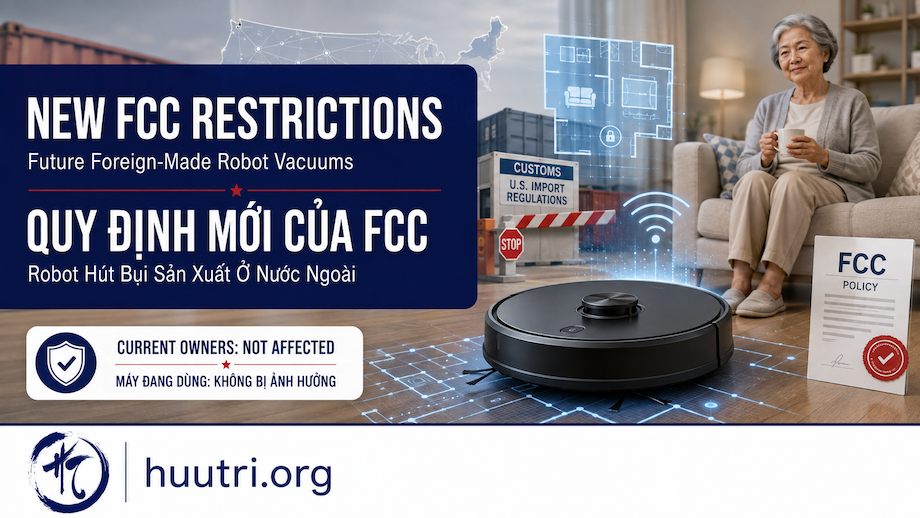
The FCC’s new restrictions may affect future foreign-made robot vacuums, but seniors can continue using the machines they already own.
Robot vacuums have become valuable household helpers, particularly for retirees, people with limited mobility and anyone who finds bending, sweeping or pushing a conventional vacuum physically difficult.
Recent headlines claiming that the United States has “banned Roombas,” however, have caused unnecessary confusion. Here is the most important reassurance:
If you already own a Roomba or another robot vacuum, you do not have to stop using it. The government is not recalling, disabling or confiscating these machines.
The new federal restrictions primarily concern future robot models manufactured outside the United States that had not received Federal Communications Commission authorization before July 28, 2026.
 What did the federal government actually do?
On July 28, 2026, the FCC added “foreign-produced advanced robotic devices” to its Covered List. Equipment on this list generally cannot receive the FCC authorization required before a new wireless product may be imported, marketed or sold in the United States.
The definition covers many devices that:
- Move and navigate autonomously on the ground.
- Avoid obstacles using cameras, LiDAR or other sensors.
- Operate without a person standing beside them.
- Connect through Wi-Fi, Bluetooth, cellular or another network.
- Use software or artificial intelligence to navigate or collect data.
- Weigh more than 4.4 pounds, including the charging or cleaning station.
Although the original policy focused considerable attention on humanoid and four-legged robots, many modern robot vacuums also satisfy these requirements. FCC announcement, FCC consumer and industry FAQ
What is—and is not—affected?
The FCC rule does not:
- Prohibit consumers from using robot vacuums they already own.
- Require owners to return or dispose of their machines.
- Prevent retailers from selling models previously authorized by the FCC.
- Prevent manufacturers from making and importing additional units of previously authorized models.
- Automatically discontinue apps, warranties, replacement parts or customer support.
The FCC has also temporarily permitted certain software and firmware updates for previously authorized products through at least January 1, 2029. These updates may be necessary to fix security problems and keep devices working with updated phones and operating systems.
The restriction primarily affects a new foreign-produced model seeking its first FCC authorization after July 28, 2026. Manufacturers may also apply for conditional approval if they can demonstrate that a product does not present the identified national-security risks.
Familiar brands and models: What owners should know
The FCC did not publish a list banning individual brands or specific currently available models. The following table provides examples of popular models already sold in the United States and the manufacturers’ documented or reported production locations.
Country of manufacture can vary by production run, factory and model number. The label on the actual machine or packaging is more reliable than the location of a company’s headquarters.
| Brand and ownership | Examples of models already marketed in the U.S. | Documented or reported production locations | What current owners should know |
| iRobot Roomba — originated in Massachusetts; acquired by China-based Picea Robotics following iRobot’s restructuring | Roomba 600, 900, e, i, j and s series; Roomba Combo j7/j9; Combo 10 Max; Roomba 105; 205 DustCompactor; Plus 405/505; Max 705 | iRobot previously reported contract manufacturing in southern China, Vietnam and Malaysia. Its newer manufacturing partner Picea operates in China and Vietnam. | Roombas already owned remain legal and usable. Previously authorized models may continue to be manufactured, imported and sold. |
| Roborock — Chinese company headquartered in Beijing | Q5 Max+, Qrevo Curv, Qrevo Edge, Saros 10 and Saros 10R | Production is outside the United States and primarily associated with China. Check the individual product label. | Current authorized models remain available. Future models produced abroad may need conditional approval. |
| ECOVACS DEEBOT — Chinese company headquartered in Suzhou | DEEBOT N30 Pro Omni, T50 Max Pro Omni and X8 Pro Omni | ECOVACS operates major robot-manufacturing facilities in China, including Suzhou and Nanxun. | ECOVACS says its existing authorized U.S. products and customers are not affected. |
| Dreame — Chinese company headquartered in Suzhou | L40 Ultra, L50 Ultra and X50 Ultra | Dreame operates manufacturing facilities in Suzhou, China. | Existing authorized U.S. models can continue to be used and sold. Future foreign-produced models face the new authorization process. |
| Eufy — smart-home brand of China-based Anker Innovations | RoboVac series, X10 Pro Omni, S1 Pro and E28 | Production is outside the United States; Anker and its production partners have manufacturing relationships in China and Vietnam. Check the model label for the specific unit. | Eufy says products currently sold in the United States remain available, supported and eligible for updates. |
| Shark — SharkNinja is headquartered in Massachusetts | Shark Matrix Plus 2-in-1 and PowerDetect 2-in-1 NeverTouch Pro | Shark uses overseas contract manufacturing, including production relationships in China and Vietnam. The precise country can differ by model or shipment. | Shark says its currently sold U.S. robot vacuums will remain available for sale, use and support. |
| Narwal — Chinese robotics company | Freo X Ultra, Freo Z Ultra and Freo Pro | Produced outside the United States, primarily through Chinese manufacturing operations. | Narwal says its previously certified products continue to work, remain supported and are still available at retailers. |
| Samsung — South Korean company | Jet Bot, Jet Bot AI+ and Bespoke Jet Bot Combo AI | Samsung products are manufactured across several Asian countries, including South Korea and Vietnam. Consumers should verify the label on the exact unit. | Previously authorized Jet Bot models are not automatically affected. The rule matters primarily for future foreign-produced models. |
| Matic — U.S. consumer-robotics company | Matic vacuum-and-mop robot | The company says it assembles its robot in California. | It may be better positioned under the rule, although U.S. assembly alone does not automatically establish that a product meets the federal “domestic end product” standard. |
Manufacturers’ statements compiled after the FCC announcement confirm that current ECOVACS, Eufy, Narwal and Shark products remain supported. Manufacturer responses
For iRobot specifically, its federal filing documented contract-manufacturing plants in China, Vietnam and Malaysia, with increasing dependence on Picea facilities in China and Vietnam. iRobot SEC filing
Does a “Made in China” label mean the vacuum is now illegal?
No.
The country-of-origin label alone does not determine whether a robot currently in a home or store is prohibited. The important questions are:
- Is this an existing model that received FCC authorization before July 28, 2026?
- Is it being sold through an authorized U.S. retailer?
- Does it have a valid FCC identification number?
- Is it a future model seeking its first authorization after the new rule took effect?
A newly manufactured unit of an older, previously authorized model may still be imported and sold. Therefore, “manufactured after July 28” does not necessarily mean “banned.”
Consumers can locate the FCC ID on the bottom of the robot, charging station, packaging or electronic regulatory-information screen and check it through the FCC ID database.
Why are robot vacuums considered a security concern?
Modern robot vacuums are small computers on wheels. Depending on the model, they may contain:
- LiDAR scanners that produce a floor plan.
- Cameras that recognize furniture, pets and obstacles.
- Microphones or voice-control technology.
- Wi-Fi connections and cloud-based accounts.
- Cleaning histories and room names.
- Software that can be updated or controlled remotely.
These features allow a robot to clean more effectively, but they can also create privacy and cybersecurity risks if the company’s servers, software or user account are compromised.
The FCC is not claiming that every robot vacuum is spying on its owner. Its decision addresses the broader possibility that a connected foreign-produced robot could expose household data, be accessed remotely or create dependence on an overseas supply chain.
Seven protective steps for retirees and their families
You do not need to abandon a useful robot vacuum. Instead, take several sensible precautions:
- Keep the app and robot updated. Security updates often repair newly discovered vulnerabilities.
- Use a unique password. Do not reuse the password from your email, bank or Medicare account.
- Enable two-step verification when the manufacturer offers it.
- Use a separate Wi-Fi network for smart devices. Many modern routers allow a guest or IoT network that keeps a robot vacuum separate from computers containing financial or medical records.
- Review privacy settings. If you do not need remote camera viewing, microphone access, voice assistants or map sharing, turn those functions off.
- Purchase the U.S. version from a reputable retailer. Avoid inexpensive “international,” “global,” gray-market or imported versions that may lack U.S. authorization, warranty coverage or compatible app support.
- Factory-reset the machine before selling, donating or discarding it. This removes account information, maps and cleaning preferences. iRobot provides reset and data-management instructions through its app. iRobot privacy guidance
The Federal Trade Commission also recommends changing default passwords, enabling two-factor authentication and regularly installing software updates on Internet-connected household devices. FTC smart-device security guidance
The bottom line for retirees
If your Roomba, Shark, Roborock, ECOVACS, Eufy, Dreame, Narwal or Samsung robot vacuum is already cleaning your home, there is no need to stop using it.
The FCC action is primarily a future-market restriction, not a recall of household appliances. Previously authorized models may continue to be manufactured, imported, sold, updated and used.
The most important change will probably occur gradually: some future models manufactured outside the United States may be delayed, redesigned, produced domestically or withheld from the American market unless their manufacturers obtain conditional approval.
For retirees who depend on these machines, the best response is not panic. Continue using the equipment carefully, install security updates and verify the exact model, FCC authorization and country-of-manufacture label before making the next purchase.
Information current as of August 13, 2026. Because manufacturers may change factories and sourcing arrangements, consumers should verify the label on the specific unit rather than relying solely on the brand’s home country.
-Nguyễn Bách Khoa-