
Information current through August 15, 2026, using CDC and FDA updates available through August 13. Most reported activity occurred from May through early August 2026.
Key national numbers
| Category | Confirmed illnesses | Hospitalizations | Deaths |
|---|---|---|---|
| U.S.-acquired cases, May 1–Aug. 10 | 13,895 | 740 | 2 |
| Iceberg-lettuce outbreak | 9,481 | 398 | 2 |
| Travel-associated cases acquired abroad | 1,530 | 58 | 0 |
The 13,895 domestic cases were reported by 47 states, the District of Columbia and Puerto Rico. CDC is reviewing at least 10,455 additional possible cases, so totals will probably continue rising because reporting and investigation can take as long as six weeks. By comparison, only 1,180 domestic cases were reported during May–August 2025. CDC national surveillance
These totals must not be added together: the 9,481 lettuce-linked illnesses and the smaller FDA clusters described below are included within, or may overlap with, national surveillance.
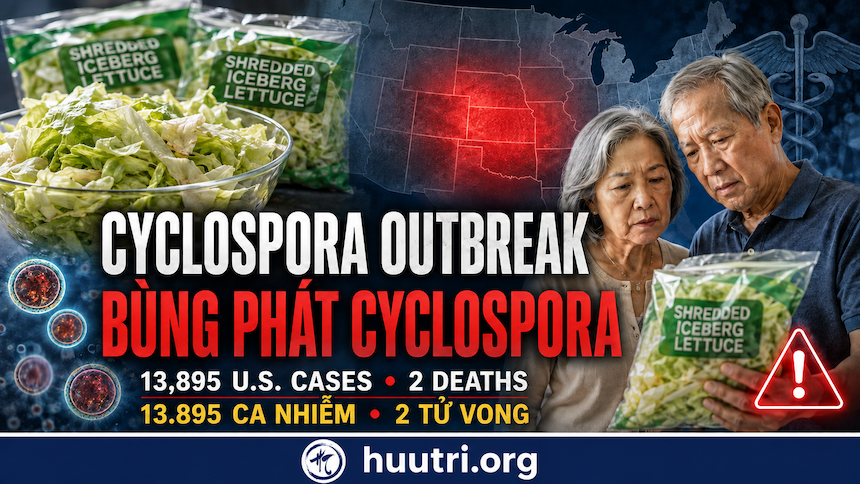 1. Major outbreak linked to iceberg lettuce
This is a multistate foodborne parasitic outbreak caused by Cyclospora cayetanensis. It is not Salmonella and is not a virus.
As of August 13:
- 9,481 laboratory-confirmed illnesses
- 398 hospitalizations
- 2 deaths
- Illness onset dates: June 14–August 3, 2026
- Cases linked to the outbreak in 17 states:
- Arkansas
- Iowa
- Illinois
- Indiana
- Kansas
- Kentucky
- Massachusetts
- Maine
- Michigan
- Missouri
- Nebraska
- New Hampshire
- North Carolina
- Ohio
- Oklahoma
- Pennsylvania
- West Virginia
People may live elsewhere but were counted after visiting one of these states and becoming exposed there. CDC outbreak investigation, FDA investigation
Source and recall
Investigators linked the outbreak to processed iceberg lettuce from Taylor Farms de Mexico, sourced from central Mexico. It was served or sold at several locations, including:
- Certain Taco Bell locations
- Marketside products sold at selected Walmart stores
- Restaurants and institutional food-service customers
- Various chopped, shredded, salad-mix and iceberg-romaine blend packages
On July 17, Taylor Farms recalled all implicated iceberg lettuce from central Mexico. The specifically identified Walmart products were:
- Marketside Iceberg Salad, 12- and 24-ounce packages
- Marketside Shredded Lettuce, 8- and 16-ounce packages
- “Best if Used By” dates from July 18 through August 3, 2026
The recalled food-service products were distributed from June 29 through July 16. Confirmed distribution reached at least 31 states; additional distribution may have included California, Delaware, District of Columbia, North Dakota, Puerto Rico, Rhode Island, South Dakota, Vermont and Washington. FDA recall notice and product list
Is the lettuce still being sold?
FDA states that:
- All listed best-by dates have passed.
- The recalled lettuce should no longer be in stores or restaurants.
- Taco Bell stopped using Taylor Farms de Mexico lettuce on July 17.
- FDA is confident the implicated lettuce from this outbreak is off the market.
- FDA’s inspection and sampling investigation remains ongoing.
Therefore, this is not currently a federal warning to avoid all lettuce or all fresh produce. Anyone who still has an old recalled package should discard it and sanitize containers, refrigerator drawers, counters or utensils that contacted it.
2. Two deaths in Michigan
Both deaths occurred in Michigan. State officials said both individuals had significant underlying medical conditions that may have been adversely affected by cyclosporiasis and dehydration. Both became ill before the July 17 recall.
Cyclospora is generally not considered life-threatening, and deaths are uncommon, but prolonged watery diarrhea and dehydration can become dangerous—especially for older or medically fragile adults. Michigan Department of Health and Human Services
Michigan reported 13,909 total cases, 314 reported hospitalizations and two deaths as of August 13. That state total is not directly comparable with CDC’s national figure because Michigan includes all cases reported during its investigation, while CDC applies its national laboratory-confirmed and domestic-acquisition criteria and uses a different reporting cutoff.
3. Other Cyclospora clusters under investigation
The iceberg-lettuce outbreak does not explain every U.S. case. FDA’s active investigation table identifies several additional clusters whose food sources have not been confirmed:
| FDA reference | Posted | Cases | Status | Product identified? |
|---|---|---|---|---|
| #1398 | Aug. 5 | 11 | Ongoing | No |
| #1392 | July 22 | 172 | Ongoing | No |
| #1385 | July 8 | 25 | Ongoing | No |
| #1384 | July 8 | 18 | Outbreak ended | No |
| #1381 | June 17 | 2 | Ended | No |
| #1375 | June 3 | 8 | Ended | No |
FDA has initiated traceback and, for some clusters, food sampling. No recalls, deaths or public product-specific warnings have been announced for these unidentified-source clusters. These case counts should not be added to CDC totals because they are part of national surveillance and could be reclassified as investigations progress. FDA outbreak investigation table
North Carolina also reported an unusual increase in cases. Interviews frequently identified parsley and cilantro consumption, but officials emphasized that this does not prove either herb was the source and that multiple exposure sources may exist. Consumers should not interpret this as a parsley or cilantro recall. North Carolina DHHS
What is Cyclospora?
Cyclospora cayetanensis is a microscopic, single-cell parasite that infects the small intestine.
People become infected by swallowing food or water contaminated with human fecal material containing the parasite. In the United States, outbreaks have frequently involved fresh produce eaten raw.
Unlike many stomach infections:
- It is unlikely to spread directly from one person to another.
- After leaving an infected person’s body, the parasite usually must mature in the environment for at least one to two weeks before becoming infectious.
- A person can become infected more than once.
- Routine chemical sanitizers may not reliably kill it. CDC overview
Symptoms
Symptoms usually begin about one week after exposure, but may appear from two days to two weeks or longer afterward.
The most characteristic symptom is:
- Prolonged, frequent watery diarrhea
Other symptoms include:
- Loss of appetite
- Unintended weight loss
- Stomach cramps or pain
- Bloating and increased gas
- Nausea
- Fatigue or unusual weakness
- Vomiting
- Headache
- Body aches
- Low-grade fever
Some infected people have no symptoms. Without effective treatment, illness may last from several days to a month or longer. Symptoms can temporarily disappear and then return—a characteristic relapse pattern.
Possible complications include:
- Dehydration and electrolyte imbalance
- Malabsorption and nutritional problems
- Gallbladder inflammation
- Reactive arthritis
- Worsening of underlying kidney, heart or other chronic medical conditions
Special warning for seniors
Older adults are not necessarily more likely to become infected, but they can experience more serious consequences from persistent diarrhea because they may:
- Have less physiologic reserve and become dehydrated faster
- Not feel thirst as strongly
- Have chronic kidney, heart or liver disease
- Take diuretics or other medications affecting fluids and electrolytes
- Have diabetes or weakened immunity
- Have difficulty preparing food or replacing fluids independently
- Be receiving cancer treatment, transplant medication or immune-suppressing drugs
Family members and caregivers should monitor for:
- Reduced urination or very dark urine
- Dry mouth
- Dizziness, especially when standing
- Increasing weakness
- Confusion, disorientation or unusual sleepiness
- Rapid heartbeat
- Fainting
- Inability to drink or keep fluids down
Seek prompt medical care for bloody diarrhea, diarrhea lasting more than three days, fever above 102°F, repeated vomiting, confusion or signs of dehydration. For a frail senior or someone with kidney, heart or immune problems, it is prudent to contact the clinician earlier rather than waiting several days. CDC foodborne-illness warning signs
Testing and diagnosis
Cyclospora is diagnosed through a stool test, but there is an important limitation:
Routine stool cultures and some gastrointestinal PCR panels do not automatically test for Cyclospora.
Patients should tell the clinician about:
- Watery or relapsing diarrhea
- Fresh lettuce, salad or herb consumption
- Restaurant meals during the two weeks before illness
- International travel
- Whether another household or dining companion became ill
The clinician may need to specifically request Cyclospora testing. Because detection can be difficult, several stool samples collected on different days may be necessary.
Treatment
The treatment of choice is the prescription antibiotic combination:
Trimethoprim-sulfamethoxazole, or TMP-SMX, commonly sold as Bactrim, Septra or Cotrim.
CDC’s standard regimen for an otherwise immunocompetent adult is one double-strength tablet—TMP 160 mg/SMX 800 mg—twice daily for seven to ten days. The treating clinician must determine the appropriate dose and duration; people with weakened immune systems may require longer treatment. CDC clinical treatment guidance
Additional care includes rest and replacement of fluids and electrolytes. People with heart failure, kidney disease or a prescribed fluid restriction should ask their clinician how much and what kind of fluid to consume.
Medication warning for seniors
Seniors should not take leftover TMP-SMX or obtain it without medical supervision. Before prescribing it, the clinician or pharmacist should review:
- Sulfa-drug allergy
- Kidney and liver function
- Potassium level
- Warfarin or other anticoagulants
- Digoxin
- Diabetes medication
- Diuretics
- ACE inhibitors, ARBs or potassium-sparing medicines
- Methotrexate and seizure medications
TMP-SMX can affect kidney function and potassium and can interact with warfarin and digoxin, particularly in older patients. NIH DailyMed safety information
No consistently effective alternative has been established for people with serious sulfa allergy. Metronidazole, azithromycin, doxycycline and several other commonly used antibiotics are not considered effective treatments for Cyclospora. The clinician should consult an infectious-disease specialist when treatment is necessary but TMP-SMX cannot be used.
Prevention
The following measures reduce risk but cannot guarantee removal of Cyclospora:
- Check CDC and FDA food-recall alerts.
- Do not eat recalled food.
- Wash hands with soap and water before and after handling produce.
- Rinse fruits, vegetables and herbs thoroughly under running water.
- Do not rely only on soaking produce in a bowl of water.
- Scrub firm produce such as cucumbers and melons with a clean produce brush.
- Remove bruised or damaged portions.
- Separate raw produce from raw meat and unwashed items.
- Clean cutting boards, knives, refrigerator drawers and countertops.
- Refrigerate cut, peeled or cooked produce within two hours.
- Remember that “prewashed” produce is not guaranteed to be free of Cyclospora.
- When practical—particularly for medically vulnerable seniors—choose cooked produce. Heating produce to at least 158°F/70°C kills the parasite.
- When traveling in tropical or subtropical regions, use safe water and be cautious with uncooked fruits, salads and herbs. Routine chemical water or food disinfection may not destroy Cyclospora. CDC prevention guidance
Bottom line
The recalled iceberg lettuce is believed to be off the market, but the investigation remains active and delayed diagnoses may continue increasing the reported totals. Anyone—especially a senior—who develops persistent or recurring watery diarrhea should contact a healthcare provider, mention the 2026 Cyclospora outbreak and specifically ask whether Cyclospora stool testing is appropriate.
-Phan Trần Hương-