
Part 2 of a two-part retirement education series for Vietnamese Americans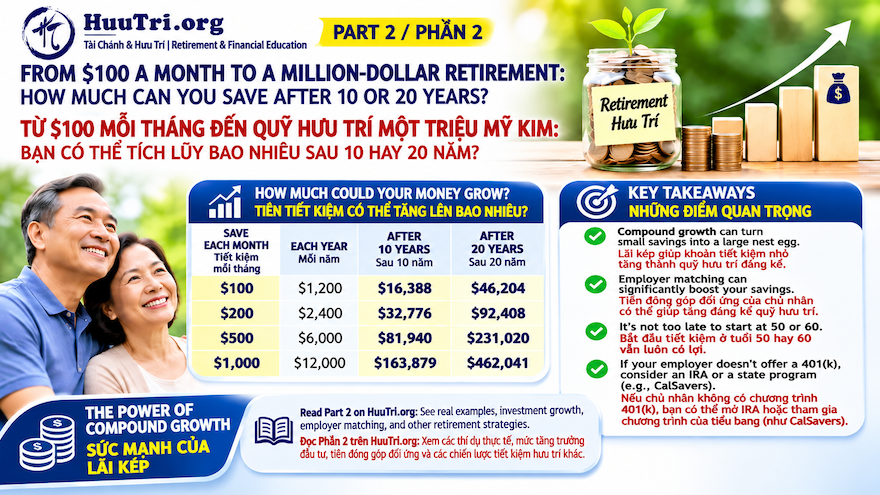
Is it possible for a restaurant worker, nail technician, retail employee, or small-business owner to build a meaningful retirement fund by saving just $100 or $200 a month?
The answer is yes. The key is starting early, contributing consistently, and allowing investments to grow over time.
In Part 1 of this series, HuuTri.org examined the new federal 401(k) and 403(b) retirement rules, automatic enrollment requirements, employee contribution limits, and retirement savings responsibilities for small-business owners.
In Part 2, we examine how these retirement programs can translate into actual financial security for Vietnamese-American workers and their families.
- The power of compound growth
Many Vietnamese-American workers believe they need substantial incomes before they can begin investing for retirement.
However, even modest contributions can accumulate into meaningful savings over several decades.
Compound growth occurs when investment earnings remain in an account and have the opportunity to generate additional earnings over time.
The longer money remains invested, the greater its potential for growth, although investment returns are never guaranteed.
Consider the following examples, assuming a hypothetical annual investment return of 6%, compounded monthly, with contributions made at the end of each month.
| Monthly contribution | Annual contribution | After 10 years | After 20 years |
| $100 | $1,200 | $16,388 | $46,204 |
| $200 | $2,400 | $32,776 | $92,408 |
| $500 | $6,000 | $81,940 | $231,020 |
| $1,000 | $12,000 | $163,879 | $462,041 |
An employee investing $200 per month for 20 years would contribute a total of $48,000. With the assumed investment growth, the account could reach approximately $92,400.
Nearly half of that balance would represent potential investment earnings rather than the employee’s original contributions.
- What happens when employees contribute the maximum allowed?
For 2026, the IRS allows eligible employees participating in most conventional 401(k) and 403(b) plans to contribute:
- $24,500 annually for most employees under age 50.
- $32,500 annually for qualifying employees aged 50 and older, including an $8,000 catch-up contribution.
- $35,750 annually for qualifying employees aged 60–63, including an enhanced $11,250 catch-up contribution.
The following hypothetical projections compare these annual contribution amounts using a constant 6% annual investment return.
| Annual contribution | Monthly equivalent | After 10 years | After 20 years |
| $24,500 | $2,041.67 | $334,587 | $943,333 |
| $32,500 | $2,708.33 | $443,840 | $1,251,361 |
| $35,750 | $2,979.17 | $488,224 | $1,376,497 |
These figures illustrate the potential power of consistent investing. They are not guarantees or predictions.
The enhanced $35,750 allowance is available only during the qualifying ages of 60 through 63 under the 2026 rules. Therefore, the last row represents a mathematical comparison rather than a contribution schedule that an employee could actually maintain for 10 or 20 consecutive years.
Future contribution limits, investment returns, account fees, taxes, and inflation will affect actual results.
- Five retirement savings scenarios for Vietnamese-American workers
Scenario A: A nail salon employee saving $100 per month
A 35-year-old nail technician earns approximately $30,000 annually and has never established a retirement account.
The employee decides to save $100 per month, equivalent to 4% of annual income.
After 10 years:
- Personal contributions: $12,000
- Hypothetical account balance: $16,388
- Potential investment growth: $4,388
After 20 years:
- Personal contributions: $24,000
- Hypothetical account balance: $46,204
- Potential investment growth: $22,204
If the salon does not offer a 401(k), the employee could investigate CalSavers, where applicable, or establish an individual IRA independently.
Scenario B: A restaurant employee saving $200 per month
A 45-year-old restaurant employee earns $40,000 annually and contributes $200 per month to a retirement account.
The contribution represents 6% of annual income.
By age 65, after 20 years:
- Personal contributions: $48,000
- Hypothetical account balance: $92,408
- Potential investment growth: $44,408
This retirement fund could provide an important financial supplement to Social Security.
Scenario C: An employee maximizing regular 401(k) contributions
A 40-year-old professional earns sufficient income to contribute the 2026 regular maximum of $24,500 annually.
Assuming contributions remain at that dollar amount and investments earn a hypothetical 6% annually, the account could grow to approximately $334,600 after 10 years and $943,300 after 20 years.
This example excludes employer matching and additional age-based catch-up contributions the employee could become eligible for at age 50.
Scenario D: A professional accelerating retirement savings at age 50
A 50-year-old employee earns $100,000 annually and decides to take advantage of the regular catch-up contribution.
Under the 2026 limits, the employee can contribute up to $32,500 annually, assuming plan eligibility.
This represents 32.5% of annual gross income.
After 10 years:
- Employee contributions: $325,000
- Hypothetical account balance: $443,840
- Potential investment growth: $118,840
This aggressive savings strategy may be particularly attractive to workers whose children have become financially independent or whose mortgages and other household debts have been substantially reduced.
However, employees should maintain adequate emergency savings and sufficient income for everyday living expenses.
Scenario E: An employee aged 60–63 preparing for retirement
A 60-year-old employee wants to take full advantage of the enhanced catch-up opportunity during the four qualifying years before turning 64.
Using the 2026 annual maximum of $35,750:
- Monthly contribution: approximately $2,979
- Four years of employee contributions: $143,000
- Hypothetical balance after four years: approximately $161,100
This amount could be added to the employee’s existing retirement savings.
The enhanced catch-up provision is particularly valuable for workers who started saving later in life and have sufficient income to accelerate their contributions.
- Employer matching: One of the most valuable retirement benefits
An employer match is an additional contribution that an employer makes based on an employee’s retirement contributions.
Suppose a company offers a dollar-for-dollar match on the first 3% of an employee’s salary.
An employee earning $50,000 annually contributes 3%, or $1,500.
The employer contributes another $1,500, bringing total annual contributions to $3,000.
| Savings period | Without employer match | With employer match |
| 10 years | $20,485 | $40,970 |
| 20 years | $57,755 | $115,510 |
Under the same hypothetical investment assumptions, employer matching doubles the projected balance in this example.
Employees should understand their company’s matching formula and vesting requirements before deciding how much to contribute.
Not all employers offer matching contributions, and federal automatic enrollment requirements do not universally require employer matching.
- Traditional 401(k) versus Roth 401(k)
Employees may have the opportunity to choose between traditional and Roth retirement contributions.
| Feature | Traditional 401(k) | Roth 401(k) |
| Contributions | Generally pre-tax | After-tax |
| Current income tax benefit | Generally yes | No |
| Qualified retirement withdrawals | Generally taxable | Generally tax-free |
| Potentially attractive to | Workers expecting lower future tax rates | Workers expecting higher future tax rates |
For example, an employee contributing $200 per month to a traditional 401(k) may experience a reduction in take-home pay of less than $200 because the contribution generally reduces current taxable income.
Roth contributions do not provide that immediate income tax reduction, but qualified withdrawals can be tax-free in retirement.
The appropriate choice depends on current and anticipated retirement income, tax filing status, and long-term financial goals.
- What can workers do if their employers do not offer a retirement plan?
Employees do not necessarily have to wait for their employers to establish a 401(k).
Workers with eligible compensation may open an individual retirement account through a brokerage firm, bank, or other qualified financial institution.
Common options include:
Traditional IRA: Contributions may be tax-deductible, depending on income and workplace retirement coverage. Withdrawals are generally taxable.
Roth IRA: Contributions are made with after-tax income, and qualified withdrawals are generally tax-free. Income eligibility restrictions apply.
State-facilitated retirement programs: Employees in participating states may contribute through payroll deductions when their employers do not offer a qualifying retirement plan.
For 2026, the general combined contribution limit for traditional and Roth IRAs is $7,500, or $8,600 for individuals aged 50 and older.
Self-employed individuals may also investigate retirement options such as a SEP IRA, SIMPLE IRA, or Solo 401(k), depending on their business circumstances.
An ordinary IRA does not provide the same employee contribution limits as a conventional employer-sponsored 401(k), but it can still provide an important foundation for retirement savings.
- Is it too late to start saving at age 50, 55, or 60?
Absolutely not.
Consider an employee who contributes $500 per month for 10 years. Assuming a 6% annual investment return, the retirement account could reach approximately $81,940.
Someone contributing $1,000 monthly over the same period could accumulate approximately $163,879.
Although starting earlier provides more time for compound growth, workers in their 50s and early 60s may have advantages they did not have when they were younger:
- Higher salaries and greater earning capacity.
- Reduced expenses associated with raising children.
- Lower mortgage balances.
- Eligibility for higher retirement catch-up contributions.
Older workers should also consider their investment risk carefully, particularly when approaching the age at which they expect to withdraw retirement savings.
- Retirement savings and Social Security should complement each other
Many Vietnamese-American seniors rely heavily on Social Security as their primary source of retirement income.
However, Social Security was designed to replace only a portion of a worker’s pre-retirement earnings.
Personal retirement savings can provide additional income to help cover:
- Housing and property taxes.
- Medicare premiums and medical expenses.
- Food, utilities, and transportation.
- Unexpected home repairs.
- Travel, family visits, and recreational activities.
- Long-term care expenses.
For example, a retiree with $250,000 in retirement investments who initially withdraws 4% annually would receive approximately $10,000 per year, or $833 per month before applicable taxes.
Someone with $500,000 would receive approximately $20,000 annually, or $1,667 monthly, using the same illustrative withdrawal rate.
These withdrawals could supplement Social Security benefits.
However, the commonly discussed 4% withdrawal rule is only a retirement planning guideline. It does not guarantee that savings will last throughout retirement.
- How to start building retirement savings today
Employees should begin by determining whether their employer offers a retirement plan and whether there is an employer matching contribution.
Those without workplace plans should investigate independent IRAs and state-sponsored retirement programs.
Workers with limited disposable income can start with an affordable contribution, such as $50, $100, or $200 per month, and increase it gradually.
It is equally important to understand investment fees, diversify investments appropriately, maintain emergency savings, and avoid unnecessary early withdrawals.
Eligible lower- and moderate-income workers should also investigate the federal Saver’s Credit for 2026, which may provide additional tax benefits.
The bottom line: Start with what you can afford
For many Vietnamese-American families, financial priorities have traditionally centered on purchasing a home, supporting children, funding education, and helping relatives.
Retirement savings sometimes receive less attention until workers reach their 50s or 60s.
The new federal retirement rules provide an opportunity to change that pattern. Automatic enrollment makes it easier to begin saving, while higher catch-up contributions provide additional opportunities for older workers.
Whether you are a 35-year-old nail technician saving $100 a month, a 45-year-old restaurant employee investing $200 a month, or a 60-year-old professional maximizing retirement contributions, every dollar invested can contribute to greater financial stability.
You do not have to become a millionaire to improve your retirement.
The most important step is to begin saving consistently, increase contributions when possible, and make informed financial decisions throughout your working years.
-Phan Trần Hương-
This concludes HuuTri.org’s two-part series on the new 401(k) and 403(b) retirement rules and retirement savings opportunities for Vietnamese Americans.
Disclaimer: All investment projections assume a hypothetical 6% annual return compounded monthly. They exclude fees, taxes, inflation, and changes in future contribution limits. Actual investment performance may be higher or lower, including losses. This article is intended for educational purposes and does not constitute individualized financial, investment, or tax advice.