
Meta, the parent company of Facebook and Instagram, has agreed to a landmark settlement valued at approximately $17 billion over allegations that it designed its platforms to keep children and teenagers online while failing to disclose the risks to their mental and physical health.
The proposed agreement, announced on August 26, 2026, would also require major changes to how Facebook and Instagram operate for users under 18. However, the settlement remains subject to court approval, and Meta continues to deny wrongdoing.
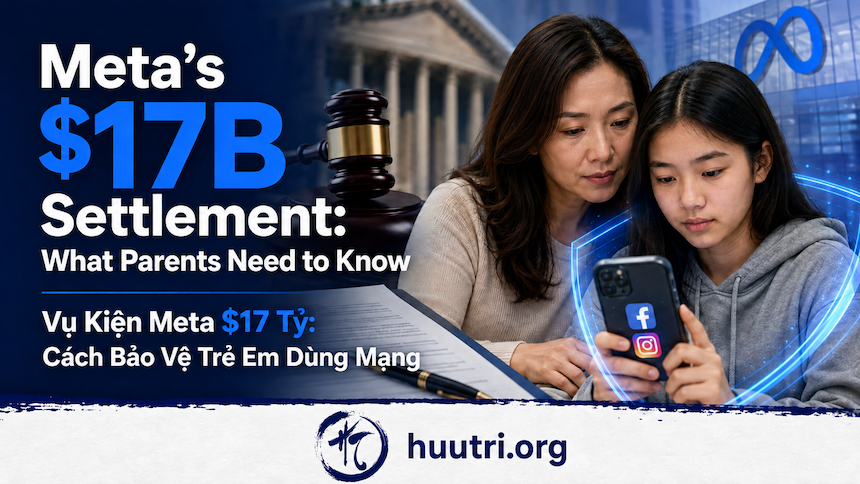 For parents and caregivers, the case is about much more than one company paying a large penalty. It challenges a business model built around capturing attention—and could establish new expectations for every social-media platform popular with young people.
How did the lawsuit begin?
The case grew out of a nationwide investigation launched by state attorneys general in November 2021. In October 2023, a bipartisan coalition of 33 attorneys general filed a federal lawsuit against Meta in the U.S. District Court for the Northern District of California. Several other states brought related cases in their own courts.
By the time of the settlement, a much broader coalition of state and territorial attorneys general had joined the agreement.
The trial began on August 18, 2026. State attorneys were preparing to present testimony and internal company evidence concerning Meta’s knowledge of the risks its platforms allegedly posed to young users. After several days of testimony, the parties reached a proposed settlement before the court issued a verdict.
This distinction is important: Meta was not found liable in this case. It settled the claims without admitting that it violated the law.
What did the states allege?
The lawsuit did not merely claim that some teenagers spent too much time on Instagram or Facebook. It alleged that Meta intentionally designed features that exploited the psychological vulnerabilities of children and teenagers to increase engagement and corporate profits.
According to the complaint, those features included:
- Infinite scrolling and autoplay, which remove natural stopping points
- Frequent notifications designed to pull users back into the apps
- Public like and reaction counts that encourage social comparison
- Disappearing content that creates a fear of missing out
- Recommendation algorithms that repeatedly deliver highly engaging content
- Filters that alter facial features and may intensify concerns about appearance
- Reward patterns compared by the states to the variable reinforcement used in gambling
The states alleged that, working together, these features encouraged compulsive and unhealthy use and contributed to problems involving sleep, anxiety, depression, body image and other physical or mental-health concerns.
They also accused Meta of misleading young users, parents and the public about the existence and seriousness of these risks.
A separate part of the case involved children under 13. The attorneys general alleged that Meta collected, retained and used personal information from underage children without obtaining verifiable parental consent, in violation of the federal Children’s Online Privacy Protection Act, commonly known as COPPA.
These remain allegations that Meta disputes. The settlement states expressly that it does not constitute an admission of liability or wrongdoing.
Is Meta actually paying $17 billion in damages?
The widely reported “$17 billion” figure is the maximum value of several payment components—not a jury award to individual families.
The settlement’s principal payment schedule provides up to approximately $16.68 billion to participating states over ten years. About $11.66 billion of that schedule is guaranteed, while roughly $5.02 billion is conditional. The agreement also includes $75 million for state investigation and litigation costs and approximately $459 million connected with certain Cambridge Analytica-related state claims. Together, the components bring the potential total to approximately $17.2 billion.
The conditional payments become due only if Snapchat, TikTok and YouTube adopt comparable age-assurance and time-management protections and, where applicable, become subject to comparable financial obligations.
Participating governments may use the money for purposes such as youth mental-health programs, crisis services, digital-wellness education, after-school activities, phone-free school initiatives and future consumer-protection enforcement. California is expected to receive between approximately $1.5 billion and $2.2 billion, depending on whether the conditional payments are triggered.
Families should not assume that the settlement creates an automatic claims process or that individual users will receive checks. The agreement resolves government enforcement claims but specifically preserves many private lawsuits brought by individuals, schools, municipalities and other plaintiffs.
What changes must Meta make?
If approved, the settlement would impose a series of protections on Facebook and Instagram accounts belonging to users under 18.
Major provisions include:
- A default combined limit of two hours per day across Facebook and Instagram, changeable to a less restrictive limit only with parental approval
- A default block on most app access between midnight and 6 a.m.
- Push notifications disabled between 10 p.m. and 7 a.m.
- School-day notifications disabled from 8 a.m. to 3 p.m. during most of the school year
- Usage reminders and “productive pauses” after extended sessions
- Like and reaction numbers hidden from teen users by default
- A prohibition against teens using cosmetic-procedure filters
- An option to use a non-personalized home feed
- Stronger parental supervision tools
- Better age-assurance systems to identify teen accounts and remove children under 13
- Faster responses to teenagers’ reports of potentially harmful content
- Independent audits and regular compliance reporting
Some exceptions matter. Messaging, settings and videos or audio classified as long-form content may not count fully toward the daily limit. Critics therefore argue that determined users may still spend substantial time inside Meta’s services.
If Snapchat, TikTok and YouTube adopt comparable rules, Meta’s daily limit would become more restrictive—generally one hour per app—and the nighttime block would expand to 10 p.m. through 7 a.m.
Does this send a warning to other social-media companies?
Yes—but it is both a warning and a direct financial incentive.
The size of the settlement tells technology companies that youth safety can no longer be treated merely as a public-relations issue. Features such as endless feeds, autoplay, notifications and public popularity scores may face legal scrutiny as deliberate product-design decisions.
The agreement also places unusual pressure on Meta’s largest competitors. Because more than $5 billion of Meta’s payments depends on Snapchat, TikTok and YouTube accepting comparable requirements, participating states now have a financial incentive to pursue industry-wide standards.
The signal is especially strong because state attorneys general from different political parties acted together. A platform may be able to challenge one state law, but coordinated lawsuits based on consumer-protection and privacy laws present a much larger legal and financial risk.
Still, the agreement is not a national law governing every social-media service. Its long-term importance will depend on court approval, effective age verification, independent enforcement and whether other platforms adopt—or are compelled to accept—similar protections.
What should parents do now?
Parents should not wait for the settlement’s protections to take effect. No automatic setting can replace an informed, continuing relationship between a child and a trusted adult.
1. Make sure the account shows the child’s real age
Safety settings cannot work properly if a teenager uses an adult birth date. Parents should review the age entered on every social-media account and avoid helping children under 13 bypass minimum-age requirements.
2. Create a family media plan
Set clear expectations about when, where and why social media may be used. The plan should apply to adults as well as children so that parents model the habits they expect.
Rather than focusing only on a single number of minutes, ask what media use is displacing: sleep, homework, exercise, family meals, hobbies or face-to-face friendships. The American Academy of Pediatrics recommends considering the child, the content, how media is used for calming, what it crowds out and how the family communicates about it.
3. Protect sleep
Keep phones and tablets outside bedrooms overnight. Establish a charging location in a shared area and turn off nonessential notifications. A practical family rule might suspend entertainment apps from 10 p.m. until after breakfast.
4. Activate the strongest available settings
Parents should enable supervision tools, private accounts, restricted-content settings and contact controls. When available, choose a non-personalized or chronological feed, hide like counts, disable autoplay and prevent messages from unknown adults.
5. Talk regularly instead of relying on secret surveillance
Ask children what they enjoy online, what makes them uncomfortable and what appears repeatedly in their feeds. Explain how algorithms learn from every pause, like, share and search.
Children are more likely to report harassment, sexual solicitation, scams or self-harm content when they know they will receive help—not immediate punishment or automatic loss of their phone.
6. Watch for changes in behavior
Possible warning signs include:
- Staying online late into the night
- Sudden withdrawal from family or friends
- Anxiety when separated from a device
- Declining grades or loss of interest in normal activities
- Extreme concern about appearance, weight or popularity
- Secretive accounts or contact with unknown adults
- Posts or conversations involving hopelessness or self-harm
A single sign does not prove that social media caused a problem. However, persistent or serious changes deserve attention from the child’s pediatrician or a qualified mental-health professional. If a child may be in immediate danger, call 911. In the United States, families can also call or text 988 for the Suicide & Crisis Lifeline.
The larger lesson
The Meta settlement recognizes something parents have long suspected: many online environments are not neutral tools. They are carefully engineered systems competing for a child’s time, attention and emotional response.
The proposed safeguards could make Facebook and Instagram safer, but they cannot eliminate every harmful post, manipulative feature or dangerous contact. Real protection will require responsible platform design, effective government oversight, informed schools and attentive families working together.
Parents should not blame themselves—or their children—for struggling against products designed to be difficult to put down. The better response is to understand how those products work, set reasonable boundaries and keep communication open.
The settlement may change the rules for Meta. Its greater legacy could be changing what society expects from every company seeking the attention of children.
-Phan Trần Hương-
Sources and further reading
- California Attorney General: Proposed Meta settlement and required reforms
- Proposed settlement agreement and consent judgment
- Multistate complaint against Meta
- U.S. Surgeon General: Social Media and Youth Mental Health
- American Academy of Pediatrics: Center of Excellence on Social Media and Youth Mental Health