
NVIDIA’s leadership crisis has rattled Wall Street, raised questions about U.S.-China technology policy, and created an unexpected opening for its biggest competitors. But are investors witnessing a changing of the guard in artificial intelligence—or simply a temporary disruption to the world’s dominant AI chipmaker?
SANTA CLARA, California — The sudden resignation of NVIDIA co-founder and CEO Jensen Huang on November 12, 2026, has sent shockwaves through the global artificial intelligence industry, raising a question that extends far beyond the allegations surrounding his personal life: Who stands to benefit from the downfall of one of Silicon Valley’s most influential executives?
Huang’s departure followed reports of extramarital relationships, including one involving Alice Huang, a former executive at Singapore-based data-center company Megaspeed International. U.S. intelligence sources reportedly suspect Alice Huang of connections to Chinese intelligence, although the allegations have not been publicly substantiated through criminal charges or disclosed intelligence evidence.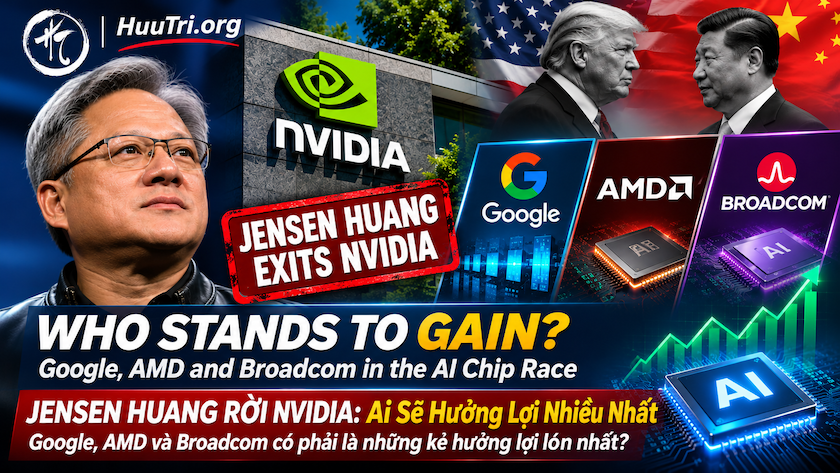
NVIDIA’s board accepted Huang’s resignation on November 11, effective immediately, and announced the transition the following day. Chief Financial Officer Colette Kress was appointed interim CEO, while longtime director Harvey C. Jones became the company’s first board chair.
The company’s official announcement did not identify espionage, China, or Alice Huang as the reason for Huang’s departure.
Yet the consequences were immediate. NVIDIA shares came under heavy pressure, while investors began reassessing the competitive positions of Google, AMD, Broadcom, and other companies seeking a larger share of the booming AI infrastructure market.
The controversy also emerged at a sensitive political moment, following the November 3 U.S. midterm elections and ahead of President Donald Trump’s scheduled November 19 meeting with Chinese President Xi Jinping in Shenzhen.
The timing has generated speculation about political and commercial motivations. However, there is no publicly established evidence that NVIDIA’s competitors orchestrated the disclosures or participated in any alleged intelligence operation.
From Intelligence Allegations to a Corporate Leadership Crisis
The events leading to Huang’s departure unfolded over several months, with the most consequential disclosures emerging in late October and early November.
2025: Early scrutiny of chip transactions
Singaporean authorities investigated potential irregularities involving Megaspeed International, a company reportedly involved in substantial purchases of NVIDIA computing equipment. U.S. authorities also examined potential export-control issues involving AI hardware.
These inquiries concerned possible commercial and regulatory violations and did not establish that Alice Huang was engaged in espionage.
Spring 2026: Reported intelligence warnings
According to subsequent news reports, senior U.S. officials received classified intelligence concerning Alice Huang’s suspected connections to Chinese intelligence.
The public has not been given access to the underlying intelligence, making it impossible to independently assess the allegations.
October 29, 2026: The first major public disclosure
The New York Times reported allegations involving Huang’s relationship with Alice Huang and possible Chinese intelligence interests.
The initial report appeared five days before the midterm elections, an important chronological detail when evaluating claims that the story was released specifically in response to the election results.
November 3: Democrats win control of Congress
The midterm elections altered the political balance in Washington, potentially increasing congressional scrutiny of technology exports and the administration’s China policy.
November 8: NVIDIA launches an independent investigation
As additional allegations emerged, NVIDIA’s board announced an investigation into reports that its CEO had been targeted by a foreign intelligence effort.
Huang acknowledged an extramarital relationship, while reporting about suspected intelligence activity intensified.
November 11–12: Huang resigns
NVIDIA accepted Huang’s resignation as CEO, president, and director. The company appointed Colette Kress interim CEO and began searching for a permanent successor.
November 15: Political pressure continues
Treasury Secretary Scott Bessent publicly called for a substantial leadership shake-up and greater scrutiny of NVIDIA’s export-control compliance.
November 17–19: Critical events ahead
NVIDIA is scheduled to report quarterly earnings on November 17, while the Trump-Xi meeting is expected on November 19.
Together, these developments have created uncertainty over NVIDIA’s leadership, future China strategy, and ability to maintain its commanding position in AI computing.
Google: The Most Significant Long-Term Challenger?
Among the potential beneficiaries of NVIDIA’s turmoil, Alphabet’s Google occupies a particularly interesting position.
Google is not merely an AI software company. It has spent years developing its own Tensor Processing Units, or TPUs, specialized processors designed to accelerate machine-learning workloads.
Unlike NVIDIA’s general-purpose GPU architecture, Google’s TPUs are optimized for particular AI operations and are integrated into its cloud computing infrastructure.
This gives Google an important strategic advantage: it can offer customers access to AI computing capacity without relying exclusively on NVIDIA hardware.
For companies developing large AI models, the ability to choose between NVIDIA GPUs and Google’s TPUs could become increasingly attractive.
The opportunity extends beyond hardware. Google controls a substantial AI technology ecosystem, including Google Cloud, its Gemini models, software infrastructure, and custom silicon.
If customers become concerned about NVIDIA’s leadership stability, product roadmap, or pricing, Google could use the opportunity to strengthen its position.
Following the November 12 leadership announcement, contemporaneous market reporting indicated that Alphabet shares rose as investors considered the competitive implications.
However, Google’s advantage should not be overstated.
NVIDIA’s CUDA software platform, extensive developer ecosystem, and established relationships with cloud providers remain formidable competitive barriers. Many organizations cannot easily migrate AI workloads to alternative hardware.
Google also purchases NVIDIA products, meaning a major disruption to NVIDIA could affect Google’s own infrastructure expansion.
Google may benefit from a more competitive AI chip market, but NVIDIA’s collapse would not necessarily be in Google’s best interests.
AMD: The Most Direct Hardware Competitor
While Google offers a vertically integrated alternative, Advanced Micro Devices is positioned to compete more directly with NVIDIA in the accelerator market.
AMD’s Instinct AI processors target many of the same data-center and high-performance computing applications served by NVIDIA.
For large cloud operators and enterprise customers, AMD represents an opportunity to diversify hardware suppliers and reduce dependence on a single company.
Huang’s departure could strengthen AMD’s negotiating position if customers become concerned about NVIDIA’s long-term leadership or product-development continuity.
However, AMD faces significant challenges.
Hardware performance is only one part of the competition. NVIDIA’s CUDA programming environment and mature software tools make switching suppliers expensive and technically demanding.
AMD must demonstrate not only competitive processing performance but also reliable software compatibility, networking, availability, and support.
The opportunity is therefore real, but significant market-share gains would likely require sustained execution rather than a single corporate scandal.
Broadcom: The Quiet Winner in Custom AI Chips
Broadcom may be one of the most strategically important beneficiaries of a shift away from NVIDIA’s dominance.
Unlike AMD, Broadcom is not primarily attempting to replicate NVIDIA’s general-purpose GPU business.
Instead, it helps major technology companies develop specialized AI processors, commonly known as application-specific integrated circuits, or ASICs.
These custom chips can offer performance and cost advantages for carefully defined workloads.
Google’s TPU program illustrates the importance of this model.
As hyperscale technology companies seek to control more of their AI infrastructure, Broadcom could benefit from increasing investment in proprietary silicon.
If NVIDIA’s leadership uncertainty accelerates customers’ decisions to diversify their computing infrastructure, Broadcom could capture additional custom-chip opportunities.
The company’s shares also gained during the November 12 market reaction, according to contemporaneous reporting.
Still, investor optimism is not evidence of an organized effort to weaken NVIDIA.
Broadcom’s potential gains arise from its established business model and customers’ growing interest in alternative AI architectures.
Amazon and Microsoft: Competitors, Customers and Potential Beneficiaries
Amazon and Microsoft occupy more complicated positions.
Amazon Web Services has invested in its Trainium AI accelerators, seeking to offer customers alternatives to conventional GPU-based computing.
Microsoft has also pursued proprietary AI silicon while continuing to invest heavily in NVIDIA-powered infrastructure.
Both companies could benefit from greater competition in the accelerator market because additional suppliers may reduce hardware costs and improve negotiating leverage.
However, both remain deeply connected to the broader NVIDIA ecosystem.
A serious disruption to NVIDIA’s supply chain, product development, or customer relationships could delay AI infrastructure projects across the industry.
Consequently, the largest cloud providers may prefer a stable NVIDIA alongside stronger alternatives, rather than the sudden disappearance of their most important accelerator supplier.
Why NVIDIA Remains Difficult to Replace
Despite the market turmoil, NVIDIA retains several structural advantages that a leadership transition cannot immediately erase.
Its competitive strength extends across advanced GPUs, high-speed networking, system integration, software development tools, and an enormous developer community.
Industry research firm IDC estimates that NVIDIA accounts for more than 80% of 2026 data-center accelerated server revenue.
That level of market penetration creates substantial switching costs.
AI developers have spent years optimizing applications for NVIDIA hardware. Cloud providers have invested billions of dollars in NVIDIA-based infrastructure, while enterprises have built operational processes around its technology.
Changing suppliers can require software modifications, infrastructure redesign, performance testing, and retraining technical personnel.
IDC has therefore cautioned that near-term AI infrastructure demand and supply arrangements are largely established. The more serious questions concern NVIDIA’s medium-term strategy, customer relationships, and future product roadmap.
The loss of Huang’s leadership may weaken investor confidence, but it does not instantly eliminate the technology, engineering teams, or customer commitments that underpin NVIDIA’s business.
The China Factor: A Strategic Opening for Competitors?
Huang’s departure may also reshape the debate over American semiconductor exports to China.
For years, Huang advocated preserving access to the Chinese market, arguing that American technology companies benefit when Chinese developers continue using U.S. computing platforms and software.
His position frequently placed him at odds with policymakers who viewed advanced AI accelerators as strategically sensitive technology.
Opponents of more permissive exports argue that advanced computing systems could support Chinese military modernization, intelligence operations, surveillance, and cyber capabilities.
The controversy surrounding Alice Huang has intensified scrutiny of these concerns.
Yet the commercial consequences of tighter export restrictions are complicated.
If NVIDIA loses access to Chinese customers, American competitors may not automatically inherit those sales. Many would face the same restrictions.
Instead, Chinese semiconductor manufacturers, including Huawei and other domestic suppliers, could gain additional opportunities to expand their market positions.
In other words, a policy designed to constrain China’s access to American technology could also accelerate China’s efforts to develop alternatives.
The departure of NVIDIA’s most influential advocate for China sales could therefore affect both U.S. trade policy and the long-term competitive balance between American and Chinese semiconductor companies.
Did Someone Benefit From the Timing of the Disclosures?
The sequence of events naturally raises questions.
The initial intelligence-related allegations became public shortly before the U.S. midterm elections. Further revelations followed the election, and NVIDIA’s leadership changed just days before a major diplomatic meeting involving the United States and China.
At the same time, competing technology companies experienced renewed investor attention.
These circumstances create understandable interest in whether the disclosures served broader political or commercial objectives.
But an important distinction must be maintained.
Benefiting from a scandal is not evidence of causing it.
Google, AMD, Broadcom, and other companies have legitimate commercial incentives to compete with NVIDIA. Their share-price movements reflect investors’ expectations about future market opportunities, not proof of participation in an intelligence leak.
Likewise, opposition to Huang’s China export policies does not establish that government officials deliberately disclosed classified information to remove him.
The New York Times attributed its reporting to sources familiar with intelligence matters, but the identities and motivations of those sources have not been publicly established.
The Department of Justice has also stated that it has not determined that Alice Huang was a Chinese spy.
Without publicly disclosed intelligence records, communications, or testimony identifying the sources and purposes of the disclosures, claims of a coordinated political or corporate campaign remain speculative.
Wall Street’s Bigger Question: Can NVIDIA Thrive Without Jensen Huang?
Huang was more than NVIDIA’s CEO.
He co-founded the company in 1993 and became the public face of its transformation from a graphics-chip manufacturer into a dominant supplier of AI computing infrastructure.
His relationships with technology executives, government officials, developers, and investors made him one of the industry’s most influential figures.
His departure creates uncertainty about the future direction of a company whose strategy was closely associated with its founder.
Yet NVIDIA’s future will ultimately depend on factors beyond its leadership controversy: engineering execution, product performance, manufacturing capacity, software adoption, customer confidence, and demand for AI computing.
The November 17 earnings announcement will provide an early opportunity to evaluate the company’s operating performance, although those results largely reflect business activity before Huang’s departure.
Investors will also watch how quickly NVIDIA identifies a permanent CEO and whether major customers alter their purchasing commitments.
For Google, AMD, and Broadcom, the opportunity is to demonstrate that the AI industry can support a more diversified computing ecosystem.
For NVIDIA, the challenge is to prove that its technological leadership is institutional rather than dependent on one individual.
Conclusion: The AI Chip Race Has Entered a New Phase
Jensen Huang’s resignation has created an unexpected turning point in the global AI industry.
Google could strengthen its TPU ecosystem. AMD could gain customers seeking alternatives to NVIDIA GPUs. Broadcom could benefit from increased investment in custom AI processors. Amazon and Microsoft could use the uncertainty to accelerate their own semiconductor strategies.
But the ultimate winner may not be any single company.
If the controversy encourages greater competition, customers could eventually benefit from more choices, improved pricing, and reduced dependence on a dominant supplier.
At the same time, NVIDIA remains deeply embedded in the infrastructure supporting the global AI economy. Its sudden decline could create significant disruptions for customers, suppliers, and investors.
The intelligence allegations surrounding Alice Huang remain unresolved publicly, and there is no established evidence that NVIDIA’s competitors engineered Huang’s departure.
What is clear is that the controversy has exposed the intersection of corporate leadership, national security, international trade, and extraordinary financial stakes in artificial intelligence.
The most consequential question may no longer be who replaces Jensen Huang, but whether the AI industry will continue to revolve around NVIDIA—or begin distributing its power among a broader group of technology giants.
-Nguyễn Bách Khoa-
Sources and reporting references
- NVIDIA Newsroom — NVIDIA Announces CEO Transition, November 12, 2026.
- U.S. Securities and Exchange Commission — NVIDIA Form 8-K, November 12, 2026.
- Reuters — Nvidia CEO Jensen Huang resigns in blow to AI boom he helped foster, November 12, 2026.
- CBS News — Timeline of a scandal: How Jensen Huang’s abrupt resignation unfolded at Nvidia, November 12, 2026.
- IDC — Jensen Huang Resigns From NVIDIA: What AI Infrastructure Buyers Should Watch, November 13, 2026.
- Reuters — Bessent says Nvidia must go outside the company to find new CEO, November 15, 2026.
Editorial note: This report distinguishes official corporate actions and documented market developments from unproven intelligence allegations and analytical projections. No criminal wrongdoing by Jensen Huang or Alice Huang is presumed.