
How America’s First President Celebrated Thanksgiving—and Why His Message Still Matters 237 Years Later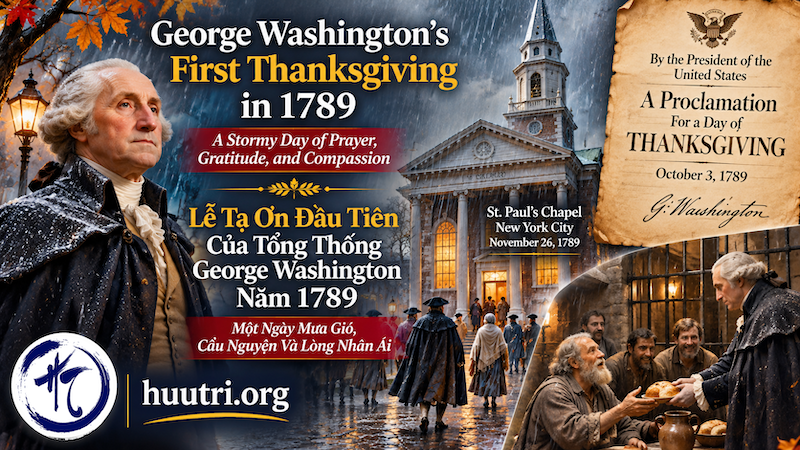
A Thanksgiving Worth Remembering
On Thursday, November 26, 2026, millions of Americans will gather around dinner tables to enjoy roasted turkey, cranberry sauce, pumpkin pie, and precious moments with family and friends.
But exactly 237 years earlier, on Thursday, November 26, 1789, America’s first president, George Washington, observed a Thanksgiving that looked quite different from today’s celebrations.
There was no White House, no televised parade, no football game, and no evidence of an elaborate presidential turkey dinner.
Instead, Washington spent part of that cold, stormy day worshipping at a small church in New York City. He also demonstrated the spirit of Thanksgiving through charitable giving, including providing food and beer to people imprisoned because they could not pay their debts.
His celebration reflected a young nation’s desire for gratitude, unity, and hope.
1789: A Young Nation Had Much to Be Thankful For
When George Washington became president on April 30, 1789, the United States was still a remarkably young country.
Only six years had passed since the Revolutionary War ended in 1783. The Constitution had recently taken effect, and Americans were beginning an extraordinary experiment in representative government.
Washington understood that independence alone did not guarantee the survival of the new republic. The nation needed cooperation, stability, and a sense of shared purpose.
In September 1789, Congress proposed that the president recommend a national day of thanksgiving.
Interestingly, not everyone in Congress agreed.
Some representatives questioned whether the federal government should encourage a religious observance, while others believed individual states should decide when to celebrate.
Nevertheless, Congress approved the proposal.
On October 3, 1789, Washington issued his historic Thanksgiving Proclamation, recommending that Americans observe Thursday, November 26, as a day of public thanksgiving and prayer.
He encouraged citizens to express gratitude for the nation’s independence, the peaceful establishment of its government, and the freedoms Americans had gained.
Among the blessings he specifically recognized were “civil and religious liberty.”
For Washington, Thanksgiving was not simply a celebration of material prosperity. It was an opportunity to acknowledge the responsibilities that came with building a new nation.
Where Did George Washington Celebrate Thanksgiving?
Surprisingly, Washington did not celebrate Thanksgiving at the White House or his beloved Mount Vernon estate in Virginia.
He was living in New York City, which served as the nation’s first capital under the Constitution.
The president and First Lady Martha Washington occupied a rented residence known as the Samuel Osgood House on Cherry Street in Lower Manhattan.
The modern White House in Washington, D.C., did not yet exist.
On the morning of November 26, Washington left his presidential residence to attend religious services at St. Paul’s Chapel, on Broadway in Manhattan.
The historic chapel, completed in 1766, was already an important landmark. It had survived the devastating New York fire of 1776 and had hosted a service attended by Washington following his presidential inauguration earlier that year.
Remarkably, St. Paul’s Chapel still stands today at 209 Broadway, allowing visitors to step inside a building where America’s first president worshipped more than two centuries ago.
A Stormy Thanksgiving—and an Almost Empty Church!
Here is one of the most surprising details of Washington’s first presidential Thanksgiving.
The weather was terrible.
In his diary dated November 26, 1789, Washington recorded:
“Being the day appointed for a thanksgiving, I went to St. Paul’s Chapel, though it was most inclement and stormy—but few people at Church.”
Imagine the scene.
The president of the newly established United States arrived at a historic Manhattan chapel, expecting to participate in a national observance of gratitude.
Yet the storm had kept most worshippers at home!
Rather than the packed congregation and grand ceremony we might imagine today, Washington found only a small gathering.
The religious service was conducted under the leadership of Episcopal Bishop Samuel Provoost, who also served as a chaplain to the United States Senate.
The sparse attendance did not prevent Washington from observing the day.
It is a wonderfully human detail: even the first president of the United States could not control the Thanksgiving weather!
Washington’s Most Meaningful Thanksgiving Gesture: Helping the Poor
Perhaps the most touching part of Washington’s celebration occurred beyond the church walls.
In 1789, people who could not repay their debts could be imprisoned. Debtors’ prisons were a harsh reality of early American society, and some prisoners were confined not because of violent crimes but because they owed money.
Washington arranged a charitable contribution of food and beer for debtors imprisoned in New York City.
The gesture did not go unnoticed.
In the December 3, 1789, issue of the New York Journal, the prisoners publicly expressed their gratitude for the president’s donation the previous Thursday.
Washington also contributed $25 to help poor members of New York City’s Presbyterian congregations, with the money forwarded through his secretary, Tobias Lear.
These actions reveal an important aspect of Thanksgiving in early America.
Giving thanks was not limited to offering prayers. It could also mean offering practical assistance to those experiencing hardship.
In Washington’s example, gratitude and generosity were closely connected.
Did Washington Eat Turkey on Thanksgiving Day?
This is a question that many Americans might naturally ask.
Did George and Martha Washington enjoy a traditional Thanksgiving turkey dinner in 1789?
The historical answer is that we do not know.
There is no well-established surviving menu documenting what Washington ate on November 26, 1789.
Turkey was already familiar to early American households, and Thanksgiving meals in some regions included turkey, goose, venison, pumpkin dishes, vegetables, and other seasonal foods.
But it would be historically inaccurate to claim that Washington sat down to a particular turkey dinner without documentary evidence.
The detailed records of his church attendance and charitable activities provide a clearer picture of how he marked the occasion than any surviving description of his Thanksgiving meal.
Was This America’s Very First Thanksgiving?
Not exactly.
The history of Thanksgiving in North America reaches back long before Washington became president.
Harvest celebrations and religious days of thanksgiving existed in Native American and European colonial traditions. The well-known 1621 harvest gathering involving English colonists at Plymouth and members of the Wampanoag people was one event in this much longer history.
During the American Revolution, the Continental Congress also designated days of thanksgiving, including one celebrated in December 1777.
What made November 26, 1789, historically important was that it became the first national Thanksgiving observed under the newly established United States Constitution.
Washington’s proclamation did not establish a permanent annual holiday.
That tradition developed over time.
In 1863, during the Civil War, President Abraham Lincoln called for a national Thanksgiving observance on the last Thursday of November, helping establish a recurring national tradition.
Congress eventually fixed Thanksgiving as the fourth Thursday in November in 1941, and President Franklin D. Roosevelt signed the legislation into law.
The Other Side of America’s Founding Era
Washington’s words about liberty and gratitude also remind us that America’s founding ideals were not yet shared equally by everyone.
Slavery remained legal, and Washington himself enslaved people, including individuals who worked in his presidential household.
Native American communities were also confronting profound threats to their land and sovereignty.
Recognizing these historical realities does not diminish the significance of Washington’s Thanksgiving Proclamation. Rather, it helps us understand the distance between the nation’s founding ideals and the experiences of many people living in 1789.
The promise of liberty, equality, and opportunity would continue to shape American history for generations.
A Thanksgiving Message That Still Speaks to Americans Today
As Americans celebrate Thanksgiving on November 26, 2026, the date provides an extraordinary connection to the nation’s earliest days.
Washington’s first presidential Thanksgiving was not remembered for a lavish banquet or an impressive public spectacle.
Instead, history records a president who attended church despite stormy weather, encouraged a divided young nation to express gratitude, and helped people who were struggling.
His proclamation emphasized not only blessings already received, but also the importance of wise laws, faithful public service, knowledge, peace, and the well-being of others.
For generations of immigrants who have made the United States their home, including Vietnamese Americans, the story offers a meaningful opportunity to reflect on the importance of religious freedom, family, community, and civic responsibility.
Thanksgiving can be an occasion to appreciate not only what we possess, but also the opportunities we have received and the people who have helped us along the way.
And perhaps Washington’s most enduring example is that gratitude becomes especially meaningful when it inspires generosity toward others.
This Thanksgiving, as families gather around their tables, remember the stormy Thursday in New York City in 1789—when America’s first president helped establish a tradition centered on gratitude, prayer, and compassion.
Happy Thanksgiving from HuuTri.org!
-Lê Nguyễn Thanh Phương-
Historical sources and verification
- National Archives — Congress Establishes Thanksgiving. Documents Congress’s request and Washington’s 1789 proclamation.
- Smithsonian Institution — Washington’s Thanksgiving Proclamation. Provides the original proclamation’s wording.
- George Washington’s Mount Vernon — Thanksgiving. Covers his church visit, charitable donations, and the holiday’s development.
- White House Historical Association — Washington’s Presidential Household. Establishes where the president lived in 1789 and the history of his household.
- Historian Maurizio Valsania — Washington’s First Presidential Thanksgiving. Examines the storm, diary entry, and the prisoners’ published thanks.