
Why Some $3 Million Soccer Stars Take Home Less Money Than Players Making $2 Million.
The Little-Known Tax Rule That Affects International Soccer Superstars
When fans hear that a soccer player has signed a $3 million contract, most assume that’s what ends up in the player’s bank account.
In reality, that couldn’t be further from the truth.
For many international soccer stars, one of the toughest opponents isn’t another defender on the field.
It’s the U.S. tax system.
Whether they come from Argentina, France, Spain, England, Brazil, or other countries, international players who earn income while competing in the United States are generally subject to U.S. federal income taxes. Depending on where they play, they may also owe state income taxes.
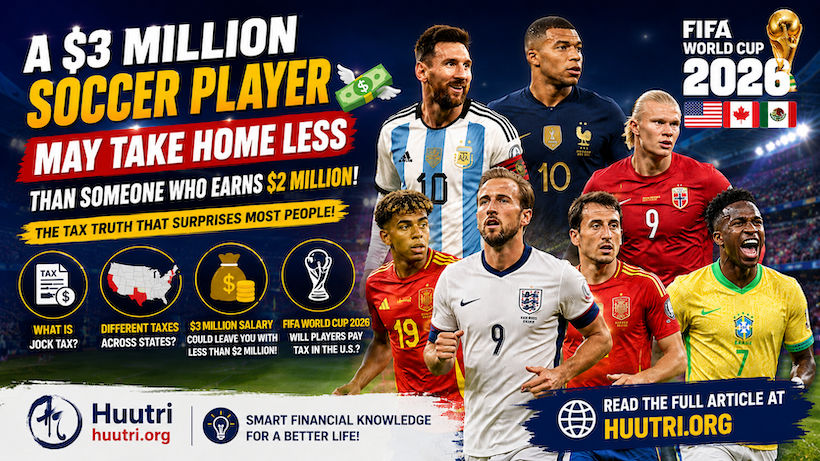 As the world looks toward the 2026 FIFA World Cup, millions of fans will watch stars such as Lionel Messi (Argentina), Kylian Mbappé (France), Lamine Yamal (Spain), Harry Kane (England), Mikel Oyarzabal (Spain), and Vinícius Júnior (Brazil). Few fans realize that tax laws can have a surprisingly large impact on what professional athletes actually keep.
Meet the “Jock Tax”
Tax professionals call it the Jock Tax.
Unlike most employees, professional athletes don’t simply pay taxes where their team is based.
Instead, many states tax athletes based on where they perform their duties—including games, practices, team meetings, and training sessions—using what’s known as the “duty days” allocation method.
As a result, a player may need to file tax returns in several different states during a single season.
Same Salary… Different Paycheck
Imagine two professional players each earn $3 million.
Player A
- Plays primarily in Texas.
- Texas has no state income tax.
Player B
- Plays many matches in California.
- California has one of the highest state income tax rates in the United States.
Although both players signed identical contracts, the California player could owe hundreds of thousands of dollars more in state income taxes.
Location matters.
A $2 Million Player Could Keep More Money
Here’s the part that surprises many fans.
Suppose:
- Player A earns $3 million but spends much of the season working in California and New Jersey.
- Player B earns $2 million while playing mostly in Texas and Florida.
After federal taxes, state taxes, agent commissions, retirement contributions, and other deductions, the $2 million player could retain a larger percentage of earnings—and in some circumstances, may take home more than fans would expect compared with the higher-paid player.
A bigger contract doesn’t always translate into a much bigger paycheck.
Some of Today’s Biggest International Stars
The following players illustrate how international athletes can become subject to U.S. taxation when they earn income in the United States:
🇦🇷 Lionel Messi — Argentina
Playing for Inter Miami means Messi benefits from Florida’s lack of state income tax for home games.
However, when he earns income in states such as California or New Jersey, portions of that income may also be taxed by those states under the “Jock Tax” rules.
🇫🇷 Kylian Mbappé — France
If Mbappé competes in official matches or tournaments in the United States, U.S.-source income may be subject to U.S. taxation, subject to applicable tax treaties and tax rules.
🇪🇸 Lamine Yamal — Spain
One of soccer’s brightest young stars, Yamal would generally face the same U.S. tax principles as other international athletes when earning income from competition in the United States.
🏴 Harry Kane — England
Like other foreign athletes, Kane’s tax obligations in the United States would depend on where income is earned and the applicable federal and state tax laws.
🇪🇸 Mikel Oyarzabal — Spain
Income earned while competing in the United States may become subject to U.S. federal taxation and, in certain states, additional state income tax.
🇧🇷 Vinícius Júnior — Brazil
Whether playing club exhibitions or international tournaments in America, Vinícius Júnior would generally be subject to U.S. tax rules on U.S.-source earnings.
World Cup 2026 Doesn’t Automatically Mean Tax-Free
Many fans assume athletes competing in the World Cup are exempt from taxes.
Generally, that isn’t the case.
Income earned in the United States is typically subject to U.S. taxation, although tax treaties and tournament-specific arrangements can affect how some income is treated.
In short, professional athletes don’t simply ask:
“How much am I making?”
They also ask:
“How much do I actually keep?”
For international soccer stars, where they play can sometimes matter almost as much as how much they earn.
-Lê Nguyễn Thanh Phương-
Sources:
- IRS – Taxation of Nonresident Aliens
https://www.irs.gov/individuals/international-taxpayers/nonresident-aliens - IRS – United States Income Tax Treaties
https://www.irs.gov/businesses/international-businesses/united-states-income-tax-treaties-a-to-z - EisnerAmper – Lionel Messi’s U.S. Tax Situation
- KLR – U.S. Taxation of Foreign Athletes
- Forbes – World Cup Crosses Borders, So Do the Tax Issues