
Of all 50 states in America, perhaps none is more frightening or mysterious than Louisiana, where legends of ghosts, spirits, supernatural phenomena, and unexplained occurrences abound. Anyone who doubts this should visit New Orleans during Halloween, when ghosts seem to roam every street and neighborhood.
Belief in ghosts and the supernatural is so deeply ingrained in Louisiana’s culture that even police officers investigating criminal cases have occasionally consulted fortune tellers, commonly known as psychics or mediums.
As unbelievable as it may sound, one psychic reportedly identified the location of a murder victim’s body and even described the killer’s appearance so accurately that police were able to produce a sketch resembling the suspect arrested nearly 30 years later.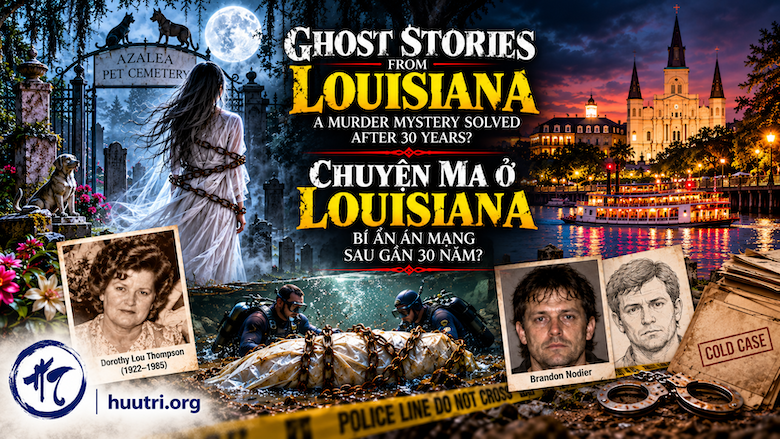
Consider the testimony of a witness who spoke to police in the town of Toca:
“That evening, I was sitting inside an old house with all the doors securely locked. The weather was still and unbearably hot. Not even the slightest breeze stirred the air.
“Suddenly, the door began to shake violently and burst open with a tremendous bang. The lights inside the house went out, leaving only the faint glow of a candle on the altar.
“I turned toward the doorway and saw something floating in midair. It resembled a woman wrapped in a thin white shroud, drifting back and forth above the floor.
“Terrified, I strained my eyes to look more closely. The white figure appeared to be bound by enormous, heavy black chains. Yet it continued hovering above the ground.
“I could not tell whether I was dreaming or awake, but I heard a faint voice whispering in my ear: ‘Help me! Please help me! He killed me!’
“I suddenly awoke, just as the white apparition floated through the doorway and disappeared.”
We will return to the mysterious “he” mentioned in this account.
Naturally, no judge would issue an arrest or search warrant based solely on testimony involving a ghostly apparition. Nevertheless, the Toca Village Police Department already had the name of a possible murderer in its investigative files.
The year was 2009, and the witness was Jose Cruz.
Three years later, in 2012, another man serving a prison sentence for an unrelated offense claimed to have encountered the same ghostly woman in white.
Somehow, according to his account, the apparition appeared inside his prison cell, standing at the foot of his bed and crying out:
“Help me! Please help me!”
Strangely, both witnesses described the same white figure wrapped in heavy chains.
The second witness, terrified by the experience, reported his encounter to police. But his testimony went further.
He claimed to have personally witnessed the mysterious “he” strangling the victim with a rope. When the victim did not die immediately, the killer strangled her a second time before covering her head with a cloth sack.
The witness also claimed that the murderer forced him to help transport the victim’s body to the riverbank, where they disposed of it.
His name was James Tregler.
The Murder
The victim was Dorothy Lou Thompson, who was 63 years old when she was murdered in 1985.
Police initially investigated several suspects, but there was insufficient evidence to bring charges or prosecute anyone. Complicating matters further, Dorothy’s body had mysteriously disappeared.
The murder shocked the local community and attracted attention across the country. Eventually, with no substantial leads, the investigation became a cold case.
Approximately one month later, Dorothy’s body was discovered by chance at the bottom of the Mississippi River.
By the time it was recovered, the remains had deteriorated severely from prolonged exposure to river water and aquatic creatures.
Her body had been wrapped in white fabric and secured with several coils of heavy chains weighing more than 200 pounds (90 kilograms), apparently intended to keep it submerged.
The body could not possibly have floated to the surface. Yet, according to the two witnesses, Dorothy’s spirit somehow managed to return from the dead to plead for help.
Investigators identified the remains as those of Dorothy Lou Thompson through dental comparisons.
Dorothy owned a pet cemetery occupying approximately 57 square meters of land.
Owners of deceased dogs, cats, pigs, snakes, centipedes, rabbits, monkeys, and other beloved animals could purchase small burial plots, install headstones, and occasionally return to place flowers on their pets’ graves.
Dorothy lived in a small house at the far end of the cemetery with her elderly mother, Grace Thompson.
During her lifetime, Grace had managed virtually every aspect of the cemetery’s operations, including burials, preparing the animals’ remains, cleaning, mowing the grass, and maintaining the grounds.
After Grace died, Dorothy inherited the property and the entire estate. Unfortunately, she knew very little about the work her mother had performed.
Her health deteriorated, and she eventually fell into substance addiction.
To keep the cemetery operating and maintain a source of income, Dorothy placed a newspaper advertisement seeking a caretaker who could also live on the property.
The man she hired was Brandon Nodier.
Deaths at the Cemetery
Grace Thompson and her daughter Dorothy had lived together in a secluded house surrounded by tall trees within the cemetery grounds.
What made the property particularly unsettling was that three people had already died in that very house.
Inside stood a home associated with human deaths; outside stretched a burial ground filled with the remains of countless pets.
Adding to the property’s sinister reputation were stories that the cemetery grounds had once been the site of massacres involving numerous enslaved Black people decades earlier.
Among Louisiana residents who believed in restless spirits and supernatural revenge, such stories only reinforced suspicions that the dead might return from the afterlife to settle unfinished business.
Grace Thompson herself had a disturbing and bloodstained past.
In 1890, she married Jack Thompson in Missouri.
Their marriage was unhappy, and the couple eventually separated. Several years later, however, Grace reportedly shot and killed her former husband’s second wife.
Grace was diagnosed with a mental illness and committed to a psychiatric institution.
Years later, she was tried and convicted of second-degree murder. The conviction was subsequently overturned, and she never served a day in prison.
Grace later moved from Missouri to New Orleans with her mother and daughter Dorothy.
There, she opened a flower shop and regularly participated in the choir at a local church.
Then, unexpectedly, her former husband, Jack Thompson, was found dead in New Orleans on the very day he had arranged to meet Grace at a hotel.
Investigators concluded that his death was connected to gambling debts.
Dorothy, however, believed that her mother had murdered her father.
He was the first of the deaths associated with Grace’s household.
Some time later, Grace purchased an abandoned farm in Toca Village and transformed it into a pet cemetery called Azalea Original Pet Cemetery.
Her devotion to animals earned the admiration of neighbors, many of whom entrusted their beloved pets to her care after their deaths.
But the family’s violent history did not end there.
While Dorothy suspected her mother of killing her father, both of Dorothy’s husbands also died from gunshot wounds at the family residence.
Her first husband was shot to death in what was ruled an act of justifiable self-defense.
Her second husband died after being shot twice in the back, yet his death was classified as a suicide near the front steps of the house.
Was it a case of “like mother, like daughter”? No one could say for certain.
A mother, a daughter, and three dead men.
Yet neither woman ever spent a single day behind bars.
Grace died in 1978 at the age of 88, leaving her entire estate to Dorothy.
Dorothy herself would later meet a violent death, and her body would mysteriously disappear.
Could this have been karma?
The Investigation
Despite efforts by local, county, and state law enforcement authorities, investigators initially failed to uncover enough reliable evidence to prosecute anyone for Dorothy’s murder.
Nevertheless, the leading suspect remained Brandon Nodier, the caretaker Dorothy had hired to help manage the cemetery.
Brandon was hardly considered an honest man.
While working at the cemetery, he allegedly developed a scheme to seize control of his employer’s property.
When Dorothy discovered his intentions, she prepared documents to evict him from the premises.
According to police, this property dispute may have provided the motive for her murder and the subsequent disposal of her body.
However, investigative techniques and interrogation procedures in those days were far less sophisticated than modern forensic methods.
Without sufficient evidence, the case was eventually shelved and classified as a cold case.
Nearly 30 years after Dorothy’s death, however, the strange and ghostly history of Azalea Cemetery suddenly returned to newspaper headlines.
Two witnesses had described remarkably similar encounters with a mysterious woman dressed in white.
Both claimed that the apparition floated above the ground, her face obscured, her body wrapped in heavy chains.
And both said the spirit had appeared to reveal the identity of her murderer.
The mysterious “he” was none other than the cemetery caretaker, Brandon Nodier.
The similarities between the two accounts prompted police to reopen the long-dormant investigation.
Jose Cruz’s testimony
Jose Cruz told investigators that he knew Brandon Nodier personally.
According to Cruz, Brandon had confessed to killing Dorothy over a property dispute.
However, Cruz claimed that he had remained silent for decades because he feared retaliation.
Only after encountering the ghostly woman did he finally find the courage to tell police what he knew.
James Tregler’s testimony
James Tregler, who had worked as Brandon’s assistant at the cemetery, provided an even more disturbing account.
He claimed to have witnessed Brandon strangling Dorothy, placing a cloth sack over her head, and transporting her body to the river for disposal.
Like Cruz, Tregler said he had kept the terrible secret for years until the dead woman’s spirit appeared to him in a dream.
These two accounts, filled with supernatural elements and seemingly far removed from the scientific methods portrayed in television programs such as CSI: Crime Scene Investigation, ultimately helped police revive their pursuit of the suspect.
In 2012, investigators located and arrested Brandon Nodier.
Brandon confessed to the murder.
The subsequent legal proceedings were particularly unusual because much of the original evidence and investigative documentation had reportedly been destroyed or washed away when Hurricane Katrina devastated Louisiana in 2005.
Cemetery records, grave markers, and headstones were swept away by floodwaters.
Coffins that had not been completely destroyed floated down the river alongside the remains of buried animals.
Local newspapers reported that approximately 5,000 pet graves at the cemetery had been destroyed by the hurricane.
Azalea Original Pet Cemetery ceased to exist.
Its owner and the animals buried there had seemingly departed together into the world beyond.
Through a plea agreement with the court, Brandon Nodier received a 10-year prison sentence.
And so ended a murder mystery that had haunted Louisiana for nearly three decades—a story in which the living remained silent for years, while, according to legend, the dead refused to rest until justice was served.
Perhaps the greatest mystery was not the murder itself, but the question that continues to linger:
Did Dorothy Lou Thompson’s spirit truly return from the grave to identify her killer?
Or were the ghostly encounters simply the manifestations of guilt, fear, and secrets that had burdened the witnesses for decades?
Whatever the explanation, the story remains a chilling reminder of Louisiana’s enduring fascination with ghosts, restless spirits, and the mysteries that lie between life and death.
By Đức Hà-
Specially written for HuuTri.org
Author’s note: Details in this article were drawn from newspapers published in New Orleans, with assistance from artificial intelligence (AI).