
On June 22, 2026, former Federal Reserve Chairman Alan Greenspan passed away at the age of 100. During his nearly two decades leading the Federal Reserve from 1987 to 2006, Greenspan became one of the most influential economic policymakers in modern history. Many referred to him as “The Maestro” because of his ability to guide the U.S. economy through multiple financial and economic challenges.
For retirees and those approaching retirement, the most important question is not simply who Alan Greenspan was, but rather:
How did his policies influence retirement savings, investment portfolios, interest rates, and the financial well-being of today’s retirees?
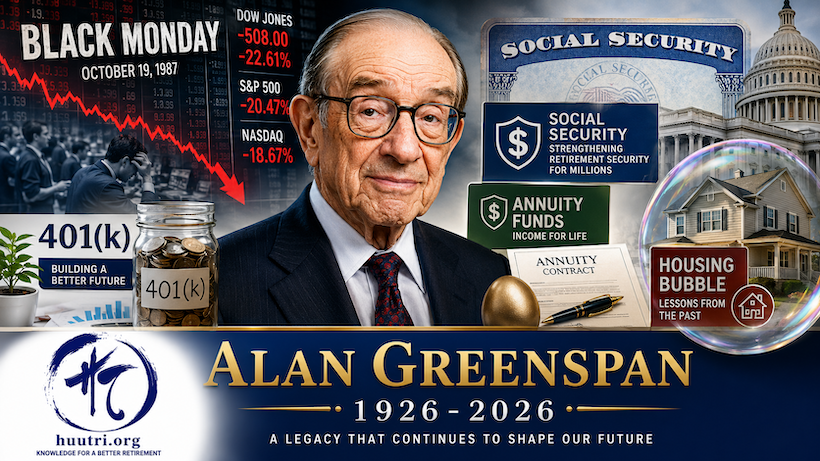 From Jazz Musician to One of America’s Most Powerful Economic Leaders
Few people realize that Greenspan’s first passion was music. He studied at the prestigious Juilliard School and played saxophone professionally in a jazz band before turning to economics. He later earned a Ph.D. in economics from New York University and became an advisor to several U.S. presidents.
In 1987, President Ronald Reagan appointed Greenspan as Chairman of the Federal Reserve, succeeding Paul Volcker. Only weeks after taking office, he faced the stock market crash known as Black Monday. The Fed’s swift action in providing liquidity to financial markets helped prevent a more severe financial crisis.
The Era of the “Great Moderation”
During Greenspan’s tenure, the United States experienced what economists often call The Great Moderation—a period characterized by relatively low inflation, steady economic growth, and moderate unemployment.
This was also a time when millions of Americans accumulated wealth through:
- Rising home values
- Employer-sponsored 401(k) plans
- Individual Retirement Accounts (IRAs)
- Long-term stock market appreciation
For many Baby Boomers who are retired today or nearing retirement, these years represented the most important wealth-building period of their lives.
Many retirement portfolios benefited from:
- Strong economic expansion
- Extended bull markets
- Rising property values
- Relatively stable inflation
As a result, a significant portion of the retirement wealth enjoyed today was built during the Greenspan era.
A Stabilizer—or an Enabler of Excessive Risk?
One of the most famous concepts associated with Greenspan is the “Greenspan Put.”
The term reflects the widespread belief that whenever financial markets encountered serious trouble, the Federal Reserve under Greenspan would lower interest rates or inject liquidity into the system to support economic growth.
Supporters argue that this approach:
- Helped prevent severe recessions
- Maintained confidence in financial markets
- Supported long-term economic growth
- Reduced the impact of market disruptions
Critics, however, contend that these policies:
- Encouraged excessive risk-taking
- Created a perception that investors would always be rescued
- Contributed to financial speculation
- Laid the groundwork for future asset bubbles
This debate remains one of the defining discussions surrounding Greenspan’s legacy.
The 2008 Financial Crisis and Lasting Controversy
Although Greenspan left the Federal Reserve in early 2006, only two years later the world experienced the most severe financial crisis since the Great Depression.
Many economists have argued that several factors contributed to the housing bubble and subsequent collapse:
- Prolonged periods of low interest rates
- Limited oversight of complex financial products
- Excessive confidence in market self-regulation
Following the crisis, Greenspan publicly acknowledged that he had overestimated the ability of financial institutions to manage their own risks.
His admission surprised many observers and remains one of the most notable moments of his career.
The Often Overlooked Contribution: Helping Save Social Security
One of Greenspan’s most significant contributions receives far less attention than his work at the Federal Reserve.
In 1983, Social Security faced a serious funding challenge and risked being unable to meet its obligations. President Ronald Reagan appointed Greenspan to lead a bipartisan commission tasked with finding solutions.
The commission’s recommendations led to major reforms that extended the financial life of the Social Security system for decades.
For millions of retirees today, this may be one of Greenspan’s most direct and lasting contributions.
Lessons for Today’s Retirees
Greenspan’s career offers several valuable lessons for retirees and investors.
1. Interest Rates Can Shape Retirement Outcomes
Federal Reserve policies affect:
- Savings accounts
- Bonds
- Annuities
- Mortgage rates
- Stock valuations
Retirees should pay attention to monetary policy because it directly influences both income generation and portfolio performance.
2. No Market Rises Forever
Many investors during the Greenspan era became accustomed to the idea that the Federal Reserve would intervene during periods of market stress.
The 2008 crisis served as an important reminder that:
- Asset bubbles can burst
- Markets can experience prolonged declines
- Diversification remains essential
Retirement security should never depend entirely on a single asset class.
3. Long-Term Discipline Matters More Than Short-Term Predictions
History has shown that investors who remain disciplined through multiple economic cycles often achieve better outcomes than those who constantly attempt to predict the Federal Reserve’s next move.
Patience, diversification, and consistent investing have historically been more reliable than trying to time markets.
A Balanced Assessment of Alan Greenspan
Viewed objectively, Alan Greenspan was both highly influential and deeply controversial.
Achievements
- Helped stabilize markets after the 1987 stock market crash
- Guided the economy through multiple economic disruptions
- Oversaw a period of strong economic growth
- Played a key role in preserving Social Security’s financial viability
- Became one of the most respected central bankers of his generation
Criticisms
- Placed too much faith in free markets
- Supported financial deregulation
- Failed to recognize certain systemic risks early enough
- May have contributed to conditions that fueled the housing bubble
Reasonable observers continue to disagree on the relative weight of these accomplishments and shortcomings.
With Alan Greenspan’s passing at age 100, the world has lost one of the most consequential economic policymakers of the modern era.
His legacy is likely to remain the subject of debate for decades. Supporters credit him with helping create one of the most prosperous periods in modern American economic history. Critics argue that some of his policies contributed to the vulnerabilities that later culminated in the 2008 financial crisis.
For retirees, the broader lesson may be simpler:
Markets change. Interest rates change. Economic policies change. But diversification, disciplined investing, and a long-term perspective remain among the most effective ways to protect financial security in retirement.
-Phan Trần Hương-