
Every four years, something remarkable happens.
People who are normally calm suddenly become emotional. Public squares fill with cheering crowds. Families and friends gather around television screens. Fans wear their national team’s jersey, paint their country’s flag on their faces, and sing the national anthem with immense pride.
Some people cry tears of joy after a victory.
Others sit in stunned silence when their team is eliminated.
The fascinating part is that most of these fans have never met a single player in person.
So why do they care so deeply?
Because the FIFA World Cup has never been just about soccer.
It is one of the greatest psychological and social phenomena in human history.
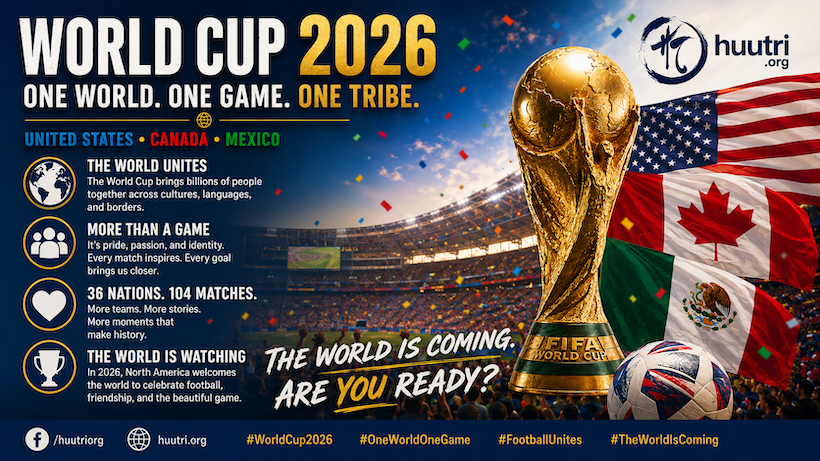 According to FIFA, more than 5 billion people engaged with the 2022 FIFA World Cup in one way or another. No other sporting event unites billions of people from different races, religions, languages, and cultures around one simple game.
What makes it so extraordinary?
Humans Are Wired to Belong to a Tribe
Hundreds of thousands of years ago, our ancestors lived in small tribes.
To survive, people depended on one another.
Being separated from the tribe often meant death.
Although modern life has changed dramatically, our brains still carry that ancient instinct.
We all long to belong to something larger than ourselves.
It might be:
- our family
- our hometown
- our school
- our faith
- our profession
- our community
- or… our national soccer team.
Psychologists call this Social Identity Theory.
Once someone identifies as a supporter of a team, that team gradually becomes part of their own identity.
That is why fans naturally say:
“We won!”
Even though they never stepped onto the field.
A victory feels like a personal achievement.
A defeat can leave them disappointed, heartbroken, or even unable to sleep.
Why National Teams Mean More Than Club Teams
A professional club can spend hundreds of millions of dollars to buy the world’s best players.
A national team cannot.
Every player wears the colors of the country they represent.
They stand for:
- language
- culture
- history
- traditions
- family
- generations who came before them
- and national pride.
That is why international matches carry a significance that club competitions rarely can.
When Japan defeats Germany…
When Morocco becomes the first African nation to reach the World Cup semifinals…
Or when Croatia—a country of fewer than four million people—defeats some of the world’s biggest football powers…
The people are not simply celebrating a soccer victory.
They feel that their nation has earned the world’s respect.
The World Cup Awakens National Pride
The flag. The national anthem. The team colors.
Symbols we see every day suddenly take on extraordinary meaning during the World Cup.
Soccer has a unique ability to unite people.
Young and old.
Rich and poor.
Citizens at home and those living abroad.
For ninety minutes, everyone shares the same dream.
Differences in profession, income, politics, or social status fade away.
There is only one hope.
That their country will win.
Why Does the World Cup Capture the World’s Attention?
Thousands of sporting events take place every year.
Yet none generates anticipation quite like the FIFA World Cup.
One reason is simple.
It happens only once every four years.
Even the greatest players may have only three or four opportunities to compete in a World Cup during their entire careers.
One injury.
One missed penalty.
One controversial referee decision.
One unforgettable goal.
Any of these moments can change history forever.
That rarity gives every match extraordinary emotional weight.
Each World Cup is like a month-long movie that the world waits four years to watch.
Soccer Is About More Than Winning
If soccer were only about the final score, fans would not cry.
They would not embrace complete strangers after a dramatic goal.
They would not stay awake until two or three o’clock in the morning just to watch a match being played on the other side of the world.
The truth is…
People do not fall in love with soccer simply because of victories.
They fall in love with the emotions it creates.
Those emotions include:
- hope
- pride
- disappointment
- anticipation
- belief
- and the powerful feeling of belonging to something much greater than themselves.
The World Cup Is Humanity’s Common Language
One of the most beautiful things about the World Cup is that a person from Vietnam, Brazil, Japan, or Croatia may not speak the same language…
Yet they all understand what it feels like to:
- hold their breath before a penalty kick,
- watch the final minutes with their heart racing,
- and erupt with joy when the ball finds the back of the net.
In those moments…
No translator is needed.
No shared nationality is required.
Only a shared love for the beautiful game.
Do Fans Love Only One Team?
Not necessarily.
Many people passionately support their own national team.
At the very same time, they may also have a second team they cheer for.
Why?
That is one of the most fascinating mysteries in the psychology of sports.
Some people support Argentina because of Lionel Messi.
Others follow Portugal because of Cristiano Ronaldo.
Many admire Brazil for its joyful, creative style of play.
Others respect Japan for its discipline, humility, and teamwork.
What makes a single player capable of attracting hundreds of millions of fans around the world?
Why do so many Mexican-Americans passionately support Mexico even though they were born and raised in the United States?
And why are millions of people willing to stay awake all night just to watch one extraordinary player compete?
Those questions lead us to Part 2.
Coming Next
Why People Fall in Love with Messi, Ronaldo, and the World’s Biggest Soccer Stars
Discover the psychology of sports idols, why millions of fans choose national teams that are not their own, and the fascinating role that cultural identity plays in shaping soccer loyalties around the world.
-Lê Nguyên Vũ-