Part 1 of a two-part retirement education series for Vietnamese Americans
A major shift in America’s retirement system is making it easier for employees to save automatically, increase their contributions over time, and build financial security.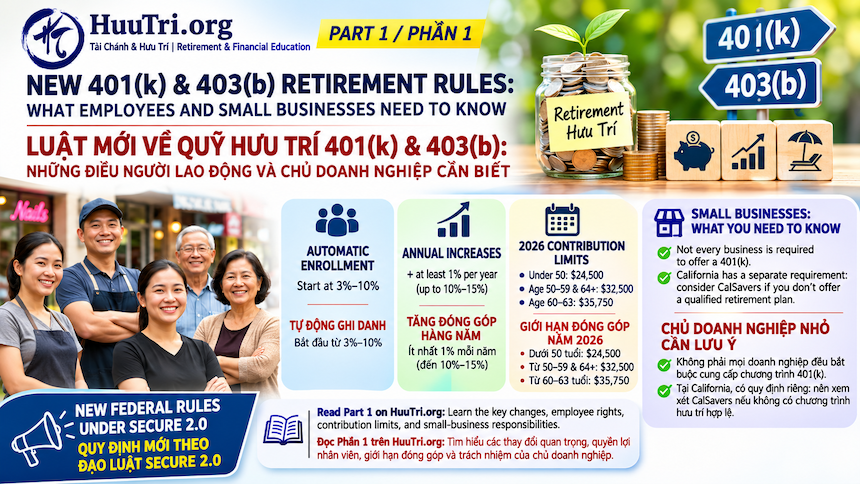
For millions of Vietnamese Americans, particularly those employed by small businesses, family-owned restaurants, nail salons, retail stores, and other service businesses, retirement savings remain a significant challenge.
Many workers depend primarily on Social Security because their employers do not provide a 401(k), 403(b), pension, or other workplace retirement plan. Others have access to a plan but never enroll because they are unfamiliar with the benefits or concerned about reducing their take-home pay.
Federal retirement reforms under the SECURE 2.0 Act are designed to change this pattern.
However, there is an important distinction: the new federal rules do not require every small business to establish a 401(k), and employees retain the right to decline automatic enrollment.
- Understanding the new federal retirement rules
The SECURE 2.0 Act, enacted in December 2022, introduced automatic enrollment requirements for many newly established 401(k) and 403(b) retirement plans, generally effective for plan years beginning in 2025.
The objective is to encourage more Americans to participate in retirement savings programs without requiring them to initiate the enrollment process.
Under the new framework:
- Employees are automatically enrolled in covered retirement plans unless they decline.
- The initial default contribution rate must generally be between 3% and 10% of eligible compensation.
- Contributions automatically increase by at least one percentage point annually until reaching the required target.
- The eventual automatic contribution target must generally be between 10% and 15%.
- Employees can change their contribution rates or opt out.
The 15% automatic contribution target is not the maximum percentage employees may voluntarily contribute. Employees may elect higher rates, subject to plan provisions and IRS annual dollar limits.
- How are the new rules different from traditional retirement plans?
Traditionally, many employers required workers to complete enrollment paperwork, select a contribution amount, and choose investments before participating in a 401(k).
Employees who took no action often saved nothing.
The new framework reverses that process by making participation the default.
| Feature | Traditional approach | New covered plans |
| Enrollment | Employee signs up | Automatic enrollment |
| Initial contribution | Employee selects | Default of 3%–10% |
| Annual increases | Optional | Generally 1 percentage point or more |
| Automatic contribution target | Varies | 10%–15% |
| Employee opt-out | Available | Available |
| Employer matching | Depends on plan | Depends on plan |
Some employers already offer automatic enrollment. The federal change makes this feature mandatory for many newly established plans, subject to exceptions.
Example: An employee earning $50,000 annually
Assume the employee begins at a 3% contribution rate, with annual increases of one percentage point.
| Year | Contribution rate | Annual contribution |
| 1 | 3% | $1,500 |
| 2 | 4% | $2,000 |
| 3 | 5% | $2,500 |
| 4 | 6% | $3,000 |
| 5 | 7% | $3,500 |
| 6 | 8% | $4,000 |
| 7 | 9% | $4,500 |
| 8 | 10% | $5,000 |
This gradual increase allows employees to strengthen their retirement savings without immediately committing a substantial portion of their salaries.
- How much can employees contribute in 2026?
The IRS has established higher employee contribution limits for most conventional 401(k) and 403(b) plans in 2026.
| Employee age | Regular contribution | Catch-up contribution | Maximum annual contribution |
| Under 50 | $24,500 | None | $24,500 |
| 50–59 | $24,500 | $8,000 | $32,500 |
| 60–63 | $24,500 | $11,250 | $35,750 |
| 64 and older | $24,500 | $8,000 | $32,500 |
The enhanced catch-up contribution for employees aged 60 through 63 provides a valuable opportunity for workers approaching retirement.
Employer contributions are generally separate from these employee elective-deferral limits. The general combined employee-and-employer annual additions limit for 2026 is $72,000, excluding eligible catch-up contributions.
Beginning in 2026, certain higher-income employees whose prior-year wages from their sponsoring employer exceeded $150,000 must generally make catch-up contributions as Roth contributions.
These contribution limits may change in future years.
- Can employees opt out or choose their own retirement contributions?
Yes. Automatic enrollment does not mean mandatory retirement contributions.
Employees generally retain the right to:
- Decline participation entirely.
- Select a lower or higher contribution rate.
- Change their contribution rate according to plan procedures.
- Stop future contributions.
- Select investments available through the employer’s plan.
- Choose traditional or Roth contributions when offered.
However, employees cannot require their employer to deposit workplace 401(k) contributions into an unrelated investment account of their choosing.
Workers concerned about household expenses can begin with a modest contribution and increase it when their financial circumstances improve.
- What if a small business does not offer a retirement plan?
This question is particularly important for Vietnamese-American small-business owners.
The federal automatic enrollment rules do not require every business to establish a retirement plan.
The new federal mandate generally exempts:
- Businesses with 10 or fewer employees.
- Businesses in existence for less than three years.
- Plans established before December 29, 2022.
- Certain governmental and church retirement plans.
- Other arrangements qualifying for statutory exceptions.
A 403(b) plan is primarily available to public schools, eligible nonprofit organizations, and certain ministers. Ordinary for-profit businesses, including restaurants and nail salons, would generally consider a 401(k), SIMPLE IRA, or another retirement arrangement instead.
However, state laws may impose additional requirements.
- California small businesses face additional retirement requirements
California has one of the largest Vietnamese-American business communities in the United States.
Under California’s retirement savings mandate, eligible employers with at least one employee generally must provide access to a qualifying retirement program or register with CalSavers. The registration deadline for newly covered employers with one to four employees was December 31, 2025.
CalSavers is a state-facilitated payroll-deduction IRA program that provides retirement savings access to employees whose employers do not sponsor a qualifying plan.
| Feature | Federal covered 401(k)/403(b) | CalSavers |
| Initial default contribution | 3%–10% | 5% |
| Annual default increase | At least 1 percentage point | 1 percentage point |
| Default escalation target | 10%–15% | 8% |
| Employer matching | May be offered | Not permitted |
| Account type | Workplace retirement plan | Roth IRA by default |
Employees participating in CalSavers can change their contribution rates or opt out. Their accounts are portable and generally remain with them when they change jobs.
Employers are responsible for facilitating payroll deductions and complying with applicable registration requirements, but CalSavers does not require employer contributions.
For example, a Vietnamese-American nail salon owner with three employees may be exempt from the federal automatic enrollment requirement but still subject to California’s retirement savings mandate.
Other states also operate retirement savings programs, and employers should investigate the requirements in their respective states.
- Retirement options for small-business owners
Small businesses have several retirement program options.
| Retirement program | Important features |
| Traditional 401(k) | Flexible contributions and optional employer matching, depending on plan design |
| Safe Harbor 401(k) | Simplified compliance testing with qualifying employer contributions |
| SIMPLE IRA | Relatively straightforward administration with required employer contributions |
| SEP IRA | Employer-funded contributions, suitable for many small businesses and self-employed individuals |
| CalSavers | State-facilitated IRA program without employer matching |
| Individual IRA | Employees establish their own accounts independently, subject to IRS limits |
Qualifying small businesses may also be eligible for federal tax credits for retirement-plan startup expenses and certain employer contributions.
Business owners should consult their payroll providers, accountants, or retirement-plan administrators to determine the most appropriate option.
A new opportunity for Vietnamese-American workers
The new federal retirement rules represent an important effort to expand retirement savings participation across the American workforce.
For Vietnamese-American businesses, providing access to retirement savings can strengthen employee retention, improve financial security, and help workers prepare for their senior years.
For employees, automatic enrollment removes one of the biggest barriers to retirement saving: getting started.
Nevertheless, workers remain responsible for selecting affordable contribution levels, understanding investment risks, and planning for their financial futures.
-Phan Trần Hương-
Coming in Part 2: Can Saving $100 or $200 a Month Change Your Retirement?
In the second part of this series, HuuTri.org will examine how employees can accumulate retirement savings over 10 or 20 years, compare different contribution levels, explore employer matching benefits, and explain how workers aged 50 and older can take advantage of higher catch-up contributions.
Disclaimer: This article is intended for educational purposes. Retirement regulations, tax consequences, and eligibility requirements vary by individual circumstances and plan provisions.