
When people hear the name “Tesla” today, many think of sleek electric cars and cutting-edge technology. But long before modern innovation captured headlines, one man quietly laid the foundation for the electrical world we now take for granted—Nikola Tesla.
His story is not just about science. It is about imagination, sacrifice, cultural identity, and a vision far ahead of its time.
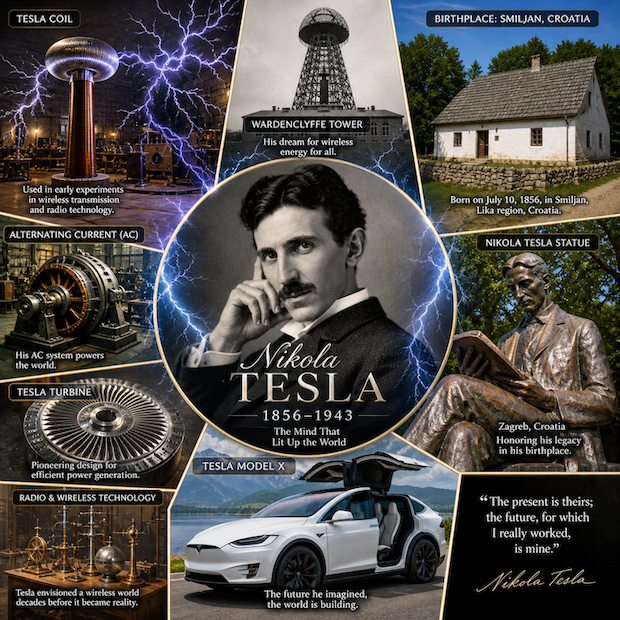
From a Small Village to Global Legacy
Nikola Tesla was born on July 10, 1856, in the village of Smiljan, located in present-day Croatia, then part of the Austrian Empire. He came from a Serbian Orthodox family—his father a priest, his mother an untrained yet highly inventive woman who built practical tools for daily life.
This dual heritage—Serbian roots, Croatian birthplace, and later an American career—makes Tesla a rare figure who belongs to multiple cultures.
A Childhood Marked by Genius and Loss
Tesla’s early life was shaped by both brilliance and tragedy. The death of his older brother left a lasting emotional impact. Yet even as a child, Tesla displayed extraordinary mental abilities:
- He could visualize complex machines entirely in his mind
- He possessed near-photographic memory
- He experienced vivid flashes of imagination that guided his inventions
These traits would later define his unique approach to engineering—he built ideas in his mind before ever touching a tool.
Education and Early Skepticism
Tesla studied engineering in Central Europe, attending the Technical University of Graz and later the University of Prague.
Ironically, some of his professors doubted his ideas—particularly his concept of alternating current (AC). At the time, it seemed impractical. History would prove otherwise.
The Inventions That Changed the World
Tesla’s work revolutionized modern life. His most important contributions include:
- Alternating Current (AC) system — the backbone of global electricity
- Electric motors based on rotating magnetic fields
- Tesla coil, essential to radio and wireless technologies
- Early concepts of wireless communication and energy transmission
Without Tesla’s innovations, the modern electrical grid—and much of today’s technology—would not exist.
The “War of Currents”
Tesla’s AC system competed with direct current (DC), championed by Thomas Edison.
Backed by industrialist George Westinghouse, Tesla’s AC system ultimately prevailed because it was more efficient for long-distance transmission. Today, AC powers the world.
Lesser-Known Facts That Reveal the Man
Even today, Tesla remains mysterious. Here are lesser-known aspects of his life:
- He was born during a lightning storm—often described symbolically as a “child of light”
- He rarely slept more than a few hours per night
- He formed a deep emotional bond with a white pigeon he cared for in New York
- He collaborated with writer Mark Twain, who visited his laboratory
- He envisioned wireless global communication decades before the internet
These details reveal a man who lived between science and imagination.
Is Tesla (the car company) named after Nikola Tesla?
Yes.
The company Tesla, Inc. was named in honor of Nikola Tesla. His work on electric motors and AC systems directly influenced modern electric vehicle technology.
Was Elon Musk inspired by Tesla?
Elon Musk did not originally name the company, but he has publicly acknowledged Tesla as a foundational figure in electrical engineering.
The name reflects recognition of Tesla’s lasting impact—not just inspiration, but technical legacy.
A Quiet Ending, A Powerful Legacy
Tesla died in New York City in 1943, largely alone and without the recognition he deserved during his lifetime.
Today, his influence is everywhere:
- Power grids
- Wireless communication
- Modern electronics
- Electric vehicles
His life reminds us that true innovation is not always immediately understood—but it can shape generations.
-Nguyễn Bách Khoa-
Sources for Further Reading