
There are decisions in life no one wants to face—yet eventually must.
Hospice care often enters the conversation at such a moment: when treatment is no longer about prolonging life at all costs, but about preserving peace, dignity, and meaning in the time that remains.
Understanding hospice clearly helps families move forward with less fear—and more intention.
What Is Hospice Care?
Hospice is a specialized form of care for individuals with serious, life-limiting illnesses, where the goal shifts from cure to comfort. It focuses on:
- Relieving pain and managing symptoms
- Helping patients live as comfortably as possible
- Providing emotional and spiritual support
- Supporting both the patient and their family through the final stage of life
Typically, hospice is considered when a physician determines a life expectancy of six months or less, assuming the illness follows its natural course.
The key idea:
Hospice does not shorten life—it helps make the remaining time more comfortable and meaningful.
Who Needs Hospice—and When?
Hospice is not only for cancer patients. It may be appropriate for individuals with:
- Advanced heart disease
- Alzheimer’s or other forms of dementia
- Chronic lung disease (COPD)
- Kidney or liver failure
- Neurological conditions such as Parkinson’s or ALS
Signs it may be time to consider hospice:
- Noticeable decline in overall health
- Frequent hospitalizations
- Difficulty performing daily activities
- Treatments no longer providing meaningful improvement
An important reality:
Many families begin hospice too late—sometimes only days before passing—when it could have provided support much earlier.
Who Makes the Decision?
This is both a medical and legal matter.
If the patient is mentally capable:
- The patient makes the decision.
If the patient cannot decide:
- A healthcare proxy or durable power of attorney
- A legally appointed guardian
- Or a close family member (depending on state laws)
The guiding principle:
Decisions should reflect the patient’s wishes—not the preferences of others.
Preparing Emotionally as a Family
This is often the most difficult part of the journey.
Common emotions families experience:
- Guilt: “Are we giving up too soon?”
- Fear: “What will the final days look like?”
- Disagreements among family members
- Physical and emotional exhaustion from caregiving
How to prepare:
1. Reframe hospice care
It is not about giving up—it is about choosing comfort and dignity.
2. Have honest conversations early
Discuss:
- Preferences for care
- Where the patient wants to be
- Spiritual or personal values
3. Accept your limitations
Love does not always equal the ability to provide full-time care.
4. Use available support
Hospice teams care for both the patient and the family—emotionally as well as medically.
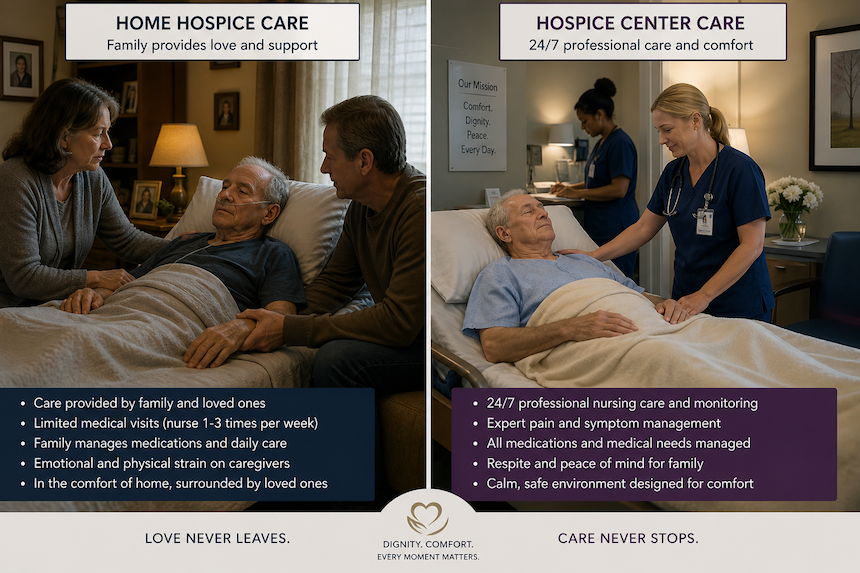
Hospice at Home vs Hospice Facility: What’s the Difference?
1. Hospice at Home
Care is provided in the patient’s residence.
Pros:
- Familiar and comforting environment
- Greater sense of closeness with family
- Honors the wish to remain at home
Cons:
- Family assumes much of the caregiving responsibility
- No continuous 24/7 bedside care
- Can be physically and emotionally overwhelming
2. Hospice Facility (Inpatient Hospice)
Care is delivered in a specialized center with staff available at all times.
Pros:
- 24/7 professional medical care
- Better for complex symptoms and pain management
- Reduces caregiver burden
Cons:
- Less personal than home
- Emotional difficulty of leaving a familiar environment
- May feel institutional for some patients
When a Living Will Says “Stay at Home”—But Reality Changes
This is one of the most emotionally challenging situations families face.
A parent may have expressed:
“I want to stay at home until the end.”
But circumstances can shift:
- Care needs become too complex
- Safety risks increase
- Family caregivers become overwhelmed
What can families do?
1. Prioritize safety and dignity
A living will reflects intention—but real-life conditions evolve.
2. Seek professional guidance
Doctors and hospice teams can provide objective recommendations.
3. Consider flexible transitions
Start with home hospice, then move to inpatient care if needed.
4. Let go of guilt
Choosing a facility is not abandonment—it may be the most compassionate option.
Benefits and Limitations of Hospice Care
For Patients
Benefits:
- Effective pain and symptom control
- Fewer invasive medical interventions
- Greater sense of dignity
- Meaningful time with loved ones
Limitations:
- No curative treatment
- Emotional difficulty accepting end-of-life reality
For Families
Benefits:
- Professional guidance and structure
- Fewer emergency situations
- Emotional and grief support
Challenges:
- Emotional burden of decision-making
- Caregiving stress (especially at home)
- Potential differences in family perspectives
How to Choose a Hospice Provider—and Avoid Scams
Not all hospice providers offer the same level of care.
Warning signs:
- Pressure to enroll quickly
- Lack of physician involvement
- Vague or unclear care plans
- Billing inconsistencies
How to choose wisely:
1. Look for Medicare-certified providers
This ensures regulatory oversight and quality standards.
2. Ask specific questions
- How often will staff visit?
- Is emergency support available 24/7?
- What does the care plan include?
3. Evaluate communication
- Are they transparent, respectful, and responsive?
4. Seek trusted referrals
- Recommendations from physicians are often reliable.
5. Check reviews and community feedback
No one is ever fully ready for this stage of life.
But understanding hospice allows families to face it with greater clarity and calm.
You cannot control the outcome.
But you can shape how the journey unfolds.
When understood properly, hospice is not the end—
it is a way to end with peace, dignity, and love fully present.
-Lê Nguyên Vũ-
Sources for Further Reading:
- Hospice Foundation of America — https://hospicefoundation.org
- Medicare Hospice Benefits — https://www.medicare.gov/coverage/hospice-care
- National Institute on Aging — https://www.nia.nih.gov
- National Hospice and Palliative Care Organization — https://www.nhpco.org
- American Cancer Society — https://www.cancer.org
- U.S. Department of Health & Human Services (OIG) — https://oig.hhs.gov