
In the first part of this series, HuuTri.org helped readers understand:
What a Healthcare Directive is, how it differs from a Living Will, why each state in the U.S. has different forms, and why this is not merely a legal issue—but also a way to protect your personal wishes and dignity when you are no longer able to speak for yourself. We also explained that many states now combine the Living Will and Medical Power of Attorney into a single Healthcare Directive to make things clearer for hospitals and families during emergencies. More importantly, Part 1 emphasized that many Vietnamese-American seniors believe they must hire an expensive attorney to prepare these documents, when in reality many states and hospitals provide them free of charge.
But after understanding what a Healthcare Directive is, many families face an even more difficult question:
Should everything be placed into one single document, or separated into multiple documents?
And if the documents contradict one another—or if the patient changes his or her mind at the last minute—who will the hospital follow?
That is exactly why Part 2 is so important, because these are real-life situations that often happen in ICUs, hospice care, or during emotionally overwhelming medical crises when families are forced to make difficult healthcare decisions.
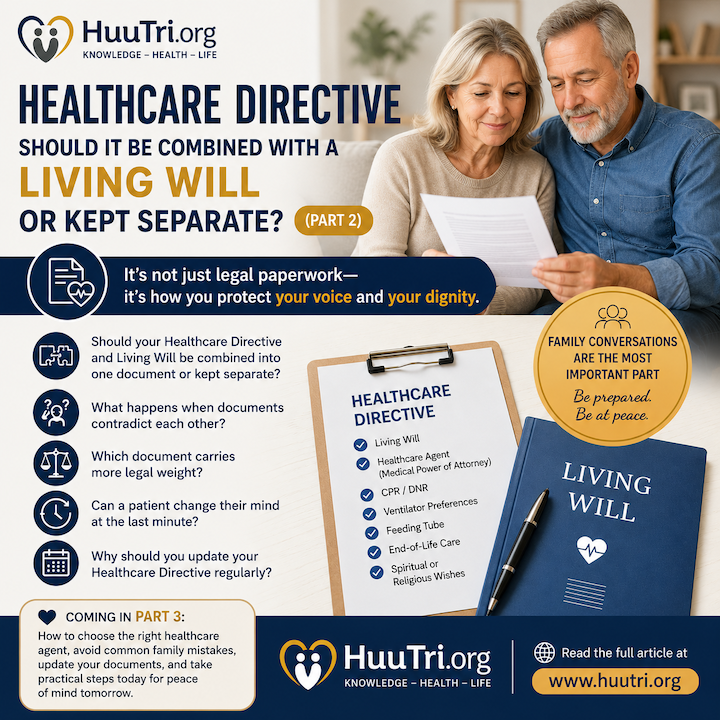
Should a Healthcare Directive Be Combined With a Living Will or Kept Separate?
Today, there are two common approaches.
Option 1: One Comprehensive Document (Recommended)
A single document that includes:
- Living Will
- Healthcare Agent / Medical Power of Attorney
- CPR/DNR wishes
- Ventilator instructions
- Feeding tube preferences
- End-of-life care wishes
- Spiritual or religious preferences
Advantages:
- Less confusion
- Easier for hospitals to understand
- Easier for family members to follow
- Reduces conflicts and misunderstandings
California often follows this approach.
Option 2: Multiple Separate Documents
Some individuals prefer having:
- A separate Living Will
- A separate Medical Power of Attorney
- A separate DNR order
- Separate POLST/MOLST forms
This approach can work effectively.
However, it also carries higher risks:
- Conflicting documents
- Old and new versions saying different things
- Family disagreements
- Hospitals becoming uncertain about which document to follow
What Happens If a Healthcare Directive Conflicts With a Living Will?
This is one of the most painful and emotionally difficult situations hospitals face.
For example:
Ten years ago:
- A father signed a Living Will stating that he did not want life support.
But several months ago:
- He told his children that he wanted treatment to continue if there was still hope.
Or:
- A newer Healthcare Directive conflicts with an older Living Will.
At that point:
- The spouse says one thing,
- The children say another,
- And the hospital may not know whose instructions should be followed.
Which Document Carries More Legal Weight?
Generally:
The most recent valid document usually carries stronger legal authority.
Hospitals will often evaluate:
- The signing date
- Mental competency at the time of signing
- Witnesses
- Notarization
- Designated healthcare agent
- The patient’s most recent verbal statements
What If the Patient Changes Their Mind at the Last Minute?
If the patient is still mentally competent:
They have the legal right to change their mind.
Even if:
- They signed documents previously,
- Their current verbal wishes may still carry significant weight.
That is why:
Healthcare Directives should be reviewed and updated regularly.
Coming in Part 3
In the final installment of this series, HuuTri.org will explore one of the most important points that hospice professionals and physicians often emphasize:
A Healthcare Directive is not just paperwork—it is a family conversation.
We will discuss:
- How to choose the right healthcare agent
- Common mistakes within Vietnamese families
- Why many people avoid discussing hospice, DNR orders, and end-of-life care
- How to properly update a Healthcare Directive
- Practical steps families should take today to avoid panic, guilt, and conflict during a medical crisis
This final section is especially important for families caring for aging parents or preparing for retirement in America.
— Nguyen Bach Khoa —
Sources for Further Reading
Official & Educational Resources on Healthcare Directives, Living Wills & Advance Care Planning
- National Institute on Aging – Advance Care Planning: Advance Directives for Health Care
Comprehensive federal overview explaining advance directives, living wills, healthcare proxies, and why advance care planning is important for older adults. - CaringInfo – Free Advance Directive Forms by State
Free downloadable Healthcare Directive and Living Will forms for all 50 states, including California, Texas, Florida, Georgia, Arizona, and Oregon. - AARP – Free Printable Advance Directive Forms by State
Easy-to-understand explanations of Living Wills, Healthcare Power of Attorney, and state-specific forms for seniors and caregivers. - National Resource Center on Psychiatric Advance Directives – State-by-State Information
State-by-state legal information and forms regarding advance directives and healthcare decision-making. - PREPARE for Your Care – Advance Directive Program
Free step-by-step planning tools created by the University of California to help families discuss and complete advance directives. - Hospice Foundation of America – Advance Directive Resources by State
Educational hospice and end-of-life planning resources, including links to state directive forms. - Compassus – Advance Directives and Living Will Information
Practical explanations of Healthcare Directives, Living Wills, witness/notary requirements, and state-by-state resources. - StatPearls / NIH – Advance Directives
Medical and legal overview discussing ethics, surrogate decision-making, DNR, feeding tubes, and end-of-life treatment planning. - ADvancing States – State-by-State Advance Directive Resources
State-specific links and information regarding advance directive laws and forms. - Everplans – State-by-State Advance Directive Forms
Additional state form directory with explanations of Living Wills and Healthcare Proxy documents.