
Perhaps the greatest loss a person can experience is the death of a loved one. We are born from dust and eventually return to dust and ashes. Whether one believes that God has called a soul home or that the deceased is being reborn into another life according to Buddhist teachings, the pain of losing a loved one is profound.
To honor the life and sacrifices of the departed, children, heirs, and surviving family members often wish to provide a proper farewell. Whether it is an elaborate funeral lasting several days or a simple yet dignified ceremony, the goal is the same: to pay final respects. This is where the work of a funeral home begins.
The process usually starts when the deceased is transported from a hospital morgue or private residence to the funeral home’s refrigeration facility. After embalming, chemical preservation, and cosmetic preparation, a visitation is held for family and friends, often with an open casket.
No organ or body tissue should ever be removed without the consent of the family. Yet when paying respects to a loved one, who would think to inspect whether gold or silver dental work is still in place? Who would question whether a ring or bracelet displayed on the deceased is the original item or a substitute? Beneath the carefully chosen clothing, who would know whether the body remains intact or whether organs and tissues have been removed?
The next step is the funeral service itself, followed by burial or cremation. Days later, family members receive an urn containing what they believe to be the ashes of their loved one—ashes that may be placed on a home altar, entrusted to a temple, or interred in a cemetery.
But how can anyone truly know that the ashes belong to the deceased family member?
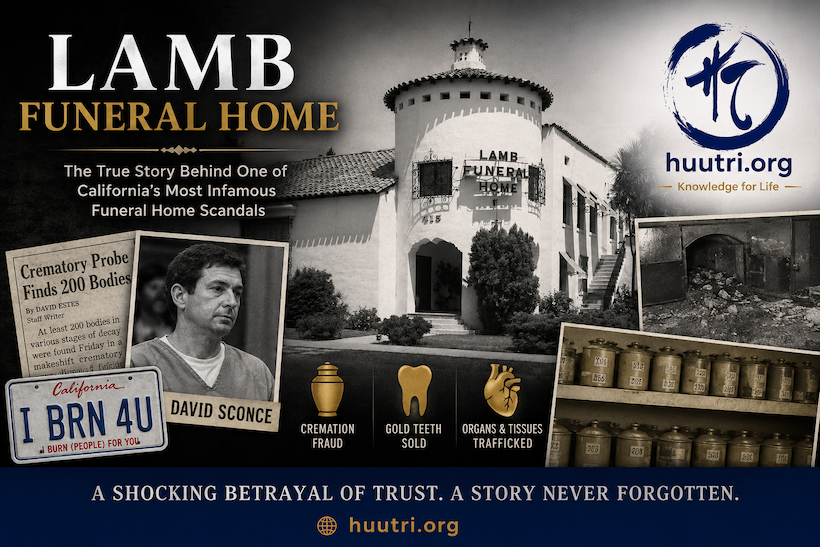
The unsettling possibility that the answers to these questions might be “no” became the foundation of a multimillion-dollar scheme operated by one of the most notorious funeral homes in Southern California history: Lamb Funeral Home in Pasadena, Los Angeles County.
Lamb Funeral Home
Lamb Funeral Home was founded in 1929 by the Lamb family and remained family-owned for decades. After the death of founder Charles F. Lamb, ownership passed to his son, Lawrence Lamb, and later to his granddaughter, Laurieanne Lamb.
Laurieanne married Jerry Sconce, and together they had a son, David Sconce.
For many years, the funeral home maintained a reputation for professionalism and trustworthiness. That image shattered in 1987 when horrifying revelations exposed a pattern of greed, deception, and shocking disrespect for the dead.
While David’s parents managed the funeral home, David himself oversaw the crematory facility in Altadena, located within Mountain View Cemetery & Mausoleum.
Driven by greed and a complete disregard for ethics, David devised numerous schemes to maximize profits—making money from the grief of families and the bodies of the deceased.
The Cremation Scheme
Under normal procedures, only one body should be cremated at a time. After the cremation is complete and the furnace cools, staff collect the ashes and bone fragments, process them into a fine consistency, and place them in an urn for the family.
David exploited the public’s trust and weaknesses in regulatory oversight.
He began contracting with funeral homes throughout California, transporting bodies to his Altadena facility. Instead of cremating one body at a time, he packed multiple bodies—sometimes dozens—into the cremation chambers simultaneously. This reduced fuel costs, accelerated processing times, and enabled him to offer prices competitors could not match.
The cremators reportedly operated around the clock. At peak capacity, David’s facility handled more than 30 bodies per day.
According to a report published by Time magazine, workers sometimes broke arms, legs, or necks of corpses to make them fit into overcrowded cremation chambers.
The volume of ashes became so large that processed remains were stored in industrial drums. The contents were then measured and distributed into urns without any certainty that the remains belonged to a particular individual.
Yet even this enormous operation was not enough for David.
He saw additional profits in gold teeth, silver dental work, jewelry, organs, and body tissues.
In a manner disturbingly reminiscent of practices associated with Nazi concentration camp crematoria, all precious-metal dental work was removed, melted down, and sold by weight.
Clothing and shoes were stripped from bodies and resold because they would otherwise be destroyed during cremation.
Depending on the condition of the body and the timing involved, organs such as hearts, livers, kidneys, lungs, pancreases, and intestines—as well as tissues including corneas, skin, tendons, bone, cartilage, heart valves, and blood vessels—were sold through Coastal International Eye & Tissue Bank, Inc., a company owned by David himself.
David later justified his actions by claiming that these organs and tissues would otherwise go to waste and could benefit others in need.
Ashes Scattered at Sea
One of David’s most profitable services involved sea scatterings.
When families requested that cremated remains be scattered at sea and did not accompany the process, David often simply loaded industrial drums filled with mixed ashes and crushed bone fragments onto a boat, sailed offshore, dumped the contents into the ocean, and completed the paperwork.
Families received certificates confirming that the scattering had been performed.
Few questioned the process. Few requested photographs.
Most trusted Lamb Funeral Home completely.
The Collapse
Eventually, a fire destroyed the primary Altadena crematory.
David quickly established another facility in Hesperia, more than an hour away. At the time, the area was largely isolated and sparsely populated, making it an attractive location for activities that might escape scrutiny.
Although the furnace was licensed for ceramic firing, David used it to cremate human remains.
The strong odor of burning bodies spread throughout the surrounding area and attracted the attention of local authorities.
Investigators also discovered improper disposal of diesel residue mixed with human fat.
The resulting investigation uncovered scenes that investigators compared to some of history’s most infamous cremation operations.
Authorities found large quantities of human remains and ashes.
A local newspaper later quoted a firefighter involved in the investigation:
“When we opened the kiln being used for cremations, we found bodies only partially burned. We had no choice but to close the door and let the cremation continue.”
No one knew who those bodies were or where they had come from.
The discovery marked the final chapter of Lamb Funeral Home.
Paying the Price
During court proceedings, David’s parents claimed they had no knowledge of their son’s actions and placed responsibility entirely on him.
Both received prison sentences of approximately three years and eight months.
David initially received a five-year prison sentence and served roughly half of that term before being released. He was later convicted in a separate case involving conspiracy to commit murder and received a 25-year sentence.
He was ultimately released from prison in 2023.
David’s father died while David was incarcerated. His mother lived a largely private life after completing her sentence.
David’s attorney told reporters:
“My client never hired anyone to kill another person, and no one was ever murdered as a result of his actions.”
An Unsettling Perspective
In the documentary The Mortician, David expressed a remarkably detached view of the controversy:
“There’s no difference in anybody’s cremated ash… people just got to be more in control of their emotions.”
For a dishonest businessman, ash may simply be ash.
Scientifically, however, that is not entirely true.
The cremated remains of a large individual differ from those of a smaller person. The remains of a healthy elderly individual differ from those of someone who died from serious illness, both in chemical composition and appearance.
There is also an important reality of cremation that many people do not realize: even when procedures are followed properly, minute traces of previously cremated remains may remain within cracks, crevices, or imperfections inside the cremation chamber and become mixed with subsequent cremations.
A License Plate That Said It All
Perhaps nothing better illustrated David Sconce’s personality than the vanity license plate on his Corvette:
“I BRN 4U”
Meaning:
“I burn (people) for you.”
To many observers, it reflected a disturbing combination of arrogance, greed, and complete indifference to the dignity of the dead.
Today
Those interested in visiting the former funeral home site can find it at:
415 E. Orange Grove Blvd.
Pasadena, CA 91104
-Đức Hà-
Special to HuuTri.org