
“I’m not Argentine… but every time Lionel Messi scores, I celebrate like I’ve waited my whole life for that moment.”
“I’ve never been to Portugal… but I haven’t missed a Cristiano Ronaldo match in years.”
If you’ve ever heard someone say something like this, you’ve witnessed one of the most fascinating psychological phenomena in modern sports.
Every four years, the FIFA World Cup transforms billions of people into passionate storytellers, emotional dreamers, and devoted believers. Streets erupt in celebration. Entire nations pause to watch ninety minutes of soccer. Families gather around televisions. Complete strangers hug after a last-minute goal.
Yet one curious question remains:
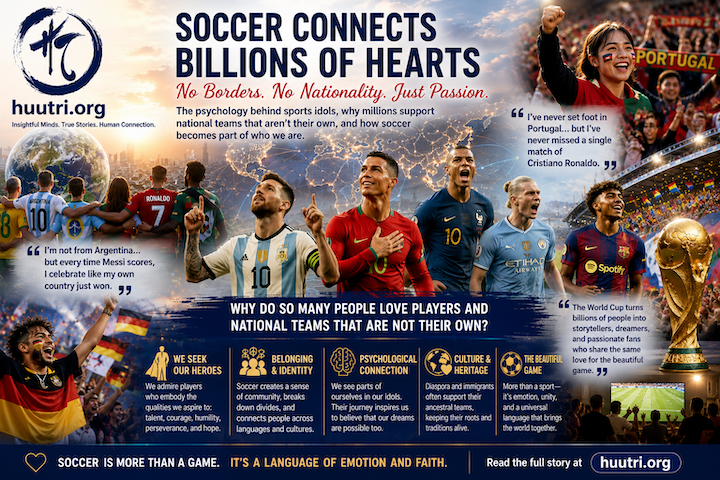 Why do so many people passionately support players and national teams that have absolutely nothing to do with their own nationality?
Why does a teenager in California wear Argentina’s famous No. 10 jersey?
Why does a Vietnamese family wake up at three in the morning to watch Portugal play?
Why do millions of Japanese fans admire Croatia, while countless Nigerians proudly cheer for Brazil?
The answers reveal something far deeper than soccer.
They reveal how human beings choose heroes.
We Don’t Simply Admire Great Players…
We Look for Heroes Who Reflect Who We Want to Become
Long before professional sports existed, every civilization celebrated heroes.
They were explorers who crossed oceans.
Warriors who defended kingdoms.
Scientists who changed the world.
Leaders who inspired generations.
Today, many of those heroes wear soccer boots.
Psychologists refer to this phenomenon as Hero Identification—our natural tendency to admire people who embody the qualities we value most or aspire to possess ourselves.
Those qualities might include:
- Extraordinary talent
- Courage under pressure
- Humility
- Relentless determination
- Leadership
- Hope
A truly great athlete eventually becomes something much larger than sports.
They become a symbol.
Lionel Messi: The Quiet Hero Millions See Themselves In
For countless fans, Lionel Messi represents much more than goals and championships.
His story begins not with triumph, but with uncertainty.
As a young boy growing up in Rosario, Argentina, Messi was diagnosed with a growth hormone deficiency. His family struggled to afford the expensive treatments needed for him to continue developing physically.
Everything changed when FC Barcelona took a chance on the undersized teenager and agreed to pay for his medical care.
The shy boy who once seemed too small to succeed would eventually become one of the greatest players the game has ever known.
Unlike many global celebrities, Messi rarely seeks attention.
He doesn’t need speeches.
His football speaks for him.
Millions admire him because he represents values that transcend sports:
- Humility
- Loyalty
- Dedication to family
- Quiet confidence
- Resilience through hardship
- Extraordinary excellence without arrogance
Psychologists believe many fans subconsciously recognize themselves in Messi.
Most people aren’t the loudest voice in the room.
Most don’t crave the spotlight.
They simply keep working, believing that persistence eventually pays off.
When Messi finally lifted the FIFA World Cup trophy in Qatar in 2022, millions of people—many with no connection to Argentina—felt as though they had witnessed one of humanity’s greatest stories finally receive its perfect ending.
Cristiano Ronaldo: The Human Symbol of Discipline
If Messi represents natural elegance…
Cristiano Ronaldo represents relentless self-improvement.
Born on Portugal’s island of Madeira into a modest family, Ronaldo’s rise wasn’t guaranteed.
Nothing about his childhood suggested global superstardom.
His career became a masterclass in discipline.
Fans admire Ronaldo because he embodies qualities many people strive to develop:
- Tireless work ethic
- Exceptional physical conditioning
- Confidence under pressure
- Mental toughness
- Refusal to accept limitations
His life tells a simple but powerful story:
Talent may open the first door.
Discipline determines how far you walk.
Ironically, the same qualities that inspire millions also generate criticism.
Some people see supreme confidence.
Others see excessive ego.
Psychologists call this the Polarization Effect.
The world’s strongest personalities rarely produce neutral opinions.
They create both passionate supporters and equally passionate critics.
The Greatest Debate in Modern Sports
Messi or Ronaldo?
For nearly twenty years, soccer fans have argued over one question:
Who is the greatest player of all time?
From a psychological perspective, the debate often reveals more about the fan than the athletes themselves.
People drawn toward creativity, humility, teamwork, and effortless brilliance often gravitate toward Messi.
Those who admire discipline, ambition, confidence, and relentless self-improvement frequently choose Ronaldo.
Neither answer is objectively right.
They simply represent two different roads to greatness.
Perhaps that is why their rivalry has become one of the defining stories in sports history.
Every Generation Finds New Heroes
While Messi and Ronaldo continue to inspire millions, a new generation is already capturing the world’s imagination.
Kylian Mbappé
Fearless.
Lightning fast.
Explosive.
He represents the confidence and excitement of modern soccer.
Erling Haaland
Powerful.
Quiet.
Clinical.
His extraordinary consistency fascinates fans who admire efficiency and precision.
Lamine Yamal
Still a teenager.
Already competing on soccer’s biggest stages.
Young fans see unlimited possibilities.
Older generations recognize the birth of what could become another legend.
There’s a unique thrill in saying:
“I watched him before the world knew his name.”
We Remember Stories Far More Than Statistics
Ask most fans how many goals Messi scored five years ago.
Few will remember.
Ask them where they were when Argentina won the World Cup.
Almost everyone remembers.
People remember moments.
Ronaldo crying after Portugal captured EURO 2016.
Mbappé’s unforgettable hat trick in the 2022 World Cup Final.
Messi finally lifting the trophy after years of heartbreak.
These moments become emotional landmarks.
Human beings are wired to remember stories—not spreadsheets.
Perhaps that’s why sports documentaries have become so beloved.
Fans aren’t simply interested in greatness.
They’re fascinated by the human journey behind it.
Why Do We Support Countries That Aren’t Our Own?
Many fans discover a national team through a favorite player.
The journey usually begins with a single sentence:
“I really like Messi.”
Eventually it becomes:
“I support Argentina.”
Or…
“I started watching Ronaldo…”
Before long:
“Portugal is my team.”
The player opens the door.
The country becomes home.
Playing Style Can Be Just As Powerful
Not everyone chooses a team because of an individual superstar.
Many fall in love with an entire football philosophy.
Brazil symbolizes creativity.
Spain represents beautiful possession football.
Germany reflects discipline and precision.
Italy embodies tactical intelligence.
Japan demonstrates humility, teamwork, and relentless organization.
Argentina plays with passion that feels almost poetic.
Every national team reflects something about the culture from which it emerged.
Fans often choose teams that mirror their own personalities.
Soccer Gives Millions a Second Homeland
Immigrant communities understand this better than anyone.
A person can love America…
while passionately supporting Vietnam.
A Canadian may proudly cheer for Croatia because that’s where their grandparents were born.
An Australian might embrace Italy because family traditions remain alive at home.
Psychologists describe this as Bicultural Identity.
People don’t lose one identity when they gain another.
Instead, both identities coexist.
Sports provide one of the most joyful ways to celebrate both.
The Vietnamese-American Experience
Vietnamese Americans offer a beautiful example of this balance.
Many proudly call the United States home while continuing to preserve Vietnamese language, culture, traditions, and family values.
When Vietnam competes internationally, many cheer passionately.
When Team USA takes the field, pride naturally follows.
During the World Cup, another favorite often joins the list.
Argentina because of Messi.
Portugal because of Ronaldo.
Japan because of discipline.
Brazil because of artistry.
There is no contradiction.
Only the richness of belonging to more than one culture.
Social Media Changed Sports Forever
Thirty years ago, fans knew athletes through television broadcasts and newspaper headlines.
Today, a teenager in California watches FC Barcelona training within seconds of it happening.
A fan in Vietnam follows Mbappé’s daily life on Instagram.
Children around the world learn languages through player interviews on YouTube.
Modern fans no longer admire only performances.
They admire character.
Family life.
Charitable work.
Values.
Authenticity.
Today’s sports heroes have become global cultural figures.
The Two Biggest Icons of an Era
Measured by worldwide recognition, commercial value, media influence, and social media following, Cristiano Ronaldo remains the most-followed athlete on Earth.
Lionel Messi follows closely behind, transcending nationality, language, and generations.
Together, they have inspired millions of children to kick a soccer ball for the very first time.
Their rivalry didn’t merely define an era.
It elevated the sport itself.
Heroes Retire.
Legends Never Do.
One day, Messi will leave the field.
Ronaldo will too.
Another generation will rise.
But inspiration never retires.
Children who once wore Messi’s No. 10 jersey will someday bring their own children to a World Cup.
Fans who watched Ronaldo’s impossible free kicks will tell those stories for decades.
Mbappé.
Haaland.
Yamal.
They will continue the cycle.
Because people don’t simply fall in love with soccer.
They fall in love with hope.
With perseverance.
With impossible dreams becoming reality.
Sometimes, all it takes is one extraordinary player…
to convince millions of ordinary people that no dream is ever beyond reach.
Coming in Part 3
Politics, War, Immigration, and the World Cup
Can international conflicts change how fans feel about a national team?
Why do neutral supporters almost always cheer for the underdog?
How does neuroscience explain the overwhelming joy we experience when our favorite team scores?
And why can a soccer match unite—or divide—entire nations?
We’ll explore these surprising questions in Part 3 of this series.
-Lê Nguyên Vũ-