
Why Soccer Can Unite Nations, Deepen Divisions, and Make Millions of Fans Feel the Same Joy, Fear, and Heartbreak
“I know it’s only a game…”
“…so why does losing feel so painful?”
It is one of the most common sentences spoken by sports fans.
A person watches eleven players representing a country thousands of miles away. They have never met the players. They may not speak the language. They may never have visited the country.
Yet when the team scores, they leap from the sofa.
When it loses, they struggle to sleep.
When an opposing player commits a foul, they feel personally offended.
And when the final whistle brings victory, complete strangers embrace as though they have survived something together.
How can a soccer match create emotions this powerful?
Because once identity, history, immigration, politics, and national pride enter the stadium, it is no longer “only a game.”
Soccer becomes a stage upon which nations tell stories about themselves.
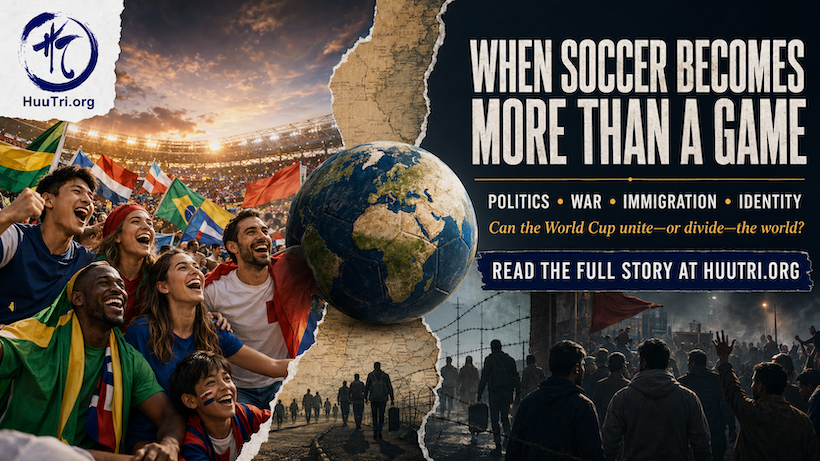
When the Team Becomes “Us”
Psychologists often explain intense sports loyalty through Social Identity Theory.
Human beings naturally organize the world into groups:
Our family.
Our community.
Our religion.
Our hometown.
Our country.
Our team.
Once we strongly identify with a team, its success can feel like our success. Its humiliation can feel like our humiliation.
Listen carefully to the way fans speak:
“We won!”
“We played terribly.”
“They cheated us.”
Most fans never touched the ball, yet they instinctively use the words “we” and “us.”
This is not simply poor grammar.
It is evidence that the boundary between the individual and the group has temporarily disappeared.
Sports psychologist Daniel Wann notes that identification with a team can provide belonging, social connection, and a shared community—benefits that help explain why fandom is often psychologically positive. American Psychological Association
Why Victory Feels Personal
Psychologists describe one familiar fan behavior as Basking in Reflected Glory.
After a victory, supporters proudly wear jerseys, display flags, post photos, and announce:
“That’s my team!”
A team’s success can temporarily elevate a fan’s own confidence and social identity.
Winning tells the world:
The group I belong to is strong.
The group I chose is respected.
The values I admire have been rewarded.
But the opposite can happen after defeat.
Some fans distance themselves from a losing team. They stop wearing the jersey. They blame the coach, the referee, or a particular player. Instead of saying, “We lost,” they suddenly say:
“They played terribly.”
The emotional connection becomes weaker when association with the team threatens the fan’s self-image.
But deeply loyal supporters rarely walk away so easily.
For them, suffering is part of belonging.
Your Brain Watches More Than a Ball
During a close match, the fan’s body may behave as though it is participating in the competition.
The heart beats faster.
Muscles tighten.
Palms become sweaty.
Breathing changes.
Stress hormones may rise as uncertainty builds.
The brain continuously predicts what might happen next:
Will the pass reach the striker?
Will the goalkeeper stop the penalty?
Will the referee call a foul?
Will this be the moment everything changes?
Soccer is especially powerful because scoring is relatively rare. A single goal may decide ninety minutes of competition.
That scarcity creates enormous emotional value.
In a high-scoring sport, one point may mean very little.
In soccer, one touch of the ball can rewrite history.
Research on football spectators suggests that both emotional attachment and uncertainty about the result help make live matches compelling. National Library of Medicine
Why a Goal Creates an Emotional Explosion
A goal is not simply a successful kick.
It is the sudden release of accumulated tension.
For minutes—or sometimes nearly the entire match—the brain has been waiting, predicting, worrying, and hoping.
Then the net moves.
The stadium erupts.
The surprise and reward activate the brain’s motivational and emotional systems. At the same moment, thousands of people scream, jump, sing, and embrace.
This shared reaction creates emotional contagion.
Human beings automatically absorb emotions from the people around them. Excitement becomes more intense when everyone else is excited. Fear becomes more powerful when thousands gasp together.
That is why watching a match alone can be enjoyable…
but watching inside a crowded stadium, café, or family living room can feel unforgettable.
The crowd does not merely observe the emotion.
The crowd multiplies it.
Why Defeat Can Physically Hurt
When a team loses, especially after a penalty shootout or a last-minute goal, fans may experience genuine emotional distress.
Their sadness is not imaginary.
They have invested time, hope, identity, memories, and social relationships in the result.
The defeat may also awaken older disappointments:
A previous World Cup elimination.
A controversial referee’s decision.
A championship that slipped away decades earlier.
A parent who loved the team but is no longer alive to watch.
For longtime supporters, one match may carry generations of memory.
This is why tears after a World Cup loss are rarely about only ninety minutes.
They are about everything those ninety minutes represented.
Why Neutral Fans Love the Underdog
Imagine a World Cup match between a five-time champion and a small nation appearing in the tournament for the first time.
Millions of neutral spectators will instinctively support the newcomer.
Why?
Because human beings are drawn to stories in which courage challenges power.
The underdog begins with fewer resources, less experience, and little expectation of victory. Supporting that team allows the fan to participate emotionally in a struggle for fairness.
If the favorite wins, the expected has happened.
If the underdog wins, the impossible has happened.
That possibility creates hope.
Underdogs also remind ordinary people of their own lives.
Most people do not feel like the most powerful person in the room. They have faced stronger competitors, larger organizations, financial limitations, immigration struggles, health problems, discrimination, or personal setbacks.
When a small team defeats a giant, the message travels far beyond sports:
Power does not always determine destiny.
This is why a goalkeeper from a little-known country can become the hero of millions overnight.
The fans are not merely cheering for him.
They are cheering for the possibility that courage can overcome advantage.
Immigration Creates More Than One Home Team
For immigrants and their children, international soccer can make identity beautifully complicated.
Consider a Vietnamese-American family watching the World Cup.
The grandparents may feel their deepest emotional connection to Vietnam.
Their children may proudly identify with both Vietnam and the United States.
The grandchildren may speak mostly English while still feeling moved when they see the Vietnamese flag.
If neither country advances, the family might support Argentina because of Lionel Messi, Portugal because of Cristiano Ronaldo, Japan because of its disciplined style, or another team connected to a friend, marriage, memory, or personal journey.
They are not confused about their identity.
They are expressing its many layers.
A person can feel gratitude toward the country that offered opportunity while preserving love for the country that shaped the family’s language, food, values, and history.
Soccer gives these identities a place to meet.
Children of Immigrants Often Cheer Differently
First-generation immigrants frequently support the country they left behind because the national team preserves an emotional connection to home.
Their children may divide their loyalty.
Their grandchildren may choose teams for completely different reasons—a favorite player, an attractive playing style, a school friendship, or a memorable tournament.
This gradual shift reveals something important:
Cultural identity is inherited, but it is also recreated.
A jersey may begin as a symbol of nationality.
Over time, it becomes a symbol of family.
A father tells his daughter where he watched a famous match.
A grandmother remembers listening to games on the radio.
A child wears the same colors without fully knowing why.
Sports traditions survive because families turn them into stories.
Can Politics Change Which Team We Support?
Absolutely.
Fans like to believe they judge teams only by talent, sportsmanship, and performance.
In reality, political events can influence sympathy.
A country seen as courageous, peaceful, oppressed, or unfairly treated may attract neutral support.
A country associated with war, aggression, discrimination, or political hostility may lose admirers—even when its players had no role in those decisions.
This creates a difficult moral question:
Should athletes be judged by the actions of their governments?
Some fans say no.
Players are individuals. Many may disagree with national leaders. Some may have relatives on both sides of a conflict.
Other fans argue that a national team competes beneath a flag, sings a national anthem, and represents the state. Therefore, politics cannot be separated from international competition.
Both reactions reveal the same truth:
National soccer is never completely detached from national reputation.
Political Conflict Does Not Affect Every Fan Equally
The intensity of a conflict matters.
A trade disagreement may create jokes and rivalry.
A diplomatic dispute may increase tension.
A territorial conflict may awaken historical grievances.
A war involving civilian deaths, forced migration, or atrocities can transform sporting dislike into moral rejection.
Personal connection matters even more.
A distant conflict may seem abstract to one viewer.
To a refugee whose family lost a home, the same conflict is deeply personal.
For this reason, there is no universal formula predicting how politics will affect fandom.
People respond not only to the event itself, but also to memory, family experience, media coverage, cultural identity, and perceived injustice.
When Soccer Rivalries Carry the Weight of History
Some matches feel larger because the countries involved share a painful past.
Former colonial powers face former colonies.
Neighboring nations carry territorial disputes.
Countries separated by war meet again on a field.
Immigrant communities watch from thousands of miles away.
In these moments, the players may say they are focused only on soccer.
The fans may experience something much more complicated.
A victory can feel like dignity restored.
A defeat can reopen an old wound.
This does not mean that soccer causes political conflict.
More often, it provides a highly visible place where existing tensions appear.
One historical example is the 1969 conflict between El Salvador and Honduras, often called the “Football War.” World Cup qualifying matches intensified public emotion, but the underlying causes included migration, land inequality, political tension, and deteriorating relations. Soccer did not create those problems; it helped ignite an atmosphere already filled with them.
National Pride Can Unite a Divided Country
A successful national team can temporarily dissolve barriers that politics cannot.
For ninety minutes, people from different regions, religions, economic classes, and political parties wear the same colors.
They sing the same anthem.
They wait for the same goal.
They celebrate the same victory.
Soccer creates what sociologists might call a shared national ritual.
The unity may not last forever. It may not solve unemployment, inequality, discrimination, or political division.
But the emotion is still real.
For one evening, millions experience the country not as an argument…
but as a community.
France and the Image of a Multicultural Nation
National teams can also become symbols of immigration and diversity.
France’s World Cup-winning squads have included players whose family histories stretch across Africa, the Caribbean, and other parts of Europe.
Supporters may see such a team as a portrait of modern France: diverse backgrounds united beneath one national jersey.
For many immigrant families, seeing players with similar names, skin colors, neighborhoods, or family histories can create powerful recognition.
The message is simple:
Someone who looks like me belongs at the center of the national story.
Yet multicultural teams may also become targets of political debate. When they win, diversity is celebrated. When they lose, questions about loyalty and belonging sometimes reappear.
Sports can reveal a country’s ideals.
They can also reveal its unresolved tensions.
When a Player Becomes a Voice for Peace
Football’s influence occasionally extends far beyond celebration.
One of the most famous examples came from Côte d’Ivoire.
After the national team qualified for the 2006 World Cup, captain Didier Drogba and his teammates appealed publicly for peace in a country divided by civil conflict.
Drogba did not single-handedly end a war. No athlete possesses that kind of power.
But his moral authority helped focus national attention on reconciliation.
The moment demonstrated something extraordinary:
A respected player can sometimes speak across political divisions more effectively than a politician.
Why?
Because supporters may distrust institutions while continuing to trust their heroes.
Can Soccer Actually Stop a War?
Usually, no.
Sport cannot replace diplomacy, justice, humanitarian aid, or political reform.
A symbolic handshake does not erase suffering.
A tournament does not automatically heal historical trauma.
But soccer can create openings.
It can bring hostile communities into the same space.
It can humanize people portrayed as enemies.
It can provide a neutral language when ordinary conversation has become impossible.
The United Nations has long recognized sport’s potential to encourage inclusion, mutual understanding, peace, and development—while also acknowledging that those outcomes require deliberate effort. United Nations
Football may not solve a conflict.
But it can remind people that cooperation is still possible.
When Unity Turns Into Division
The same group identity that produces belonging can also create hostility.
Once fans see their team as “us,” the opponent easily becomes “them.”
Most rivalry remains playful:
Songs.
Flags.
Jokes.
Friendly arguments.
But under certain conditions—alcohol, political tension, online misinformation, historical hatred, or aggressive crowd behavior—competition can become dehumanization.
An opposing player is no longer treated as an athlete.
An opposing fan is no longer treated as a person.
Racism, violence, and threats can follow.
This is the dangerous side of tribal identity.
Passion becomes harmful when loyalty requires hatred.
Social Media Intensifies Both Love and Anger
In earlier generations, the emotional aftermath of a match stayed mostly inside the stadium, neighborhood, or family.
Today, it travels around the world in seconds.
A controversial foul becomes a viral video.
A player’s mistake produces millions of comments.
A referee receives threats.
False rumors spread before official information appears.
Social media rewards the most emotional reactions. Calm analysis rarely travels as quickly as outrage.
It also removes the human face from the conversation.
A person who would never insult an athlete in public may post something cruel from behind a screen.
This creates an unhealthy illusion:
Because a player is famous, the player cannot be hurt.
But athletes are human beings. They have parents, spouses, children, fears, and vulnerabilities.
No missed penalty deserves racism.
No defeat justifies threats.
No championship is more important than human dignity.
Sportsmanship Can Change the Entire Story
A single act of respect can become more memorable than the score.
A player comforting an opponent.
A goalkeeper helping a striker stand.
A team applauding its supporters after defeat.
Fans cleaning the stadium before leaving.
An athlete admitting that the referee made a mistake in his favor.
These moments interrupt the “us versus them” instinct.
They remind spectators that competition does not require cruelty.
True sportsmanship says:
I want to defeat you…
but I do not need to hate you.
That distinction is the foundation of healthy fandom.
Why Soccer Remains So Powerful
Soccer requires very little.
A ball.
An open space.
Two goals that can be made from shoes, stones, backpacks, or pieces of wood.
A child in a wealthy European academy and a child playing barefoot in a rural village can understand the same game.
That accessibility has allowed soccer to cross nearly every border of language, class, religion, and geography.
Its rules are simple enough to share.
Its emotions are powerful enough to remember forever.
And its stories belong to everyone.
The World Cup Is a Mirror
The World Cup shows us athletic excellence.
But it also shows us ourselves.
Our need to belong.
Our desire for heroes.
Our loyalty to family and country.
Our sympathy for the powerless.
Our attraction to courage.
Our fear of defeat.
Our capacity for joy.
And sometimes, our willingness to turn difference into hostility.
Soccer can unite a divided nation.
It can help immigrants preserve a connection to home.
It can inspire strangers to embrace.
It can give the underdog a global audience.
It can also expose prejudice, political anger, and unresolved historical pain.
The game itself does not decide which side of human nature will prevail.
We do.
Perhaps the most important question is not:
“Which team will win?”
It is:
“What kind of fan will we choose to become?”
Because the finest supporters do more than celebrate victory.
They respect the opponent.
They protect the dignity of the players.
They understand that pride does not require hatred.
And when the final whistle sounds, they remember the truth beneath every flag, jersey, anthem, and rivalry:
Before we are fans of different teams…
we are members of the same human family.
-Lê Nguyên Vũ-